Investment objective

The iShares S&P/TSX Capped Energy Index ETF (XEG) offers an attractive option for Canadian investors who want exposure to the energy sector. The primary goal of XEG is to replicate the performance of the S&P/TSX Capped Energy Index, which tracks the overall performance of the Canadian energy market. This makes XEG an ideal vehicle for those seeking a diversified entry point into the energy sector without the need to buy individual energy stocks.
cibc investors' edge

Investors in XEG gain exposure to a wide array of companies involved in the exploration, production, and distribution of energy. These companies range from large, established oil and gas producers to newer firms that are innovating within the energy space. The ETF allows you to invest across the entire energy value chain, from upstream exploration to downstream distribution, all through a single, low-cost investment.

Why would investors consider XEG?

Diversification in the Energy Sector: XEG includes a variety of companies from different energy sub-sectors, reducing the risks associated with investing in individual companies. Investors can capture a broad range of opportunities across the Canadian energy landscape, from traditional oil producers to more diversified energy firms.

Low-Cost Access: XEG offers an affordable way to gain exposure to the energy sector. Compared to actively managed funds or picking individual energy stocks, XEG’s management fees are lower, making it a cost-effective option for long-term investors.

Performance Linked to the Energy Sector: Since XEG tracks the S&P/TSX Capped Energy Index, its performance is directly tied to the overall health of the Canadian energy sector. As the energy industry remains a significant driver of the Canadian economy, this ETF benefits from the cyclical upsides of oil and gas prices and energy demand.

Easy Entry Point for Sector-Specific Investing: Whether you’re bullish on energy prices or looking to diversify your portfolio, XEG offers an easy way to include a critical sector of the Canadian economy in your investment strategy. It’s particularly attractive for investors with a positive outlook on the future of energy markets or those wanting to hedge against inflation through energy investments.

In summary, XEG is an effective tool for Canadian investors looking to capitalize on the energy sector’s growth. Whether you’re interested in traditional oil and gas or the broader energy market, XEG provides a convenient and cost-efficient way to gain exposure.

Historical performance vs similar funds

[stock_market_widget type=”table-quotes” template=”color-header-border” color=”#5679FF” assets=”XEG.TO,NNRG.NE,ENCC.TO,NXF.TO,ZEO.TO” fields=”symbol,ytd_return,three_year_average_return,five_year_average_return” display_header=”true” display_chart=”false” pagination=”true” search=”false” rows_per_page=”5″ sort_field=”logo_name_symbol” sort_direction=”asc” alignment=”left” api=”yf”]

XEG.TO is a standout performer with a YTD return of 11.45%, a 3-year average return of 26.30%, and a 5-year average return of 18.05%. Its combination of solid returns and low fees makes it an attractive option for investors seeking exposure to the energy sector. However, it’s important to keep in mind that XEG has significant concentration risk, with a large portion of the fund invested in just two companies: Canadian Natural Resources and Suncor. This concentration exposes the ETF to potential volatility if either of these companies underperforms.

NNRG.NE shows promise with a YTD return of 6.65% and a 3-year average return of 22.56%. Although it lacks a 5-year history, its focus on mid-cap energy stocks provides diversification away from the larger energy players that dominate the other funds.

ENCC.TO currently lacks sufficient return data, making it difficult to assess its performance. As more data becomes available, it may be worth considering.

NXF.TO has a YTD return of -0.50%, a 3-year average return of 17.02%, and a 5-year average return of 7.87%. Its covered call strategy aims to enhance income generation, which could appeal to dividend-focused investors, though its recent negative YTD performance indicates it might lag in times of market volatility.

ZEO.TO delivers strong returns with a YTD return of 17.60%, a 3-year average return of 22.25%, and a 5-year average return of 16.65%. This solid performance makes it a competitive option, especially for those seeking high returns within the energy sector.

In conclusion, XEG.TO remains a top performer despite the potential risks of concentration, while ZEO.TO and NNRG.NE offer competitive alternatives. NXF.TO, with its income-focused strategy, could be more suitable for dividend-oriented investors, and ENCC.TO is one to watch as it gathers more data.

Fees

Management Fee 0.55%
Management Expense Ratio (MER) 0.60%

Top 10 holdings

TickerNameWeight (%)
CNQCANADIAN NATURAL RESOURCES LTD26.12
SUSUNCOR ENERGY INC21.45
CVECENOVUS ENERGY INC11.74
TOUTOURMALINE OIL CORP7.71
IMOIMPERIAL OIL LTD4.97
ARXARC RESOURCES LTD4.70
MEGMEG ENERGY CORP2.67
WCPWHITECAP RESOURCES INC2.10
CPGCRESCENT POINT ENERGY CORP2.01

Sector allocation

TypeFund
Oil & Gas Exploration & Production55.31
Integrated Oil & Gas38.16
Oil & Gas Drilling5.08
Oil & Gas Equipment & Services1.42
Cash and/or Derivatives0.03

Latest posts

If you’re seeking enhanced income options, Hamilton ETFs offers two interesting covered call ETFs: HYLD and HDIF. These ETFs share a focus on income generation, but understanding their distinctions is key when choosing which might align better with your portfolio (HYLD vs HDIF).

Executive summary

FeatureHYLD (Hamilton Enhanced U.S. Covered Call ETF)HDIF (Hamilton Enhanced Multi-Sector Covered Call ETF)
IssuerHamilton ETFsHamilton ETFs
FocusU.S. stocks (primarily S&P 500)Canadian stocks
StrategyCovered call options for income enhancementCovered call options for income enhancement
Geographical ExposureUnited StatesCanada
Currency Risk (for Canadian Investors)Yes (USD exposure)No
Potential Sector DifferencesHeavier tech weighting typical of S&P 500May have heavier energy and financials weighting
ConsiderationsPreference for U.S. market, currency fluctuationsPreference for Canadian market, domestic focus

The Basics

HYLD (Hamilton Enhanced U.S. Covered Call ETF): HYLD targets high income by writing covered calls on stocks primarily within the S&P 500 index, offering investors exposure to the U.S. market.

HDIF (Hamilton Enhanced Multi-Sector Covered Call ETF): Similar to HYLD, HDIF also uses a covered call income strategy but concentrates on equities within the Canadian market.

The Hamilton Approach

Since HYLD and HDIF are both issued by Hamilton ETFs, they likely use similar covered call strategies. However, the differences in their underlying holdings lead to some key considerations:

Geographical Focus: HYLD provides exposure to the broader U.S. market, while HDIF remains within Canada. This impacts potential currency fluctuations and exposure to the unique economic cycles of each country.

Sector Differences: The S&P 500 (HYLD’s focus) and the Canadian market (HDIF’s focus) could have varying sector weights. For example, the Canadian market often has a heavier energy and financials weighting compared to the U.S.

Yield and Risk

Hamilton ETFs are known for their focus on income generation. But remember:

  • Covered calls can limit upside potential if underlying stocks experience substantial growth.
  • Market volatility and stock price declines can negatively impact premiums or even lead to distribution reductions.

Considerations for Choosing

The optimal choice for you depends on:

Geographical preference: Where do you want your primary market exposure?

Sector interests: Do you have specific sector preferences that better align with the U.S. or Canadian market composition?

Currency considerations: (for Canadian investors) HYLD has U.S. dollar exposure, introducing currency exchange factors to consider.

Risk tolerance: Are you willing to accept potential distribution fluctuations in pursuit of higher income potential?

Final Word

HYLD and HDIF, as Hamilton ETFs, offer ways to enhance income. However, they’re not designed for massive capital gains. Before investing, do your homework to understand their strategies, risks, and how they fit into your overall financial plan.

Disclaimer: This blog post is for informational purposes only and should not be considered financial advice. Seek guidance from a qualified financial advisor for personalized investment recommendations.

Let me know if you have any other aspects you’d like explored further!

What is XAW ETF?

XAW, functioning as an index ETF, provides a seamless and efficient avenue for international market exposure. It stands out as an attractive addition to portfolios primarily centered on Canadian stocks. This fund’s unique approach involves investing in a diversified basket of index funds, allowing investors to harness growth opportunities beyond the confines of the Canadian market. It proves to be a strategic choice for long-term investors, emphasizing simplicity and effectiveness in achieving global diversification.

Notably, XAW’s scope is comprehensive, capturing large, mid, and small-cap companies across 22 developed market countries (excluding Canada) and 27 emerging market countries. This is achieved primarily through investments in six ETFs, ensuring a broad representation of companies in various stages of development.

Crucially, XAW’s investment strategy extends to securities of one or more ETFs managed by BlackRock or an affiliate. This distinctive feature adds a layer of expertise and reliability to the fund’s composition, aligning with the interests of investors seeking a well-managed and diversified approach to international market participation. In essence, XAW remains an ideal choice for long-term investors, offering a holistic and expertly managed pathway to global diversification.

The Case for International Diversification

One of the key reasons for XAW’s popularity is that it serves as a powerful diversification tool. Many Canadians have portfolios heavily weighted towards Canadian assets, often for reasons of familiarity, favorable tax treatment, and avoiding currency risk. However, limiting your investments to Canada comes with significant risks. The Canadian market represents only about 3% of the global economy, and it is highly concentrated in sectors like financials, energy, and materials. This leaves Canadian investors exposed to sector-specific and regional risks.

By investing in XAW, Canadians can reduce these risks and gain exposure to the broader global economy. The ETF includes companies from the United States, Europe, Asia, and emerging markets, providing a much more balanced portfolio across sectors and geographies. This helps mitigate the risks of relying too heavily on a single country’s economy or market trends.

XAW also removes the need for investors to buy multiple international ETFs. Instead, it bundles global exposure into a single, low-cost product, simplifying the process for DIY investors who prefer a hands-off approach.

Cost Efficiency: Low Management Fees and MER

Another reason why XAW appeals to Canadian investors is its cost efficiency. With a management expense ratio (MER) of around 0.22%, XAW is a relatively cheap way to gain broad international exposure. Compared to mutual funds, which often have MERs exceeding 2%, XAW’s low fee structure allows investors to keep more of their returns over the long term.

In addition, because XAW bundles different regions into a single product, investors save on transaction costs, avoiding the need to buy multiple individual ETFs for U.S., international developed markets, and emerging markets.

Tax Considerations for DIY Investors

One thing to keep in mind when investing in XAW is foreign withholding tax on dividends. When holding international equities in non-registered accounts or Tax-Free Savings Accounts (TFSAs), Canadian investors may face foreign withholding taxes that reduce the total return from dividends. These taxes can be difficult or impossible to recover in certain account types, such as the TFSA, which is not recognized as a tax shelter outside Canada.

However, holding XAW in a Registered Retirement Savings Plan (RRSP) can help mitigate this issue. Thanks to tax treaties between Canada and other countries, you may avoid foreign withholding taxes when holding U.S. and international equities in an RRSP, making it a more tax-efficient way to invest in international assets.

XAW vs XEQT iShares all equity ETF

XEQT stands out as an all-in-one ETF, offering investors a comprehensive and fully diversified portfolio that encompasses both Canadian and international markets. This single investment vehicle eliminates the need for multiple holdings, providing a convenient solution for those seeking broad market exposure. In contrast, XAW focuses exclusively on international markets, excluding Canada, making it an essential component for building a fully diversified portfolio when paired with a Canadian index ETF like XIC.

For investors opting for a multi-ETF approach, combining XIC and XAW, the iShares Core MSCI All Country World ex Canada Index ETF, proves to be an excellent choice. This strategy involves regular rebalancing but results in a slightly lower fee, appealing to those comfortable with a more hands-on approach.

On the other hand, XEQT offers a straightforward alternative for those desiring simplicity in their investment strategy. By encompassing a diverse range of holdings, including XEF and IMEG, XEQT presents an attractive choice for investors looking for an uncomplicated yet highly diversified investment solution. Ultimately, the decision between XEQT and a multi-ETF approach hinges on individual preferences for simplicity, involvement in rebalancing, and fee considerations.

XEQT holdings

ITOTISHARES CORE S&P TOTAL U.S. STOCK46.06%
XEFISHARES MSCI EAFE IMI INDEX24.55%
XICISHARES S&P/TSX CAPPED COMPOSITE23.98%
XECISHARES MSCI EMERGING MARKET4.98%

Tax implications of owning ETFs that invest in US and International stocks

There are tax implications when holding an ETF that invests in US and international stocks. Any dividend received will be reduced by withholding taxes depending on the scenarios below. The table below provides a summary:

Canadian ETF: 1$ dividend
scenario
TaxesDividend
received
1- Holding US or
International stocks directly
-0.15$ (withholding tax from US or
foreign jurisdiction) Creditable
0.85$
2- Holding US listed
ETFs that invest in US stocks
-0.15$ (withholding tax from US or
foreign jurisdiction) Creditable
0.85$
3- Holding US listed ETFs
that invest in International stocks
-0.15$ (withholding tax from foreign
jurisdiction) Non creditable -0.13
(withholding tax from US) Creditable
0.72$

The chart is designed for illustrative purposes only and is subject to change. Please consult a tax specialist for more information.

XAW ETF historical performance and dividend yield

[stock_market_widget type=”table-quotes” template=”color-text” color=”#1613F3″ assets=”XAW.TO” fields=”symbol,ytd_return,three_year_average_return,five_year_average_return” links=”{‘XAW.TO’:{}}” display_header=”true” display_chart=”false” display_currency_symbol=”true” pagination=”true” search=”false” rows_per_page=”15″ sort_field=”logo_name_symbol” sort_direction=”asc” alignment=”left” api=”yf”]

XAW ETF holdings

TickerNameWeight
%
IVVISHARES CORE S&P 500 ETF53.02
XEFISHARES MSCI EAFE IMI INDEX26.08
XECISHARES MSCI EMERGING MARKET11.17
ITOTISHARES CORE S&P TOTAL U.S. STOCK3.83
IJHISHARES CORE S&P MID-CAP ETF3.66
IJRISHARES CORE S&P SMALL-CAP ETF2.14
USDUSD CASH0.10
CADCAD CASH0.01

My personal take HDIF vs HDIV

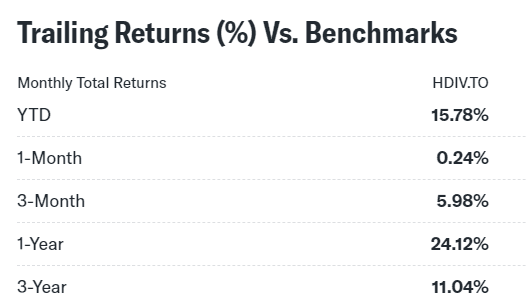
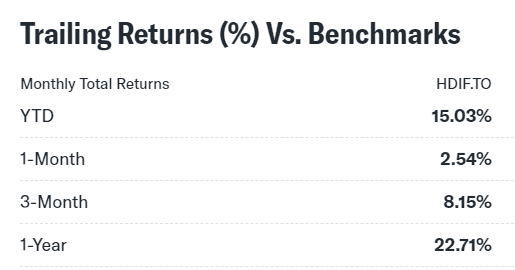
Despite having a higher MER, HDIV appears to be a more favorable option for income-oriented investors, boasting a superior yield and total return. It’s crucial to consider that this comparison relies solely on a one-year historical analysis, making it unjust to declare a decisive winner within such a limited timeframe. Both funds operate as covered call ETFs, generating monthly income through premiums from option-selling activities. Additionally, they fall under the category of funds of funds, composed of various ETFs. (HDIF vs HDIV)

cibc investors' edge

While HDIF exclusively invests in Harvest-issued ETFs, HDIV takes a more diversified approach by including ETFs from BMO, Hamilton, Horizons, and others, positioning itself better in terms of diversification.

Both ETFs share similar drawbacks, particularly the covered call strategy employed by both, limiting upside potential for the portfolio.

Both funds utilize 25% leverage, which has the potential to increase yields and performance but also introduces additional risk, especially in a high-interest rate environment.

It’s essential to recognize that both funds cater to a specific niche of investors prioritizing income. While I personally advocate for investors to seek a balance between growth and income, I caution that, in the long run, covered call ETFs may exhibit unstable yields and underwhelming total return (price performance + dividend yield).

Executive summary HDIF vs HDIV

AspectHDIFHDIV
Investment ApproachFund of funds, diversified portfolio of Harvest’s ETFsFund of funds, diversified portfolio of ETFs
Primary ObjectiveHigher yield through covered call strategy + Moderate potentiel growthHigher yield through covered call strategy + Moderate potentiel growth
Underlying HoldingsHarvest’s covered call ETFsSeven covered call ETFs from different issuers (sector-focused ETFs)
Yield11.39%12.21%
Leverage25% leverage 25% leverage
MER (Management Expense Ratio)1.98%2.39%
Risk ManagementCovered call strategy on up to 33% of equity securitiesUnknown
Frequency of Dividend DistributionMonthly basis, consistently at the targeted rateMonthly basis, consistently at the targeted rate
cibc investors' edge

Performance comparison

Investment objective

HDIF: Harvesting Diversification for Enhanced Monthly Income

Harvest Diversified Monthly Income ETF (HDIF) takes center stage as a unique fund of funds, delving into diverse sectors. This article unveils its covered call strategy and explores its distinctive approach, focusing on delivering high yields through dividends and premiums. With a target yield exceeding 9%, HDIF offers consistency in monthly dividends and the allure of 25% leverage at institutional rates, all at a competitive Management Expense Ratio (MER) of 1.98%.

HDIV: Harvesting Global Investments for Income and Stability

Harvest Global Investments Ltd. introduces HDIV, a passive covered call ETF designed for income-seeking investors with a penchant for low volatility. This segment delves into HDIV’s strategic investment in seven covered call and sector-focused ETFs, emphasizing large corporations. Unraveling its risk management approach and expense structure, HDIV showcases a nuanced path for investors aiming for both yield and stability, sporting a MER of 2.39% and an expense ratio of 0.65%.

Under the Hood: Unveiling Their Underlying Holdings

This section peels back the layers, comparing the underlying holdings of HDIF and HDIV. HDIF’s venture into Harvest’s covered call ETFs contrasts with HDIV’s meticulous selection of seven ETFs from different issuers, aligning with its focus on large corporations. The common thread? Both deploy covered call strategies, introducing an extra income stream while navigating the complexities of risk management.

HDIF

TickerETF Name
HTAHarvest Tech Achievers Growth & Income ETF
HBFHarvest Brand Leaders Plus Income ETF
HLIFHarvest Canadian Equity Income Leaders ETF
HHLHarvest Healthcare Leaders Income ETF
HUTLHarvest Equal Weight Global Utilities Income ETF
HUBLHarvest US Bank Leaders Income ETF
TRVIHarvest Travel & Leisure Income ETF
Please visit issuers’ website for most up-to-date data
cibc investors' edge

HDIV

TICKERNAMEWEIGHT
NXFCI Energy Giants Covered Call ETF20.9%
HMAXHamilton Canadian Financials Yield Maximizer ETF18.7%
HFINHamilton Enhanced Canadian Financials ETF18.3%
GLCCHorizons Gold Producer Equity Covered Call ETF18.0%
HTAHarvest Tech Achievers Growth & Income ETF17.1%
HHLHarvest Healthcare Leaders Income ETF16.2%
UMAXHamilton Utilities Yield Maximizer ETF12.3%
HUTSHamilton Enhanced Utilities ETF3.8%

Covered Call ETFs: High Yields or Hidden Hazards?

Full review of ZWU – BMO Covered Call Utilities ETF

cibc investors' edge

Latest posts

When comparing the iShares Core S&P U.S. Total Market Index ETF (XUU.TO) and the Vanguard U.S. Total Market Index ETF (VUN.TO), both offer Canadian investors broad exposure to the U.S. stock market. However, there are a few key differences between these two ETFs that might help you decide which is better suited to your investment strategy. Let’s take a closer look at the main differences in terms of the index they track, fund management, fees, and other factors.

[stock_market_widget type=”table-quotes” template=”color-header-border” color=”#5679FF” assets=”XUU.TO,VUN.TO” fields=”symbol,name,net_assets,fund_inception_date” display_header=”true” display_chart=”false” search=”false” pagination=”false” scroll=”false” rows_per_page=”5″ sort_direction=”asc” alignment=”left” api=”yf”]

[stock_market_widget type=”table-quotes” template=”color-header-border” color=”#5679FF” assets=”XUU.TO,VUN.TO” fields=”symbol,ytd_return,three_year_average_return,five_year_average_return” display_header=”true” display_chart=”false” search=”false” pagination=”false” scroll=”false” rows_per_page=”5″ sort_direction=”asc” alignment=”left” api=”yf”]

cibc investors' edge

1. Index Tracked

One of the main differences between XUU and VUN is the index they track. XUU follows the S&P Total Market Index, while VUN tracks the CRSP U.S. Total Market Index. Although both indexes aim to cover the entire U.S. stock market, including large, mid, small, and micro-cap stocks, there are slight variations between them.

  • S&P Total Market Index (XUU): This index includes over 3,000 U.S. stocks, representing nearly 100% of the investable U.S. equity market. The S&P index is widely recognized and commonly used in many investment products.
  • CRSP U.S. Total Market Index (VUN): This index covers a slightly smaller number of stocks, around 4,000, but the overall exposure is quite similar to that of the S&P Total Market Index. The CRSP index uses a different methodology for categorizing companies by market cap, which can lead to slight differences in holdings and weightings compared to the S&P index.

While these differences are small, they can lead to slight variations in performance over time. However, for most investors, the impact is usually minimal.

2. Fund Management

Another key difference is the fund manager. XUU is managed by BlackRock under its iShares brand, while VUN is managed by Vanguard. Both companies are highly respected in the ETF world and offer low-cost, high-quality products. However, their management styles and corporate philosophies differ slightly:

  • BlackRock (iShares): Known for its broad range of ETF products, BlackRock emphasizes innovation and has a strong focus on institutional investors. Their ETFs are widely used for building portfolios that target specific investment needs.
  • Vanguard: Known for its investor-focused philosophy, Vanguard is often praised for its low-cost structure and commitment to helping retail investors. Vanguard operates on a not-for-profit basis, which helps keep its fees low.

Both BlackRock and Vanguard are reputable and well-established firms, so choosing between them often comes down to personal preference.

3. Fees and Costs

Both XUU and VUN are known for their low-cost structures, making them attractive options for cost-conscious investors. However, there are small differences in their management expense ratios (MER):

  • XUU has a MER of approximately 0.07%.
  • VUN has a MER of around 0.16%.

While these fees are very low compared to actively managed funds, XUU has a slight advantage in terms of cost. Over time, lower fees can lead to better returns, particularly for long-term investors.

4. Holdings and Performance

While both ETFs provide similar exposure to the U.S. market, their holdings may differ slightly due to the different indexes they track. As a result, their performance can vary from year to year. However, over the long term, their performance tends to be very similar, as they both aim to capture the total return of the U.S. stock market.

5. Currency Exposure

Both XUU and VUN are unhedged ETFs, meaning they do not protect against fluctuations in the U.S. dollar and Canadian dollar exchange rate. This means that their returns could be influenced by currency movements. If the U.S. dollar strengthens relative to the Canadian dollar, these ETFs may benefit from higher returns for Canadian investors.

Conclusion

In summary, both XUU and VUN offer Canadian investors broad, low-cost exposure to the U.S. stock market. The key differences lie in the indexes they track, their management styles, and their fees. While XUU has a slight edge in terms of cost, VUN is backed by Vanguard’s strong reputation for retail investor support. Ultimately, the choice between the two will depend on personal preferences, such as which index you prefer and whether you have a preference for one fund manager over the other.

iShares Core S&P U.S. Total Market Index ETF (XUU.TO)

Objective: XUU seeks to track the S&P Total Market Index, offering broad exposure to U.S. stocks across all market capitalizations, including large, mid, small, and micro-cap stocks.

Composition: It includes a wide range of U.S. stocks, giving a comprehensive view of the U.S. equity market.

Expense Ratio: Typically has a low expense ratio, making it a cost-effective option for investors.

Diversification: Provides extensive diversification due to its broad market coverage.

Performance: The performance depends on the overall U.S. market performance, mirroring the S&P Total Market Index.

Vanguard U.S. Total Market Index ETF (VUN.TO)

Objective: VUN aims to track the CRSP US Total Market Index, which also offers broad exposure to the U.S. stock market, including large, mid, small, and micro-cap equities.

Composition: Similar to XUU, VUN encompasses a wide array of U.S. stocks, providing a comprehensive snapshot of the U.S. equity landscape.

Expense Ratio: MER: XUU has a lower MER at 0.08%, while VUN’s MER is 0.17%.

Diversification: Offers significant diversification across various sectors and company sizes in the U.S. market.

Performance: Its performance reflects the performance of the CRSP US Total Market Index, closely mirroring the broader U.S. market.

The TXF ETF, also known as the CI Tech Giants Covered Call ETF, is designed for investors who want exposure to large technology companies while generating income through a covered call strategy. In this post, we’ll explore how TXF works, its key features, and how it compares to similar ETFs like TEC.

What is TXF ETF?

The TXF ETF provides exposure to some of the world’s largest technology companies, including Apple, Microsoft, Alphabet, and Intel. It combines this tech exposure with a covered call strategy, where the fund sells call options on 25% of its holdings. This generates income from option premiums but limits the upside potential on that portion of the portfolio.

TXF primarily targets U.S.-based tech companies across multiple sub-sectors like software, hardware, semiconductors, and telecommunications. These companies are global leaders in areas like cloud computing, artificial intelligence, and hardware manufacturing.

Comparing TXF and TXF.B: Hedged vs. Unhedged Options

Here’s a table summarizing the differences between TXF and TXF.B:

FeatureTXF (CI Tech Giants Covered Call ETF)TXF.B (CI Tech Giants Covered Call ETF – Unhedged)
Currency HedgingHedged to Canadian dollars (CAD)Unhedged (exposed to U.S. dollar currency fluctuations)
Risk of Currency ExposureLower risk due to hedgingHigher risk due to exposure to USD/CAD exchange rates
Target InvestorInvestors seeking stability from currency fluctuationsInvestors wanting exposure to U.S. dollar movements
ObjectiveProvide steady returns with minimal currency impactProvide returns with potential benefit/risk from U.S. dollar appreciation/depreciation
Ticker SymbolTXF.TOTXF.B.TO

Key Features of TXF ETF

·  Focus on Tech Giants: TXF holds shares in large-cap tech leaders like Apple, Microsoft, Alphabet, Adobe, and Intel, providing exposure to one of the fastest-growing sectors.

·  Covered Call Strategy: TXF writes at-the-money or slightly out-of-the-money calls on 25% of its holdings, balancing income generation with growth potential. This lower coverage ratio allows investors to still benefit from market rallies on 75% of the portfolio.

·  High Dividend Yield: The ETF offers an attractive dividend yield of 8% to 10%, driven by:

  • Dividends from underlying stocks like Microsoft and Intel.
  • Premium income from selling options, which is higher in the volatile tech sector.

·  Quarterly Distributions: Unlike many covered call ETFs that pay monthly, TXF offers quarterly distributions, aligning with corporate dividend schedules and paying out collected premiums.

·  Management Fee: TXF charges a competitive 0.65% management fee, and the total Management Expense Ratio (MER) is 0.78%.

Performance and Risk

Source: Yahoo finance

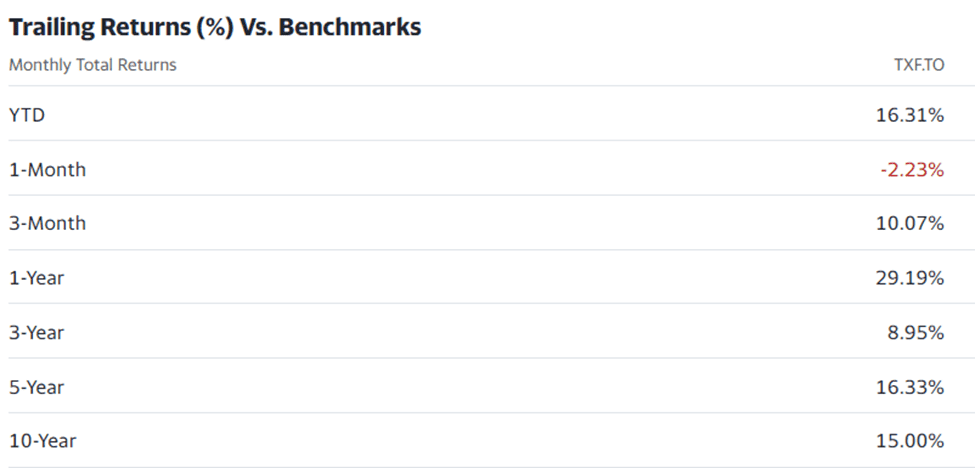
TXF.TO (CI Tech Giants Covered Call ETF) has shown strong long-term performance, driven by its holdings in major tech companies like Apple, Microsoft, and Alphabet. These tech giants have delivered impressive growth over the years, fueling TXF’s solid returns, particularly over the 1-year (29.19%) and 5-year (16.33%) periods. The ETF employs a covered call strategy, generating additional income by selling call options on its holdings.

While TXF’s covered call strategy helps generate income even in fluctuating markets, it may underperform during strong market rallies due to the capped upside from the calls. However, TXF retains growth potential with 75% of the portfolio uncovered, allowing participation in tech sector growth.

Tax Efficiency

In non-registered accounts, the covered call income from TXF is tax-efficient. The premiums collected are typically treated as capital gains.

TXF vs TEC

Here’s a comparison between TXF and the TEC (TD Global Technology Leaders Index ETF):

FeatureTXF (CI Tech Giants Covered Call ETF)TEC (TD Global Technology Leaders Index ETF)
Holdings FocusU.S. tech giants (Apple, Microsoft, Alphabet)Global tech (U.S., Europe, Asia)
Covered Call StrategyYes (income generation, limited upside)No (full market upside potential)
Income GenerationHigher due to covered call premiumsLower income focus, more growth-oriented
Growth PotentialModerate due to income strategyHigher growth potential with global tech exposure
Currency HedgingHedged (TXF) or unhedged (TXF.B)Unhedged, exposed to foreign currency fluctuations
Target MarketPrimarily U.S. tech giantsBroader global tech sector
Risk LevelLower volatility due to income strategyHigher risk from global exposure and growth focus

In summary, TXF uses a covered call strategy to generate steady income by selling options on U.S. tech giants, offering lower risk but limited upside during stock rallies. It’s ideal for income-focused investors who prefer more stability. In contrast, TEC is a growth-oriented ETF with full exposure to the global tech sector, offering higher upside but also greater risk due to market volatility. TEC suits investors seeking long-term growth without a focus on income.

Conclusion

The TXF ETF stands out as an ideal investment for those seeking exposure to high-growth tech companies while also generating significant income through a covered call strategy. Its lower coverage ratio allows for participation in tech stock rallies, making it attractive for growth-oriented investors who also want consistent, high-yield payouts. However, investors should be aware of the trade-offs, including potential underperformance in a rapidly rising market and the higher volatility associated with tech stocks.

As with any investment, ensure that TXF fits within your financial goals and risk tolerance

Investment objective

The Brompton Enhanced Multi-Asset Income ETF (BMAX) seeks to provide investors with a diversified, actively managed portfolio of income-generating securities, including Preferred shares (approx: 20%), Canadian equities, Canadian bonds, U.S. equities, and U.S. high yield bonds. This is an actively managed fund.

Strategy:

seeks to identify undervalued income-generating assets across multiple asset classes

using derivatives to enhance income and manage risk

focus on risk management and capital preservation

This ETF is for Investors who are…

Seeking stable enhanced monthly cash distributions

Conservative investors who desire a low volatility portfolio with some potentiel for capital approciation

Leverage

A leveraged ETF is a type of exchange-traded fund (ETF) that uses financial derivatives and debt to amplify the returns of an underlying index. While leveraged ETFs can potentially deliver higher returns than non-leveraged ETFs, they also come with increased risk. Due to the use of leverage, the value of a leveraged ETF can fluctuate more than the underlying index it tracks, and losses can be magnified as well as gains. BMAX uses 33% leverage ratio to enhance portfolio income & capital appreciation potential Medium risk-rating.

[stock_market_widget type=”card” template=”basic” color=”#5679FF” assets=”BMAX.TO” display_currency_symbol=”true” api=”yf”]

[stock_market_widget type=”chart” template=”line” color=”#5679FF” assets=”BMAX.TO” range=”1mo” interval=”1d” axes=”true” cursor=”true” range_selector=”true” display_currency_symbol=”true” api=”yf”]

What’s a covered call ETF?

What’s unique about this ETF is that it uses covered calls to protect against downside risk. This being said, the covered call strategy provides limited downside protection. Also, when you write a covered call, you give up some of the stock’s potential gains. These ETFs will tend to have a higher yield and a lower performance.

Historical performance

ETFDiv
Yld
BMAX9.99%

[stock_market_widget type=”table-quotes” template=”color-text” color=”#0F3FF6″ assets=”BMAX.TO” fields=”symbol,ytd_return,three_year_average_return,five_year_average_return” links=”{‘BMAX.TO’:{}}” display_header=”true” display_chart=”false” display_currency_symbol=”true” pagination=”true” search=”false” rows_per_page=”5″ sort_field=”logo_name_symbol” sort_direction=”asc” alignment=”left” api=”yf”]

Historical performance updated daily

Best US Dividend ETFs in Canada!

BMAX MER

ETFMER*
%
BMAX Not yet published

BMAX Stock Profile

[stock_market_widget type=”table-quotes” template=”color-text” color=”#0F3FF6″ assets=”BMAX.TO” fields=”symbol,price,change_abs,change_pct,net_assets,nav,fund_family” links=”{‘ZWC.TO’:{}}” display_header=”true” display_chart=”false” display_currency_symbol=”true” pagination=”true” search=”false” rows_per_page=”5″ sort_field=”logo_name_symbol” sort_direction=”asc” alignment=”left” api=”yf”]

Updated daily

BMAX Stock 52 weeks high and low

[stock_market_widget type=”table-quotes” template=”color-text” color=”#0F3FF6″ assets=”BMAX.TO” fields=”symbol,price,52_week_low,52_week_low_change_pct,52_week_high,52_week_high_change_pct,fund_inception_date” links=”{‘BMAX.TO’:{}}” display_header=”true” display_chart=”false” display_currency_symbol=”true” pagination=”true” search=”false” rows_per_page=”5″ sort_field=”logo_name_symbol” sort_direction=”asc” alignment=”left” api=”yf”]

Updated daily

CIBC investors' edge

BMAX ETF Holdings


% of Portfolio
Brompton Flaherty & Crumrine Investment Grade Preferred ETF21.1%
Brompton Tech Leaders Income ETF10.3%
Brompton European Dividend Growth ETF10.2%
Brompton North American Low Volatility Dividend ETF9.8%
Brompton Sustainable Real Assets Dividend ETFBrompton Sustainable Real Assets Dividend ETF9.8%
Brompton North American Financials Dividend ETF9.7%
Brompton Global Dividend Growth ETF9.5%
Brompton Global Healthcare Income & Growth ETF9.2%
Brompton Split Banc Corp Preferred Shares2.6%
Life & Banc Split Corp Preferred Shares2.4%
Global Dividend Growth Split Corp Preferred Shares1.8%
Dividend Growth Split Corp Preferred Shares1.7%
Cash and short-term investments1.6%
Sustainable Power & Infrastructure Split Corp Preferred Shares0.2%
Total99.9%
Please check issuer’s website for up-to-date data

Introduction to Weekly Dividend ETFs

Weekly dividend ETFs are an intriguing option for investors looking to create a consistent cash flow. Unlike traditional dividend ETFs that typically pay out monthly or quarterly, these ETFs aim to provide income on a weekly basis. They achieve this through unique investment strategies that capitalize on market opportunities.

Two notable examples of weekly dividend ETFs are the Roundhill Innovation 100 ETF (QDTE) and the Roundhill S&P 500 ETF (XDTE). Both funds use innovative approaches to generate high yields, but they also come with their own set of risks and considerations.

Roundhill Innovation 100 ETF (QDTE)

The Roundhill Innovation 100 ETF (QDTE) is designed for investors seeking high-yield opportunities from the tech-heavy NASDAQ 100. Here’s how it works:

Investment Focus: QDTE invests in the largest companies in the NASDAQ 100, a collection of leading tech and innovation-driven firms.

Income Strategy: To generate weekly dividends, QDTE employs a covered call strategy. Specifically, it uses options that expire on the same day they are written, known as Zero Days to Expiration (0 DTE) options.

Risks and Rewards of the 0 DTE Strategy in Weekly Dividend ETFs

AspectRewardsRisks
IncomeHigh yield potentialUnpredictable, fluctuating income
Market VolatilityBenefits from market volatilityIncreased price volatility, risk of capital loss
ComplexityAdvanced strategy managed by the ETFDifficult to understand for average investors
CostsGenerates income without active tradingHigh management fees reduce returns
Time HorizonGood for short-term income generationNot ideal for long-term, low-risk investors

Yield Potential: The potential yield for QDTE is quite high, sometimes reaching up to 62%. However, this yield is closely tied to market volatility—when the market is turbulent, yields can spike, but they can also drop when the market is calm.

Dividend Variability: Because QDTE’s income is based on market conditions, the dividends can vary significantly from week to week, making them less predictable.

Roundhill S&P 500 ETF (XDTE)

The Roundhill S&P 500 ETF (XDTE) takes a similar approach but focuses on a different set of underlying assets:

Investment Focus: XDTE invests in companies within the S&P 500, which includes a broad mix of large-cap U.S. companies across various industries.

Income Strategy: Like QDTE, XDTE uses a 0 DTE options strategy to generate income, writing covered calls that expire the same day.

Yield Potential: XDTE typically offers slightly lower yields compared to QDTE, reflecting the lower volatility of S&P 500 stocks. While the yield may not be as high, it can be somewhat more stable.

Dividend Stability: Dividends from XDTE are also subject to variability but tend to be a bit more consistent compared to QDTE, given the less volatile nature of the S&P 500 index.

Pros and Cons of QDTE and XDTE

Both QDTE and XDTE offer unique advantages and potential drawbacks:

Pros:

High Yield Potential: Both ETFs have the potential to deliver significantly higher yields than traditional dividend-paying ETFs or individual dividend stocks.

Weekly Cash Flow: The weekly dividend payments can provide a steady stream of income, which can be particularly useful for investors who need regular cash flow.

Cons:

High Expense Ratios: These ETFs come with higher-than-average management fees, typically around 0.95%, which can eat into your overall returns.

Dividend and Price Volatility: The dividends can vary significantly, and the prices of these ETFs can be more volatile due to their reliance on market conditions and the 0 DTE options strategy.

Conclusion: Is a Weekly Dividend ETF Right for You?

Investing in weekly dividend ETFs like QDTE and XDTE can be a compelling strategy for those looking for high yields and frequent income. However, it’s essential to understand the risks involved. The high yield potential is attractive, but the variability in dividends and the associated market risks may not suit every investor.

For those comfortable with the volatility and seeking simplicity in income generation, these ETFs might be an excellent fit. However, investors looking for more stable income might prefer traditional dividend-paying stocks or ETFs with more predictable payouts.

Ultimately, whether QDTE or XDTE is right for you depends on your investment goals, risk tolerance, and need for consistent cash flow. If you decide to invest, consider starting with a small allocation to see how these ETFs perform in your portfolio.

Investment objective

The ZWB ETF is designed to offer investors exposure to a selection of Canadian bank stocks that pay dividends. In addition to holding these dividend-paying securities, the ETF also generates income by writing covered call options. The stocks included in the portfolio are selected based on several key factors: Dividend growth rate, Dividend yield, Payout ratio and Liquidity.

[stock_market_widget type=”card” template=”basic” color=”#5679FF” assets=”ZWB.TO” display_currency_symbol=”true” api=”yf”]

cibc investors' edge

[stock_market_widget type=”chart” template=”line” color=”#5679FF” assets=”ZWB.TO” range=”1mo” interval=”1d” axes=”true” cursor=”true” range_selector=”true” display_currency_symbol=”true” api=”yf”]

What’s a covered call ETF?

This ETF stands out because it uses a covered call strategy to help protect against losses when stock prices drop. However, it’s important to note that this strategy offers only limited protection. Additionally, by writing covered calls, you may miss out on some of the stock’s potential gains if prices rise significantly. As a result, these ETFs typically offer a higher yield but may have lower overall performance.

ZWB is a great choice for conservative investors who want steady income, moderate risk, and exposure to Canadian banks. It’s also tax-efficient since all the dividends come from Canadian banks.

Please consult our recent post comparing ZWB with other popular High Dividend ETFs in Canada.

Historical performance

ETFDiv
Yld
ZWB6.79%

[stock_market_widget type=”table-quotes” template=”color-text” color=”#0F3FF6″ assets=”ZWB.TO” fields=”symbol,ytd_return,three_year_average_return,five_year_average_return” links=”{‘ZWB.TO’:{}}” display_header=”true” display_chart=”false” display_currency_symbol=”true” pagination=”true” search=”false” rows_per_page=”5″ sort_field=”logo_name_symbol” sort_direction=”asc” alignment=”left” api=”yf”]

Historical performance updated daily

Best US Dividend ETFs in Canada!

ZWB MER

ETFMER*
%
ZWB – BMO Covered
Call Canadian Banks
0.71

Top 10 Best Growth ETF in Canada!

XIC vs XIU: Best Canadian Index ETFs

ZWB Stock Profile

[stock_market_widget type=”table-quotes” template=”color-text” color=”#0F3FF6″ assets=”ZWB.TO” fields=”symbol,price,change_abs,change_pct,net_assets,nav,fund_family” links=”{‘ZWC.TO’:{}}” display_header=”true” display_chart=”false” display_currency_symbol=”true” pagination=”true” search=”false” rows_per_page=”5″ sort_field=”logo_name_symbol” sort_direction=”asc” alignment=”left” api=”yf”]

Updated daily

ZWB Stock 52 weeks high and low

[stock_market_widget type=”table-quotes” template=”color-text” color=”#0F3FF6″ assets=”ZWB.TO” fields=”symbol,price,52_week_low,52_week_low_change_pct,52_week_high,52_week_high_change_pct,fund_inception_date” links=”{‘ZWB.TO’:{}}” display_header=”true” display_chart=”false” display_currency_symbol=”true” pagination=”true” search=”false” rows_per_page=”5″ sort_field=”logo_name_symbol” sort_direction=”asc” alignment=”left” api=”yf”]

Updated daily

ZWB vs HMAX ETF

The ZWB ETF from BMO employs a strategy where it sells out-of-the-money (OTM) call options on 50% of the stocks in its portfolio. This OTM strategy limits the potential gains of these positions to the option’s strike price until the option expires. For BMO ETFs like ZWB, these options typically expire within 1 to 2 months.

Compared to the HMAX ETF, which also uses a covered call strategy but with at-the-money (ATM) options, ZWB focuses exclusively on big Canadian banks and offers a dividend yield of 6-7%. HMAX, on the other hand, includes a broader mix of financial sectors such as banks, insurance, and asset management, and targets a higher yield of 13%. ZWB’s concentrated allocation to Canadian banks makes it a more focused option for investors seeking exposure to this sector with steady income.

CIBC investors' edge

ZWB Dividend history

AmountAdj. AmountDividend TypeFrequencyEx-Div DateRecord DatePay DateDeclare Date
0.11000.1100RegularMonthly7/30/20247/30/20248/2/20247/23/2024
0.11000.1100RegularMonthly6/27/20246/27/20247/3/20246/20/2024
0.11000.1100RegularMonthly5/30/20245/30/20246/4/20245/23/2024
0.11000.1100RegularMonthly4/26/20244/29/20245/2/20244/19/2024

ZWB ETF Holdings

NameWeight
BMO Equal Weight Banks ETF27.2%
  Bank of Montreal12.9%
Canadian Imperial Bank of Commerce12.7%
Royal Bank of Canada12.1%
National Bank of Canada11.9%
  The Toronto-Dominion Bank11.9%
Bank of Nova Scotia11.4%

Consult issuers’ website for up-to-date data