Global X is one of the largest ETF issuers in North America. In this post, we will focus on their covered call ETFs whose main objective is to maximize dividend yield. In fact, Covered call ETFs are more and more popular among income oriented investos. Global X had issued various ETFs within this category with different strategies to cater to most investors.

List of High income Vanguard covered call ETFs

High income ETFs from Vanguard
DJIA -Global X Dow 30 Covered Call ETF
QYLD -Global X NASDAQ 100 Covered Call ETF
XYLD -Global X S&P 500 Covered Call ETF
RYLD -Global X Russell 2000 Covered Call ETF
QYLG -Global X Nasdaq 100 Covered Call & Growth ETF
XYLG -Global X S&P 500 Covered Call & Growth ETF

BMO Covered call ETF list – Full comparison

JEPI ETF REVIEW: JPMorgan Equity Premium Income

Strategy: summary table

Covered Call ETFs
DJIA, QYLD, XYLD, RYLD
Covered Call &
Growth ETFs

QYLG, XYLG
Strategy
Overview
Buy reference index
components, write
monthly At The Money
index calls
on 100% of the fund’s
portfolio in an effort to
maximize income.
Buy reference index
components, write
monthly At The Money index
calls on 50% of the fund’s
portfolio for income with
some upside potential.
ETFsDJIA, QYLD, XYLD, RYLDQYLG, XYLG
StrategySells At The Money Covered Calls
(on 100% of assets) 100%
of the upside is forfeited
Sells At The Money Covered Calls
(on 50% of assets) 50% of
the upside is forfeited
Dividend
Frequency
MonthlyMonthly

Asset under management and inception date

[stock_market_widget type=”table-quotes” template=”color-header-border” color=”#5679FF” assets=”DJIA,QYLD,XYLD,RYLD,QYLG,XYLG” fields=”symbol,name,net_assets,fund_inception_date” links=”{‘DJIA’:{},’QYLD’:{},’XYLD’:{},’RYLD’:{},’QYLG’:{},’XYLG’:{}}” display_header=”true” display_chart=”false” display_currency_symbol=”true” pagination=”true” search=”false” rows_per_page=”10″ sort_field=”logo_name_symbol” sort_direction=”asc” alignment=”left” api=”yf”]

Performance comparison

[stock_market_widget type=”table-quotes” template=”color-header-border” color=”#5679FF” assets=”DJIA,QYLD,XYLD,RYLD,QYLG,XYLG” fields=”symbol,ytd_return,three_year_average_return,five_year_average_return” links=”{‘DJIA’:{},’QYLD’:{},’XYLD’:{},’RYLD’:{},’QYLG’:{},’XYLG’:{}}” display_header=”true” display_chart=”false” display_currency_symbol=”true” pagination=”true” search=”false” rows_per_page=”10″ sort_field=”logo_name_symbol” sort_direction=”asc” alignment=”left” api=”yf”]

Dividend yield comparison

SymbolDiv
Yld
MER
DJIA11%0,61
QYLD13.74%0,61%
XYLD13.42%0,60%
RYLD13.50%0,55%
QYLG6.89%0,61%
XYLG6.43%0,60%
Source: TD Market research and Yahoo Finance

Full list of ‘Dividend Kings’ stocks by sector – 2023

PFF ETF Review: US Preferred Stock Ishares

QYLD -Global X NASDAQ 100 Covered Call ETF

QYLD is a passive index ETF that uses a covered call strategy to enhance yield and lower volatility. The fund was created by Global X and tracks the Nasdaq 100. The manager follows a “covered call” or “buy-write” strategy, in which the Fund buys the stocks in the Nasdaq 100 Index and “writes” or “sells” corresponding call options on the same index. 

[stock_market_widget type=”card” template=”basic” color=”#5679FF” assets=”QYLD” display_currency_symbol=”true” api=”yf”]
[stock_market_widget type=”chart” template=”basic” color=”#5679FF” assets=”QYLD” range=”1mo” interval=”1d” axes=”true” cursor=”true” range_selector=”true” display_currency_symbol=”true” api=”yf”]

Is QYLD a good investment?

When it comes to investing, finding the right balance between risk and reward is a constant pursuit. The QYLD ETF, or the Global X NASDAQ 100 Covered Call ETF, is an investment option that has captured the attention of both conservative investors and income seekers. In this exploration, we delve into the positives and drawbacks of QYLD, shedding light on its unique attributes.

Positives: Embracing Income and Stability

Attractive Yield: QYLD is often celebrated for its attractive yield, which is primarily derived from the premiums earned by issuing call options on the NASDAQ 100 index. For those seeking a regular income stream, this feature can be enticing, offering a consistent source of cash flow.

Lower Volatility: Another notable advantage of QYLD is its lower volatility when compared to direct investments in the NASDAQ 100, such as QQQ. The covered call strategy embedded in the fund serves as a cushion, effectively reducing overall volatility. This quality makes it particularly appealing to conservative investors who prioritize capital preservation.

Time and Effort Saved: QYLD provides a valuable shortcut for investors. Writing call options in the NASDAQ 100 involves extensive research, active management, and ongoing monitoring. QYLD simplifies this process by offering a professionally managed covered call strategy, saving investors both time and effort.

Liquidity: With assets under management surpassing 6 billion dollars, the fund offers liquidity that ensures investors can efficiently trade shares as needed.

Drawbacks: Considerations on Performance and Diversification

Performance Limitations: While QYLD excels in income generation and risk reduction, it’s important to recognize that this strategy has its limitations. The covered call approach inherently places a cap on the fund’s potential for capital appreciation. As a result, investors may miss out on the full upside potential of the NASDAQ 100, particularly during robust market rallies.

Market Unpredictability: In the face of an unpredictable or highly volatile market, the effectiveness of covered call strategies like the one employed by QYLD may be challenged. While it serves as a risk management tool during stable market conditions, extreme fluctuations can render the strategy less effective.

Lack of Diversification: QYLD’s dominance by tech firms means it falls short of offering true diversification. Investors looking for a broad spectrum of investments beyond the tech sector may find this aspect limiting.

High Fees: It’s worth noting that QYLD comes with a total expense ratio of 0.60%, which some investors may find relatively high compared to other ETF options.

In conclusion, the QYLD ETF presents a unique investment proposition with its emphasis on income generation and risk management. However, it’s crucial for investors to weigh these advantages against the potential limitations and consider their individual financial objectives and risk tolerance. The decision to invest in QYLD should align with one’s investment strategy and goals, keeping in mind the trade-offs involved in pursuing income and stability in a dynamic market landscape.
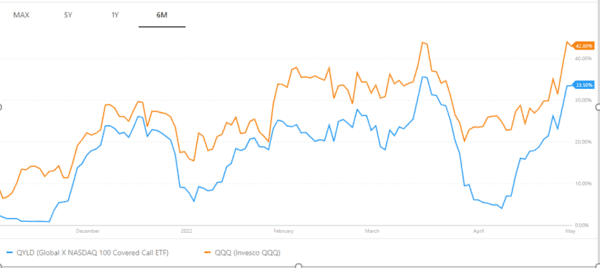
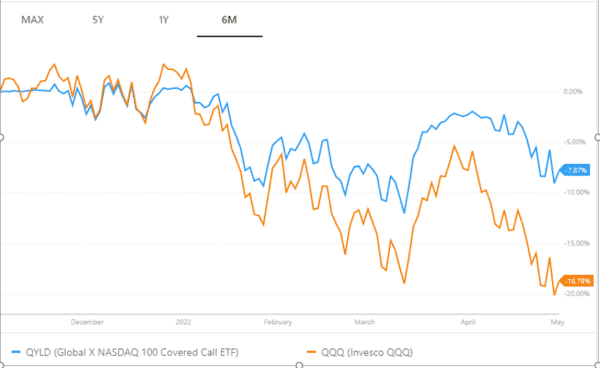
Volatility comparison: QYLD has a lower volatility than the NASDAQ 100 (source of graphic: portfoliolabs.com)
In bear markets, QYLD protects investors and in normal circumstances will offer a better performance than the NASDAQ 100. The graphic depicts growth of 10K invested in the past 6 Months

QYLD Top ten holdings

Net Assets (%)Name
11.85APPLE INC
11.79MICROSOFT CORP
6.54AMAZON.COM INC
3.91ALPHABET INC-CL C
3.88ALPHABET INC-CL A
3.66NVIDIA CORP
2.75TESLA INC
2.72META PLATFORMS INC
2.08PEPSICO INC
2.03BROADCOM INC

XYLD -Global X S&P 500 Covered Call ETF

XYLD is a passive index ETF that uses a covered call strategy to enhance yield and lower volatility. The fund was created by Global X and tracks the S&P500. The manager follows a “covered call” or “buy-write” strategy, in which the Fund buys the stocks in the S&P 500 Index and “writes” or “sells” corresponding call options on the same index. So far, XYLD has paid monthly distributions 9 years running.

[stock_market_widget type=”card” template=”basic” color=”#5679FF” assets=”XYLD” display_currency_symbol=”true” api=”yf”]
[stock_market_widget type=”chart” template=”basic” color=”#5679FF” assets=”XYLD” range=”1mo” interval=”1d” axes=”true” cursor=”true” range_selector=”true” display_currency_symbol=”true” api=”yf”]

Is XYLD a good investment?

The XYLD ETF, or the Global X S&P 500 Covered Call ETF, presents a compelling investment option with a range of benefits that cater to various investor preferences. This ETF employs a covered call strategy on the S&P 500, offering a unique blend of income generation and risk management.

One of the most appealing features of XYLD is its attractive yield, primarily derived from the premiums earned by issuing call options on the S&P 500. For income-seeking investors, this regular income stream can be an attractive proposition, offering consistent cash flow.

What sets XYLD apart is its lower volatility when compared to directly investing in the S&P 500 through ETFs like SPY. The covered call strategy acts as a buffer, helping to reduce the fund’s overall volatility. This characteristic makes it particularly well-suited for conservative investors who prioritize capital preservation.

It’s worth noting that higher market volatility often translates into increased premiums earned by the fund. This dynamic can further enhance the yield potential for XYLD, making it an enticing option during turbulent market conditions.

Additionally, XYLD can save investors valuable time and effort. If you were to take on the task of writing call options on the S&P 500 yourself, it would require substantial research, monitoring, and active management. XYLD simplifies this process by offering a diversified investment strategy that automatically implements the covered call approach.

Liquidity is another advantage of XYLD. With over 6 billion dollars in assets under management, the fund offers ample liquidity, ensuring that investors can efficiently buy and sell shares as needed.

In summary, the XYLD ETF presents a diversified investment opportunity that combines an attractive yield, lower volatility, and the convenience of a professionally managed covered call strategy. This blend of features makes it an appealing choice for conservative investors, income seekers, or those looking to streamline their investment approach.
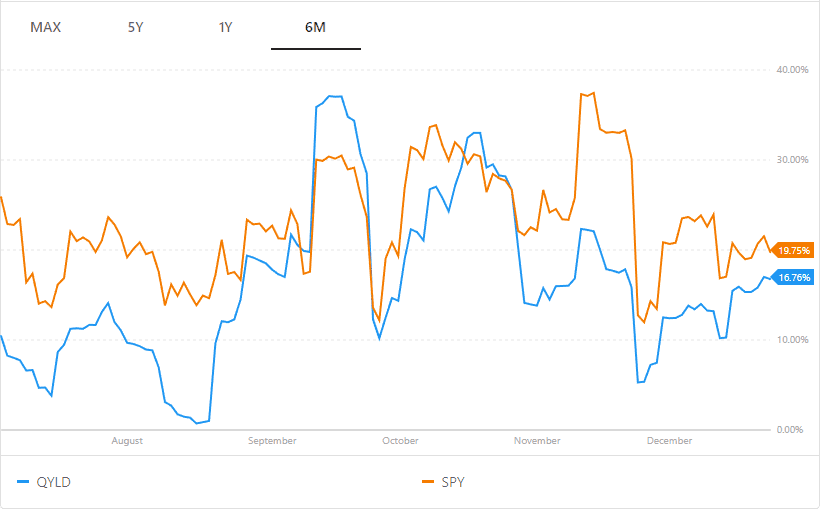
Volatility comparison: XYLD has a lower volatility than the S&P 500 (source of graphic: portfoliolabs.com)

Negatives

However, it’s essential to be aware of a couple of potential drawbacks. Firstly, while the ETF’s strategy is effective in generating income and reducing volatility, it does mean that investors may miss out on the full upside potential of the S&P 500. The covered call strategy inherently places a cap on the fund’s potential for capital appreciation, which can be a trade-off for the income it provides.

Secondly, it’s important to acknowledge that the strategy of covered calls may become less effective in an unpredictable or highly volatile market. While it can act as a risk management tool during normal market conditions, extreme fluctuations can challenge the effectiveness of this approach.

Top Holdings 

Net Assets (%)Name
6.28APPLE INC
5.37MICROSOFT CORP
2.58AMAZON.COM INC
1.73ALPHABET INC-CL A
1.71BERKSHIRE HATH-B
1.55ALPHABET INC-CL C
1.43EXXON MOBIL CORP
1.41UNITEDHEALTH GROUP INC
1.38JOHNSON & JOHNSON
1.30NVIDIA CORP

RYLD -Global X Russell 2000 Covered Call ETF

RYLD is an index ETF with an active covered call strategy in place to enhance yield. The index tracked is the Russell 2000, which consists of small to mid cap stocks. This fund is different than XYLD or QYLD because the focus here is not on large cap stocks. When investing in small caps, investors hope usually for higher growth. Small caps are also known to outperform large caps in begenning of the growth phase of the economy.

RYLD writes call options on the Russell 2000 Index (a succession of one-month at-the-money covered call options). The fund does not use leverage.

The Russel 2000 top three holdings are Ovintiv, Avis Budget Group, and Antero Resources.

[stock_market_widget type=”card” template=”basic” color=”#5679FF” assets=”RYLD” display_currency_symbol=”true” api=”yf”]
[stock_market_widget type=”chart” template=”basic” color=”#5679FF” assets=”RYLD” range=”1mo” interval=”1d” axes=”true” cursor=”true” range_selector=”true” display_currency_symbol=”true” api=”yf”]

Top Holdings 

Net Assets (%)Name
31.40VANGUARD RUSSELL 2000 ETF
0.23IRIDIUM COMMUNIC
0.23CROCS INC
0.22INSPIRE MEDICAL
0.21HALOZYME THERAPEUTICS INC
0.21MATADOR RESOURCES CO
0.21EMCOR GROUP INC
0.21TEXAS ROADHOUSE INC
0.20RBC BEARINGS INC
0.20AGREE REALTY CORP

QYLG -Global X Nasdaq 100 Covered Call & Growth ETF

As shown in the table above, summary of strategies. This fund is one of the ETFs whose objective is to seek both growth and income. Therefore, the strategy in place uses covered call options, however, on only 50% of the portfolio. In other words, QYLG is similar to QYLD but it will offer less dividends and more room for growth. Besides, in normal market conditions, QYLG will be more volatile than QYLD.

As its name implies, QYLG is an index fund and is replicating the portfolio constituents of the Nasdaq 100.

[stock_market_widget type=”card” template=”basic” color=”#5679FF” assets=”QYLG” display_currency_symbol=”true” api=”yf”]
[stock_market_widget type=”chart” template=”basic” color=”#5679FF” assets=”QYLG” range=”1mo” interval=”1d” axes=”true” cursor=”true” range_selector=”true” display_currency_symbol=”true” api=”yf”]

Top Holdings 

Net Assets (%)Name
11.84APPLE INC
11.78MICROSOFT CORP
6.54AMAZON.COM INC
3.91ALPHABET INC-CL C
3.87ALPHABET INC-CL A
3.66NVIDIA CORP
2.75TESLA INC
2.72META PLATFORMS INC
2.07PEPSICO INC
2.02BROADCOM INC

XYLG -Global X S&P 500 Covered Call & Growth ETF

As shown in the table above, summary of strategies. This fund is one of the ETFs whose objective is to seek both growth and income. Therefore, the strategy in place uses covered call options, however, on only 50% of the portfolio. In other words, XYLG is similar to XYLD but it will offer less dividends and more room for growth. Besides, in normal market conditions, XYLG will be more volatile than XYLD.

As its name implies, XYLG is an index fund and is replicating the portfolio constituents of the S&P 500.

[stock_market_widget type=”card” template=”basic” color=”#5679FF” assets=”XYLG” display_currency_symbol=”true” api=”yf”]
[stock_market_widget type=”chart” template=”basic” color=”#5679FF” assets=”XYLG” range=”1mo” interval=”1d” axes=”true” cursor=”true” range_selector=”true” display_currency_symbol=”true” api=”yf”]

XYLG – Top Holdings 

Net Assets (%)Name
6.23APPLE INC
5.33MICROSOFT CORP
2.56AMAZON.COM INC
1.71ALPHABET INC-CL A
1.69BERKSHIRE HATH-B
1.53ALPHABET INC-CL C
1.41EXXON MOBIL CORP
1.39UNITEDHEALTH GROUP INC
1.37JOHNSON & JOHNSON
1.29NVIDIA CORP

XYLG – Sector allocation

SECTORWEIGHT (%)
Information Technology25.6
Health Care15.9
Financials11.6
Consumer Discretionary9.8
Industrials8.8
Communication Services7.3
Consumer Staples7.2
Energy5.2
Utilities3.2
Materials2.7

DJIA -Global X Dow 30 Covered Call ETF

This fund allows investors to track 30 Dow stocks and generate income through issuing covered call options. DJIA is less diversified than XYLD, since the S&P 500 is much larger and broader than the Dow 30.

The 30 companies making up the index are mostly bluechips.


[stock_market_widget type=”card” template=”basic” color=”#5679FF” assets=”DJIA” display_currency_symbol=”true” api=”yf”]
[stock_market_widget type=”chart” template=”basic” color=”#5679FF” assets=”DJIA” range=”1mo” interval=”1d” axes=”true” cursor=”true” range_selector=”true” display_currency_symbol=”true” api=”yf”]

DJIA Top 10 holdings
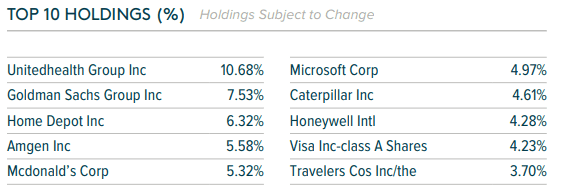
The BMO Covered Call U.S. Banks ETF (ZWK) is professionally managed by BMO Global Asset Management. The fund has been designed to provide exposure to a portfolio of U.S. banks while earning call option premiums.

cibc investors' edge

The fund invests in 38 US Banks. It’s ideal for investors looking for dividend income. The dividend yield on November 24th was 6.19%!

The fact that the fund uses call options accomplishes two things:

  • increases the dividend yield;
  • reduces volatility but also growth potential. So, it’s something to keep in mind.

[stock_market_widget type=”card” template=”basic” color=”#5679FF” assets=”ZWK.TO” display_currency_symbol=”true” api=”yf”]

[stock_market_widget type=”chart” template=”basic” color=”#5679FF” assets=”ZWK.TO” range=”1mo” interval=”1d” axes=”true” cursor=”true” range_selector=”true” display_currency_symbol=”true” api=”yf”]

What’s a covered call ETF?

What’s unique about this ETF is that it uses covered calls to protect against downside risk. This being said, the covered call strategy provides limited downside protection. Also, when you write a covered call, you give up some of the stock’s potential gains. These ETFs will tend to have a higher yield and a lower performance.

ZWK is an excellent option for conservative investors looking for a steady income, moderate volatility and exposure to the US banking sector.

Historical performance

ETFDiv
Yld
ZWK7.60%

[stock_market_widget type=”table-quotes” template=”color-text” color=”#0F3FF6″ assets=”ZWK.TO” fields=”symbol,ytd_return,three_year_average_return,five_year_average_return” links=”{‘ZWB.TO’:{}}” display_header=”true” display_chart=”false” display_currency_symbol=”true” pagination=”true” search=”false” rows_per_page=”5″ sort_field=”logo_name_symbol” sort_direction=”asc” alignment=”left” api=”yf”]

Historical performance updated daily

Best US Dividend ETFs in Canada (2023)!

cibc investors' edge

ZWB MER

ETFMER*
%
ZWK -BMO Covered
Call US Banks 
0.72

Top 10 Best Growth ETF in Canada!

XIC vs XIU: Best Canadian Index ETFs

ZWK Stock Profile

[stock_market_widget type=”table-quotes” template=”color-text” color=”#0F3FF6″ assets=”ZWK.TO” fields=”symbol,price,change_abs,change_pct,net_assets,nav,fund_family” links=”{‘ZWK.TO’:{}}” display_header=”true” display_chart=”false” display_currency_symbol=”true” pagination=”true” search=”false” rows_per_page=”5″ sort_field=”logo_name_symbol” sort_direction=”asc” alignment=”left” api=”yf”]

Updated daily

ZWK Stock 52 weeks high and low

[stock_market_widget type=”table-quotes” template=”color-text” color=”#0F3FF6″ assets=”ZWK.TO” fields=”symbol,price,52_week_low,52_week_low_change_pct,52_week_high,52_week_high_change_pct,fund_inception_date” links=”{‘ZWK.TO’:{}}” display_header=”true” display_chart=”false” display_currency_symbol=”true” pagination=”true” search=”false” rows_per_page=”5″ sort_field=”logo_name_symbol” sort_direction=”asc” alignment=”left” api=”yf”]

Updated daily

How to choose a good dividend ETF

– Total return: Though the focus here is on the dividend yield, you have to keep in mind the total return. The profit or loss we make on any investment combines both dividend income and capital gain or loss. Looking at the long-term performance of the fund is crucial. An ETF that provides a good capital appreciation with a high dividend yield is preferable.

Diversification: A diversified ETF is always a safer option. Some high yield ETFs are sector-specific (Financials, Energy or Gold). The ones focused on Energy and Gold have had an inferior long-term performance and carry high volatility risk.

Volume and liquidity of the ETF. The higher the asset under management, the lower the trading costs of the ETF (difference between the bid and ask price).

CIBC investors' edge

ZWK Dividend history

Distrib
Period
Ex-Div
Date
Pay
Date
Cash
Distrib
Per Unit
Total
Distrib
Per Unit
January 2023January 27, 2023February 02, 20230.1700000.170000
February 2023February 24, 2023March 02, 20230.1700000.170000
March 2023March 29, 2023April 04, 20230.1700000.170000
April 2023April 26, 2023May 02, 2023
May 2023May 30, 2023June 05, 2023

ZWK ETF Holdings

Weight (%)NameTicker
7.56%CITIGROUP INCC
7.31%GOLDMAN SACHS GROUP INC/THEGS
7.30%JPMORGAN CHASE & COJPM
7.24%MORGAN STANLEYMS
7.21%BANK OF AMERICA CORPBAC
7.18%US BANCORPUSB
7.10%WELLS FARGO & COWFC
6.29%TRUIST FINANCIAL CORPTFC

Consult issuers’ website for up-to-date data

In this post, we will be going over the Best Canadian Dividend Stocks Canada (Top 10). We started by reviewing the full list of the Canadian dividend aristocrats with over ten years of consistently increasing dividends. From the list, we picked ten stocks which we think are the best available in Canada right now.

cibc investors' edge

Canadian dividend aristocrats

The list of Canadian ”Dividend Aristocrats” stocks is managed by the firm Standard and Poors. The index is titled the S&P Canadian Dividend Aristocrats. It requires a minimum of 5 years of successive dividend increases, which is low compared to the minimum 25 years for the US version of the index. You can check out our article on America’s Dividend Aristocrats here by sector.

For this post, we will share the list of Canadian “dividend aristocrats” stocks that have increased their dividends for at least ten consecutive years! In addition, we will also pick ten stocks among the ones most recommended by income-seeking bloggers. For each, we will provide financial data and analysis.

18 Best Monthly Dividend Stocks in Canada for passive income

8 Best Covered Call ETF Canada – High dividend yield

Why invest in dividend aristocrats

If you are asking yourself, what is the typical profile of a dividend aristocrat stock? I have listed some common characteristics below:

Dividend aristocrats tend to dominate their industry

• The vast majority are companies that are well established in their sector. They manage to generate significant profits thanks to their comfortable position against the competition. In some cases, they operate in regulated markets such as electric utilities with almost no competition;

Safe heaven during turbulent times

• “Dividend aristocrats” are sometimes considered by the financial market as safe havens in the event of a market correction or decline. Indeed, dividend aristocrats are generally less volatile than the market, and there are less targeted by speculators;

Strong financial statements

• “Dividend aristocrats” will tend to have a better financial situation in terms of liquidity than the rest of the market. Their levels of liquidity or debt are generally better than the rest of the market;

Limited growth but there are exceptions

• In general, dividend aristocrats are mature businesses. That is, the growth potential is quite limited. However, some companies can pay dividends and invest in their growth. Hence the importance of focusing on the dividend payout ratio.

What is a good dividend payout ratio

The dividend payout ratio is the amount of dividend distributed by a company divided by the total earnings. For example, a company makes a profit of $ 100 and pays $ 40 in dividends. Its payout ratio is 40%.

How to interpret a payout ratio

If the ratio is high, the company pays almost all of its profits in dividends. There will be little money left in the coffers to innovate or expand to new markets;

It is preferable to invest in a company where the dividend payout ratio is low or medium. The reasoning is that these companies will have money set aside to invest in new projects and thus create growth;

Another variation of payout ratio (Trailing div / Earnings) is the payout ratio to cash (Div / Free cash flows). Earnings can be easily manipulated, so analysts use the payout ratio to cash to assess the safety of dividends better. The website ‘Marketbeat‘ provides the payout ratio to cash for Canadian stocks.

Total return

When one wishes to invest in a dividend-paying stock, it is essential to pay attention to its performance and growth potential. The most common mistake is to invest in stocks with high dividend yields. This strategy is risky. Here’s why :

• A stock can pay a high dividend yield, but is it sustainable? Some companies have a payout ratio that is close to and even exceeds 100%. They manage to post desirable dividend yields, but if we look at the growth prospects, it’s almost nil;

• Investors sometimes shun companies for lack of growth potential or actual risk of lower revenues in the future. These companies experience a drop in the price of their shares, and this causes the dividend yield to become abnormally high. Sooner or later, these businesses will have to cut their dividend.

Best canadian dividend stocks – full list

The table below lists the Canadian Dividend Aristocrats. Stocks are ranked by the number of successive years of dividend increase. These stocks are considered the best dividend stocks in Canada.

Symbol – NameDGR*
Streak
CU –Canadian Utilities49
FTS -Fortis47
TIH -Toromont Industries31
CWB –Canadian Western Bank29
ACO.X -Atco Ltd27
TRI -Thomson Reuters Corp27
IMO -IMPERIAL OIL26
MRU – Metro Inc26
EMP.A -Empire Company (A)26
ENB.TO – Enbridge25
CNR -Canadian National R.R.25
SAP – Saputo Inc23
TRP – TC Energy20
CNQ -Canadian Natural Rsrcs20
TCL.A -Transcontinental Inc. (A)19
FTT – Finning Int19
CCL.B -CCL Industries (B)19
RBA -Ritchie Bros Auctioneers18
T – Telus17
CCA -Cogeco Cable17
CGO – COGECO Inc16
IFC – Intact Financial16
SJ – Stella-Jones Inc.16
XTC– Exco Technologies15
ADW.A – Andrew Peller15
EMA – Emera Inc14
ENGH – Enghouse Systems14
BYD -Boyd Group Services14
FNV – Franco-Nevada Corp.13
TCS – Tecsys Inc13
BCE – BCE Inc12
NA – National Bank11
MG – Magna Int’l. (A)11
LGT.B – Logistec Corp11
ATD.B –Alimentation
Couche-Tard
11
WCN -Waste Connections11
KEY -Keyera Corp10
EIF -Exchange Income10
CM -CIBC Bank10
BNS -Bank of Nova Scotia10
AQN- Algonquin Power and
Utilities Corp
10
TD – TD Bank10
GRT.UN -Granite Real
Estate Investment Trust
10
RY -Royal Bank10
CTC.A -Canadian Tire
Corp Cl A NV
10
GCG.A -Guardian Capital Gr10
HDI -Hardwoods Distribution10
EQB  -Equitable Group Inc10
TFII -Tfi International Inc10
DOL -Dollarama Inc10
Best dividend stocks Canada

* Number of years of successive dividend increases

The stocks below are the ones most recommended by Canadian bloggers. We present you the relevant financial information with our comments and analysis.

Canadian Utilities stock

[stock_market_widget type=”chart” template=”basic” color=”#5679FF” assets=”CU.TO” range=”1mo” interval=”1d” axes=”true” cursor=”true” range_selector=”true” display_currency_symbol=”true” api=”yf”]

[stock_market_widget type=”table-quotes” template=”color-header-border” color=”#5679FF” assets=”CU.TO” fields=”symbol,market_cap,dividend_yield,payout_ratio,beta” links=”{‘CU.TO’:{}}” display_header=”true” display_chart=”false” display_currency_symbol=”true” pagination=”true” search=”false” rows_per_page=”5″ sort_field=”logo_name_symbol” sort_direction=”asc” alignment=”left” api=”yf”]

[stock_market_widget type=”table-quotes” template=”color-header-border” color=”#5679FF” assets=”CU.TO” fields=”symbol,pe_ratio,debt_equity,total_cash_per_share” links=”{‘CU.TO’:{}}” display_header=”true” display_chart=”false” display_currency_symbol=”true” pagination=”true” search=”false” rows_per_page=”5″ sort_field=”logo_name_symbol” sort_direction=”asc” alignment=”left” api=”yf”]

Canadian Utilities Limited and its subsidiaries are engaged in the electricity, natural gas, and retail energy industries. Canadian Utilities has increased its dividends continuously for 49 years!

Analysts see weak growth for this stock in the future. One can also question the ability of Canadian utilities to increase their dividends in the future since the pay-out ratio is high. Remember that when interest rates rise, utility companies compete with bonds; conservative investors tend then to drop utilities for bonds, causing a sell-off of utility stocks.

Fortis stock

[stock_market_widget type=”chart” template=”basic” color=”#5679FF” assets=”FTS.TO” range=”1mo” interval=”1d” axes=”true” cursor=”true” range_selector=”true” display_currency_symbol=”true” api=”yf”]

[stock_market_widget type=”table-quotes” template=”color-header-border” color=”#5679FF” assets=”FTS.TO” fields=”symbol,market_cap,dividend_yield,payout_ratio,beta” links=”{‘FTS.TO’:{}}” display_header=”true” display_chart=”false” display_currency_symbol=”true” pagination=”true” search=”false” rows_per_page=”5″ sort_field=”logo_name_symbol” sort_direction=”asc” alignment=”left” api=”yf”]

[stock_market_widget type=”table-quotes” template=”color-header-border” color=”#5679FF” assets=”FTS.TO” fields=”symbol,pe_ratio,debt_equity,total_cash_per_share” links=”{‘FTS.TO’:{}}” display_header=”true” display_chart=”false” display_currency_symbol=”true” pagination=”true” search=”false” rows_per_page=”5″ sort_field=”logo_name_symbol” sort_direction=”asc” alignment=”left” api=”yf”]

Fortis Inc. operates as an electric and gas utility company in Canada, the United States, and the Caribbean countries.

Analysts recommend Fortis for anyone looking for stable and predictable dividend income. Fortis has increased its dividends for 47 consecutive years. The company serves more than 2.2 million electricity customers and 1.1 million gas utility customers. Fortis offers a good dividend yield and a decent dividend growth rate (6.79% over the last five years).

In an effort to boost growth, Fortis is diversifying its portfolio assets to include clean energy and renewable energy sources.

Toromont industries stock

[stock_market_widget type=”chart” template=”basic” color=”#5679FF” assets=”TIH.TO” range=”1mo” interval=”1d” axes=”true” cursor=”true” range_selector=”true” display_currency_symbol=”true” api=”yf”]

[stock_market_widget type=”table-quotes” template=”color-header-border” color=”#5679FF” assets=”TIH.TO” fields=”symbol,market_cap,dividend_yield,payout_ratio,beta” links=”{‘TIH.TO’:{}}” display_header=”true” display_chart=”false” display_currency_symbol=”true” pagination=”true” search=”false” rows_per_page=”5″ sort_field=”logo_name_symbol” sort_direction=”asc” alignment=”left” api=”yf”]

[stock_market_widget type=”table-quotes” template=”color-header-border” color=”#5679FF” assets=”TIH.TO” fields=”symbol,pe_ratio,debt_equity,total_cash_per_share” links=”{‘TIH.TO’:{}}” display_header=”true” display_chart=”false” display_currency_symbol=”true” pagination=”true” search=”false” rows_per_page=”5″ sort_field=”logo_name_symbol” sort_direction=”asc” alignment=”left” api=”yf”]

Toromont Industries Ltd. supplies specialized capital goods in Canada, the United States, and abroad. It operates in two segments, Equipment Group and CIMCO. The Equipment Group segment is engaged in the sale, rental, and maintenance of mobile equipment. The CIMCO segment is involved in the design, engineering, manufacture, installation, and aftermarket support of refrigeration systems in the industrial and recreational markets.

Toromont is a well managed company that frequently beats market estimates. This stock is perfect if you want to have a combination of dividend income and growth potential. It’s a long-term buy.

The company has continuously increased its dividends for over 31 years. Over the past five years, the dividend has increased by 13%.

Enbridge stock

cibc investors' edge

[stock_market_widget type=”chart” template=”basic” color=”#5679FF” assets=”ENB.TO” range=”1mo” interval=”1d” axes=”true” cursor=”true” range_selector=”true” display_currency_symbol=”true” api=”yf”]

[stock_market_widget type=”table-quotes” template=”color-header-border” color=”#5679FF” assets=”ENB.TO” fields=”symbol,market_cap,dividend_yield,payout_ratio,beta” links=”{‘ENB.TO’:{}}” display_header=”true” display_chart=”false” display_currency_symbol=”true” pagination=”true” search=”false” rows_per_page=”5″ sort_field=”logo_name_symbol” sort_direction=”asc” alignment=”left” api=”yf”]

[stock_market_widget type=”table-quotes” template=”color-header-border” assets=”ENB.TO” fields=”symbol,pe_ratio,debt_equity,total_cash_per_share” links=”{‘ENB.TO’:{}}” display_header=”true” display_chart=”false” display_currency_symbol=”true” pagination=”true” search=”false” rows_per_page=”5″ sort_field=”logo_name_symbol” sort_direction=”asc” alignment=”left” api=”yf”]

Enbridge is responsible for transporting a quarter of the oil produced in North America through its extensive pipeline system. The company also transports one-fifth of the natural gas used in the United States.

Enbridge is often part of the best dividend stocks in Canada. And for a good reason! Despite a high dividend rate and sometimes bad economic conditions, the company has never reduced its dividends and continues to increase them.

Analysts agree on the low growth potential for ENB. However, Enbridge remains a business with stable income stemming from an existing pipeline system.

Canadian National Railway stock

[stock_market_widget type=”chart” template=”basic” color=”#5679FF” assets=”CNR.TO” range=”1mo” interval=”1d” axes=”true” cursor=”true” range_selector=”true” display_currency_symbol=”true” api=”yf”]

[stock_market_widget type=”table-quotes” template=”color-header-border” color=”#5679FF” assets=”CNR.TO” fields=”symbol,market_cap,dividend_yield,payout_ratio,beta” links=”{‘CNR.TO’:{}}” display_header=”true” display_chart=”false” display_currency_symbol=”true” pagination=”true” search=”false” rows_per_page=”5″ sort_field=”logo_name_symbol” sort_direction=”asc” alignment=”left” api=”yf”]

[stock_market_widget type=”table-quotes” template=”color-header-border” color=”#5679FF” assets=”CNR.TO” fields=”symbol,pe_ratio,debt_equity,total_cash_per_share” links=”{‘CNR.TO’:{}}” display_header=”true” display_chart=”false” display_currency_symbol=”true” pagination=”true” search=”false” rows_per_page=”5″ sort_field=”logo_name_symbol” sort_direction=”asc” alignment=”left” api=”yf”]

The Canadian National Railway Company is active in the rail and related transportation industry. The company operates a 19,500-mile road network spanning Canada and the United States. Among other things, it transports petroleum and chemicals, grains and fertilizers, coal, metals and minerals, and forest products.

Canadian National Railway has diversified revenues across several product lines. Although the rate of return is low at 1.62%, the company is recording an exciting dividend growth rate of 13% over five years.

Telus stock

[stock_market_widget type=”chart” template=”basic” color=”#5679FF” assets=”T.TO” range=”1mo” interval=”1d” axes=”true” cursor=”true” range_selector=”true” display_currency_symbol=”true” api=”yf”]

[stock_market_widget type=”table-quotes” template=”color-header-border” color=”#5679FF” assets=”T.TO” fields=”symbol,market_cap,dividend_yield,payout_ratio,beta” links=”{‘T.TO’:{}}” display_header=”true” display_chart=”false” display_currency_symbol=”true” pagination=”true” search=”false” rows_per_page=”5″ sort_field=”logo_name_symbol” sort_direction=”asc” alignment=”left” api=”yf”]

[stock_market_widget type=”table-quotes” template=”color-header-border” color=”#5679FF” assets=”T.TO” fields=”symbol,pe_ratio,debt_equity,total_cash_per_share” links=”{‘T.TO’:{}}” display_header=”true” display_chart=”false” display_currency_symbol=”true” pagination=”true” search=”false” rows_per_page=”5″ sort_field=”logo_name_symbol” sort_direction=”asc” alignment=”left” api=”yf”]

Telus provides a range of telecommunications products and services, including wireless and wired voice and data. The company has approximately 11 million subscribers.

T.TO has been increasing its dividends for 17 years now.

The pandemic has reduced the company’s revenue, mainly the profits made on the “Roaming” calls/data used while traveling. The dividend payout ratio is worrying at 132%. It’s worth noting, the payout ratio to cash is 76%. The latter is considered a better measure of the sustainability of the dividends.

National Bank stock

[stock_market_widget type=”chart” template=”basic” color=”#5679FF” assets=”NA.TO” range=”1mo” interval=”1d” axes=”true” cursor=”true” range_selector=”true” display_currency_symbol=”true” api=”yf”]

[stock_market_widget type=”table-quotes” template=”color-header-border” color=”#5679FF” assets=”NA.TO” fields=”symbol,market_cap,dividend_yield,payout_ratio,beta” links=”{‘NA.TO’:{}}” display_header=”true” display_chart=”false” display_currency_symbol=”true” pagination=”true” search=”false” rows_per_page=”5″ sort_field=”logo_name_symbol” sort_direction=”asc” alignment=”left” api=”yf”]

[stock_market_widget type=”table-quotes” template=”color-header-border” color=”#5679FF” assets=”NA.TO” fields=”symbol,pe_ratio,debt_equity,total_cash_per_share” links=”{‘NA.TO’:{}}” display_header=”true” display_chart=”false” display_currency_symbol=”true” pagination=”true” search=”false” rows_per_page=”5″ sort_field=”logo_name_symbol” sort_direction=”asc” alignment=”left” api=”yf”]

National Bank is the sixth-largest bank in Canada. It has a strong presence in Quebec.

NA was the best-performing stock this year among banking stocks. The company has a dividend rate of return of 2.79% with good growth potential. Dividends have grown by almost 7% over the past five years.

National Bank is recognized for its dynamism and continues to grow outside Quebec.

TD Bank stock

[stock_market_widget type=”chart” template=”basic” color=”#5679FF” assets=”TD.TO” range=”1mo” interval=”1d” axes=”true” cursor=”true” range_selector=”true” display_currency_symbol=”true” api=”yf”]

[stock_market_widget type=”table-quotes” template=”color-header-border” color=”#5679FF” assets=”TD.TO” fields=”symbol,market_cap,dividend_yield,payout_ratio,beta” links=”{‘TD.TO’:{}}” display_header=”true” display_chart=”false” display_currency_symbol=”true” pagination=”true” search=”false” rows_per_page=”5″ sort_field=”logo_name_symbol” sort_direction=”asc” alignment=”left” api=”yf”]

[stock_market_widget type=”table-quotes” template=”color-header-border” color=”#5679FF” assets=”TD.TO” fields=”symbol,pe_ratio,debt_equity,total_cash_per_share” links=”{‘TD.TO’:{}}” display_header=”true” display_chart=”false” display_currency_symbol=”true” pagination=”true” search=”false” rows_per_page=”5″ sort_field=”logo_name_symbol” sort_direction=”asc” alignment=”left” api=”yf”]

TD Bank is one of the largest Canadian banks. The dividend rate of return stands at 3.63%, with impressive growth over the last five years at around 9%.

The company has increased its dividends every year for the past ten years now. The banking sector has shown a substantial rise since the almost normal recovery of economic activity in North America.

Algonquin Power And Utilities stock

[stock_market_widget type=”chart” template=”basic” color=”#5679FF” assets=”AQN.TO” range=”1mo” interval=”1d” axes=”true” cursor=”true” range_selector=”true” display_currency_symbol=”true” api=”yf”]

[stock_market_widget type=”table-quotes” template=”color-header-border” color=”#5679FF” assets=”AQN.TO” fields=”symbol,market_cap,dividend_yield,payout_ratio,beta” links=”{‘AQN.TO’:{}}” display_header=”true” display_chart=”false” display_currency_symbol=”true” pagination=”true” search=”false” rows_per_page=”5″ sort_field=”logo_name_symbol” sort_direction=”asc” alignment=”left” api=”yf”]

[stock_market_widget type=”table-quotes” template=”color-header-border” color=”#5679FF” assets=”AQN.TO” fields=”symbol,pe_ratio,debt_equity,total_cash_per_share” links=”{‘AQN.TO’:{}}” display_header=”true” display_chart=”false” display_currency_symbol=”true” pagination=”true” search=”false” rows_per_page=”5″ sort_field=”logo_name_symbol” sort_direction=”asc” alignment=”left” api=”yf”]

AQN is very well managed and has one of the strongest growth profiles in the industry. The valuation is attractive. Investors faced with the risk of rising interest rates are beginning to lose interest in companies that provide regulated public services.

Alimentation Couche-Tard stock

[stock_market_widget type=”chart” template=”basic” color=”#5679FF” assets=”ATD.TO” range=”1mo” interval=”1d” axes=”true” cursor=”true” range_selector=”true” display_currency_symbol=”true” api=”yf”]

[stock_market_widget type=”table-quotes” template=”color-header-border” color=”#5679FF” assets=”ATD.TO” fields=”symbol,market_cap,dividend_yield,payout_ratio,beta” links=”{‘ATD.TO’:{}}” display_header=”true” display_chart=”false” display_currency_symbol=”true” pagination=”true” search=”false” rows_per_page=”5″ sort_field=”logo_name_symbol” sort_direction=”asc” alignment=”left” api=”yf”]

[stock_market_widget type=”table-quotes” template=”color-header-border” color=”#5679FF” assets=”ATD.TO” fields=”symbol,pe_ratio,debt_equity,total_cash_per_share” links=”{‘ATD.TO’:{}}” display_header=”true” display_chart=”false” display_currency_symbol=”true” pagination=”true” search=”false” rows_per_page=”5″ sort_field=”logo_name_symbol” sort_direction=”asc” alignment=”left” api=”yf”]

Dividend growth is exciting at 21%. The rate of return is relatively low at 0.73%. Couche-Tard is a company that aims for long-term growth mainly through acquisitions, and the potential is there. Less than 25% of convenience stores in North America are part of a chain.

Couche-Tard managed to soften the impact of the pandemic with high margins in the petroleum products sales. The increased margin compensated for lower sales. This being said, these margins are not sustainable long term.

EV market is growing and Couche-Tard knows it will hurt its bottom line. The company is already starting to rethink its products mix to adapt to this new trend.

Investing in an AI ETF can be a good way for investors to gain exposure to the potentially high-growth exponential technology sector without having to invest in individual Artificial Intelligence stocks. ETFs provide diversification by spreading your investment across multiple companies, which can help to reduce risk. In this post, we will discuss the most popular ETFs that give investors exposure to the AI sector (AI ETF List).

cibc investors' edge

Artificial Intelligence

The digital revolution has given rise to artificial intelligence (AI), a disruptive technology that has a high potential for growth and is attracting the attention of asset managers as a means of achieving better performance. This technology enables machines and software to think like humans, and according to experts, it is a silent revolution that is already causing changes in various sectors and opening up new opportunities for development.

The AI market was worth $200 million in 2015, and it is projected to reach almost $90 billion by 2025, potentially adding up to €13.5 trillion to the global economy by 2030, as per PwC’s analysis. Accenture’s study from 2016 suggests that AI could increase global productivity by 40% by 2035, allowing workers to focus on more fulfilling tasks. Furthermore, according to the World Economic Forum, AI has the potential to create 133 million jobs while eliminating 75 million, resulting in a net positive of 58 million jobs.

Full review of XQQ: iShares NASDAQ 100 Index (CAD-Hedged)

QYLD ETF Review: Global X Nasdaq-100 Covered Call ETF

Best AI ETFs (List)

ETF
Name
Fees
%
IYW – iShares U.S. Technology ETF0.39
FTEC – Fidelity MSCI Information
Technology Index ETF
0.08
FDN – First Trust Dow Jones
Internet Index Fund
0.52
XT – iShares Exponential
Technologies ETF
0.47
IXN – iShares Global Tech ETF0.46
Most popular AI ETF list (by Assets under management)

[stock_market_widget type=”table-quotes” template=”color-header-border” color=”#5679FF” assets=”IYW,FTEC,FDN,XT,IXN” fields=”symbol,price,change_pct,net_assets” links=”{‘IYW’:{},’FTEC’:{},’FDN’:{},’XT’:{},’IXN’:{}}” display_header=”true” display_chart=”false” display_currency_symbol=”true” pagination=”true” search=”false” rows_per_page=”5″ sort_field=”logo_name_symbol” sort_direction=”asc” alignment=”left” api=”yf”]

Performance comparison (AI ETF list)

[stock_market_widget type=”table-quotes” template=”color-header-border” color=”#5679FF” assets=”IYW,FTEC,FDN,XT,IXN” fields=”symbol,ytd_return,three_year_average_return,five_year_average_return” links=”{‘IYW’:{},’FTEC’:{},’FDN’:{},’XT’:{},’IXN’:{}}” display_header=”true” display_chart=”false” display_currency_symbol=”true” pagination=”true” search=”false” rows_per_page=”5″ sort_field=”logo_name_symbol” sort_direction=”asc” alignment=”left” api=”yf”]

AI ETF list: performance comparison

cibc investors' edge

IYW – iShares U.S. Technology ETF

IYW is the ticker symbol for the iShares U.S. Technology ETF. This exchange-traded fund (ETF) is designed to track the performance of the Dow Jones U.S. Technology Index, which includes some of the largest and most well-known technology companies in the United States.

Some of the top holdings of the IYW ETF include companies like Apple, Microsoft, and Amazon, which are all leaders in the technology industry. The ETF also includes exposure to other subsectors of the technology industry, such as software, internet services, and semiconductor companies.

[stock_market_widget type=”card” template=”basic” color=”#5679FF” assets=”IYW” display_currency_symbol=”true” api=”yf”]

[stock_market_widget type=”chart” template=”basic” color=”#5679FF” assets=”IYW” range=”1mo” interval=”1d” axes=”true” cursor=”true” range_selector=”true” display_currency_symbol=”true” api=”yf”]

[stock_market_widget type=”table-quotes” template=”color-text” color=”#0F3FF6″ assets=”IYW” fields=”symbol,price,change_abs,change_pct,net_assets,nav,fund_family” links=”{‘IYW’:{}}” display_header=”true” display_chart=”false” display_currency_symbol=”true” pagination=”true” search=”false” rows_per_page=”5″ sort_field=”logo_name_symbol” sort_direction=”asc” alignment=”left” api=”yf”]

[stock_market_widget type=”table-quotes” template=”color-text” color=”#0F3FF6″ assets=”IYW” fields=”symbol,price,52_week_low,52_week_low_change_pct,52_week_high,52_week_high_change_pct,fund_inception_date” links=”{‘IYW’:{}}” display_header=”true” display_chart=”false” display_currency_symbol=”true” pagination=”true” search=”false” rows_per_page=”5″ sort_field=”logo_name_symbol” sort_direction=”asc” alignment=”left” api=”yf”]

IYW Holding allocation

NAMEHOLDING
ALLOCATION
Apple Inc.19.76%
Microsoft Corporation17.07%
Alphabet Inc. Class A5.29%
NVIDIA Corporation4.72%
Alphabet Inc. Class C4.63%
Meta Platforms Inc. Class A4.01%
Broadcom Inc.2.75%

FTEC – Fidelity MSCI Information Technology Index ETF

FTEC is the ticker symbol for the Fidelity MSCI Information Technology Index ETF. This exchange-traded fund (ETF) is designed to track the performance of the MSCI USA IMI Information Technology Index, which includes a broad range of technology companies in the United States.

The FTEC ETF includes exposure to a wide range of technology subsectors, such as software, hardware, internet services, and semiconductor companies. Some of the top holdings of the FTEC ETF include companies like Apple, Microsoft, and Facebook, which are all leaders in the technology industry.

[stock_market_widget type=”card” template=”basic” color=”#5679FF” assets=”FTEC” display_currency_symbol=”true” api=”yf”]

[stock_market_widget type=”chart” template=”basic” color=”#5679FF” assets=”FTEC” range=”1mo” interval=”1d” axes=”true” cursor=”true” range_selector=”true” display_currency_symbol=”true” api=”yf”]

[stock_market_widget type=”table-quotes” template=”color-text” color=”#0F3FF6″ assets=”FTEC” fields=”symbol,price,change_abs,change_pct,net_assets,nav,fund_family” links=”{‘FTEC’:{}}” display_header=”true” display_chart=”false” display_currency_symbol=”true” pagination=”true” search=”false” rows_per_page=”5″ sort_field=”logo_name_symbol” sort_direction=”asc” alignment=”left” api=”yf”]

[stock_market_widget type=”table-quotes” template=”color-text” color=”#0F3FF6″ assets=”FTEC” fields=”symbol,price,52_week_low,52_week_low_change_pct,52_week_high,52_week_high_change_pct,fund_inception_date” links=”{‘FTEC’:{}}” display_header=”true” display_chart=”false” display_currency_symbol=”true” pagination=”true” search=”false” rows_per_page=”5″ sort_field=”logo_name_symbol” sort_direction=”asc” alignment=”left” api=”yf”]

Full Review of XEQT: iShares Core Equity ETF Portfolio

Best ETF Canada: Top 7 offered by BMO – 2023

FTEC Holding allocation

NAMEHOLDING
ALLOCATION
Apple Inc.23.28%
Microsoft Corporation18.27%
NVIDIA Corporation6.03%
Visa Inc. Class A3.46%
Mastercard Incorporated Class A2.91%
Broadcom Inc.2.31%
Salesforce, Inc.1.77%

FDN – First Trust Dow Jones Internet Index Fund

FDN is the ticker symbol for the First Trust Dow Jones Internet Index Fund. This exchange-traded fund (ETF) is designed to track the performance of the Dow Jones Internet Composite Index, which includes companies that generate at least 50% of their annual revenue from the internet.

The FDN ETF includes exposure to a wide range of internet subsectors, such as e-commerce, online advertising, and social networking companies. Some of the top holdings of the FDN ETF include companies like Amazon, Facebook, and Alphabet (Google), which are all leaders in the internet industry.

[stock_market_widget type=”card” template=”basic” color=”#5679FF” assets=”FDN” display_currency_symbol=”true” api=”yf”]

[stock_market_widget type=”chart” template=”basic” color=”#5679FF” assets=”FDN” range=”1mo” interval=”1d” axes=”true” cursor=”true” range_selector=”true” display_currency_symbol=”true” api=”yf”]

[stock_market_widget type=”table-quotes” template=”color-text” color=”#0F3FF6″ assets=”FDN” fields=”symbol,price,change_abs,change_pct,net_assets,nav,fund_family” links=”{‘FDN’:{}}” display_header=”true” display_chart=”false” display_currency_symbol=”true” pagination=”true” search=”false” rows_per_page=”5″ sort_field=”logo_name_symbol” sort_direction=”asc” alignment=”left” api=”yf”]

[stock_market_widget type=”table-quotes” template=”color-text” color=”#0F3FF6″ assets=”FDN” fields=”symbol,price,52_week_low,52_week_low_change_pct,52_week_high,52_week_high_change_pct,fund_inception_date” links=”{‘FDN’:{}}” display_header=”true” display_chart=”false” display_currency_symbol=”true” pagination=”true” search=”false” rows_per_page=”5″ sort_field=”logo_name_symbol” sort_direction=”asc” alignment=”left” api=”yf”]

FTEC Holding allocation

NAMEHOLDING
ALLOCATION
Amazon.com, Inc.9.82%
Meta Platforms Inc. Class A7.87%
Alphabet Inc. Class A5.83%
Salesforce, Inc.5.42%
Alphabet Inc. Class C5.11%
Cisco Systems, Inc.4.98%
Netflix, Inc.4.67%

XT – iShares Exponential Technologies ETF

XT is the ticker symbol for the iShares Exponential Technologies ETF. This exchange-traded fund (ETF) is designed to provide exposure to companies that are developing and utilizing exponential technologies, which are technologies that have the potential to significantly change the way we live and work.

The XT ETF includes exposure to a wide range of subsectors, such as robotics, artificial intelligence, nanotechnology, and energy storage. Some of the top holdings of the XT ETF include companies like Tesla, Amazon, and Alphabet (Google), which are all leaders in the exponential technology industry.

[stock_market_widget type=”card” template=”basic” color=”#5679FF” assets=”XT” display_currency_symbol=”true” api=”yf”]

[stock_market_widget type=”chart” template=”basic” color=”#5679FF” assets=”XT” range=”1mo” interval=”1d” axes=”true” cursor=”true” range_selector=”true” display_currency_symbol=”true” api=”yf”]

[stock_market_widget type=”table-quotes” template=”color-text” color=”#0F3FF6″ assets=”XT” fields=”symbol,price,change_abs,change_pct,net_assets,nav,fund_family” links=”{‘XT’:{}}” display_header=”true” display_chart=”false” display_currency_symbol=”true” pagination=”true” search=”false” rows_per_page=”5″ sort_field=”logo_name_symbol” sort_direction=”asc” alignment=”left” api=”yf”]

[stock_market_widget type=”table-quotes” template=”color-text” color=”#0F3FF6″ assets=”XT” fields=”symbol,price,52_week_low,52_week_low_change_pct,52_week_high,52_week_high_change_pct,fund_inception_date” links=”{‘XT’:{}}” display_header=”true” display_chart=”false” display_currency_symbol=”true” pagination=”true” search=”false” rows_per_page=”5″ sort_field=”logo_name_symbol” sort_direction=”asc” alignment=”left” api=”yf”]

XT Holdings

NAMEHOLDING
ALLOCATION
Meta Platforms Inc. Class A0.90%
NVIDIA Corporation0.82%
Coinbase Global, Inc. Class A0.74%
Salesforce, Inc.0.72%
HubSpot, Inc.0.72%

IXN – iShares Global Tech ETF

IXN is the ticker symbol for the iShares Global Tech ETF. This exchange-traded fund (ETF) is designed to provide exposure to global technology companies across a range of industries, including hardware, software, semiconductors, and internet services.

The IXN ETF includes exposure to companies from around the world, with top holdings including companies like Apple, Microsoft, and Taiwan Semiconductor Manufacturing. The fund aims to provide investors with broad exposure to the global technology sector, which can help to reduce risk by diversifying across multiple regions and industries.

[stock_market_widget type=”card” template=”basic” color=”#5679FF” assets=”IXN” display_currency_symbol=”true” api=”yf”]

[stock_market_widget type=”chart” template=”basic” color=”#5679FF” assets=”IXN” range=”1mo” interval=”1d” axes=”true” cursor=”true” range_selector=”true” display_currency_symbol=”true” api=”yf”]

[stock_market_widget type=”table-quotes” template=”color-text” color=”#0F3FF6″ assets=”IXN” fields=”symbol,price,change_abs,change_pct,net_assets,nav,fund_family” links=”{‘IXN’:{}}” display_header=”true” display_chart=”false” display_currency_symbol=”true” pagination=”true” search=”false” rows_per_page=”5″ sort_field=”logo_name_symbol” sort_direction=”asc” alignment=”left” api=”yf”]

[stock_market_widget type=”table-quotes” template=”color-text” color=”#0F3FF6″ assets=”IXN” fields=”symbol,price,52_week_low,52_week_low_change_pct,52_week_high,52_week_high_change_pct,fund_inception_date” links=”{‘IXN’:{}}” display_header=”true” display_chart=”false” display_currency_symbol=”true” pagination=”true” search=”false” rows_per_page=”5″ sort_field=”logo_name_symbol” sort_direction=”asc” alignment=”left” api=”yf”]

IXN Holdings – AI ETF list

NAMEHOLDING
ALLOCATION
Apple Inc.22.82%
Microsoft Corporation19.65%
NVIDIA Corporation6.29%
Taiwan Semiconductor Manufacturing Co., Ltd.2.88%
Broadcom Inc.2.43%
Samsung Electronics Co., Ltd.2.32%
ASML Holding NV2.30%

Investment objective

The BMO Laddered Preferred Share Index ETF (ZPR) has been designed to replicate, to the extent possible, the performance of the Solactive Laddered Canadian Preferred Share Index, net of expenses. The Fund invests in and holds the Constituent Securities of the Index in the same proportion as they are reflected in the Index. The constituents are preferred shares issued by major Canadian businesses.

ZPR is ideal for investor who are seeking a fixed income product with high dividend yield. These ETFs are pretty popular because they offer investors attractive yields with the possibility of capital appreciation. Among all fixed-income products, there’s no question that preferred shares usually provide the best return compared to bonds. This being said a preferred share carries more risk than owning a bond.

ZPR stock analysis and comments

ZPR has short-duration preferred shares (meaning the fund invests in preferred shares that have a short term maturity). ZPR also has rate reset features. If you think we will see rising rates, which is a reasonable assumption, they will ratchet their rates up to keep up with rising interest rates. If rates rise, it does participate and offset some inflation.

Thanks to the rate reset feature, ZPR offers more stability. Additionally, it is professionally managed by BMO Global Asset Management.

Best Canadian Bank ETFs

Best US Dividend ETFs in Canada

Top 5 Best Canadian REITs ETF

MER and AUM: ZPR vs DXP,RPF,HPR and CPD

Name-TickerAUM MER
BMO Laddered
Pref Share – ZPR
2,1850.50
Horizons Active
Pref Share – HPR
1,6020.64
Ishares S&P TSX
CDN Pref – CPD
1,3860.50
RBC Canadian Pref
Share – RPF
9040.58
Dyn Ishares Active
Pref Shares – DXP
6970.67

Source: Barchart

Performance: ZPR vs DXP,RPF,HPR and CPD

[stock_market_widget type=”table-quotes” template=”color-text” color=”#1613F3″ assets=”ZPR.TO,HPR.TO,CPD.TO,RPF.TO,DXP.TO” fields=”symbol,ytd_return,three_year_average_return,five_year_average_return” links=”{‘ZPR.TO’:{},’HPR.TO’:{},’CPD.TO’:{},’RPF.TO’:{},’DXP.TO’:{}}” display_header=”true” display_chart=”false” display_currency_symbol=”true” pagination=”true” search=”false” rows_per_page=”10″ sort_field=”logo_name_symbol” sort_direction=”asc” alignment=”left” api=”yf”]

Updated daily

ETFDiv
Yield
 ZPR5.95%
 HPR5.84%
 CPD5.49%
 RPF5.60%
 DXP4.58%

Source: Barchart / Dividend yield as of November 23rd

ZPR Stock: Morningstar rating

ZPR Monthly Dividend distribution

YearAmountFrequencyEx-Div DateRecord
Date
Pay
Date
0.0450Monthly9/27/20239/28/202310/4/2023
0.0450Monthly8/29/20238/30/20239/5/2023
0.0450Monthly7/27/20237/28/20238/2/2023

ZPR Holdings

  • by preferred shares
Weight (%)Name
1.70%TC ENERGY SR 15 4.90 PFD
1.65%ROYAL BANK SR BD 3.20 PFD
1.57%BCE INC SR AK 2.954 PFD
1.38%CANADIAN I SR 45 4.40 PFD
1.32%ENBRIDGE I SR 19 4.90 PFD
1.30%TORONTO-DO SR 5 3.876 PFD
1.22%ENBRIDGE I SR 17 5.15 PFD
1.17%INTACT FIN SR 3 3.332 PFD
1.12%ENBRIDGE I SR 11 4.40 PFD
1.09%CANADIAN I SR 47 4.50 PFD

ZPR stock: Sector Allocation

ZPR invests primarily in preferred shares of stocks operating in the financial and oil/Gaz industry.

  • 26.69%, Diversified Banks.
  • 21.85%, Oil & Gas Storage & Transportation.
  • 8.21%, Life & Health Insurance.

ENB Dividend dates 2023

Ex-DateAmountFrequencyDeclaration
Date
Record
Date
Payment
Date
Aug 13, 2023C$0.89QuarterlyAug 14, 2023Aug 31, 2023
May 11, 2023C$0.89QuarterlyMay 02, 2023May 14, 2023May 31, 2023
Feb 13, 2023C$0.89QuarterlyNov 29, 2022Feb 14, 2023Feb 28, 2023
Nov 13, 2022C$0.86QuarterlyNov 01, 2022Nov 14, 2022Nov 30, 2022
Aug 11, 2022C$0.86QuarterlyJul 25, 2022Aug 14, 2022Aug 31, 2022
May 11, 2022C$0.86QuarterlyMay 02, 2022May 12, 2022May 31, 2022
Feb 13, 2022C$0.86QuarterlyFeb 17, 2022Feb 14, 2022Feb 28, 2022

ENB Dividend Growth Grade

VIEW RATINGS

ENB:CA
1 Year Dividend Growth Rate (TTM)3.10%
Dividend Per Share Growth (FWD)2.99%
Dividend Per Share Growth FY1 – FY3 (CAGR)1.75%
Dividend Growth Rate 3Y (CAGR)3.60%
Dividend Growth Rate 5Y (CAGR)6.07%
Dividend Growth Rate 10Y (CAGR)18.78%
Revenue Growth (FWD)0.88%
EPS Diluted Growth (FWD)1.74%
Free Cash Flow Per Share Growth Rate (FWD)75.82%
EBITDA Growth (FWD)5.38%

ENB: Overview, Price and Chart

Enbridge is responsible for transporting a quarter of the oil produced in North America through its extensive pipeline system. The company also transports one-fifth of the natural gas used in the United States.

Enbridge is often part of the best dividend stocks in Canada. And for a good reason! Despite a high dividend rate and sometimes bad economic conditions, the company has never reduced its dividends and continues to increase them.

[stock_market_widget type=”chart” template=”basic” color=”#5679FF” assets=”ENB.TO” range=”1mo” interval=”1d” axes=”true” cursor=”true” range_selector=”true” display_currency_symbol=”true” api=”yf”]

[stock_market_widget type=”table-quotes” template=”color-header-border” color=”#5679FF” assets=”ENB.TO” fields=”symbol,market_cap,dividend_yield,payout_ratio,beta” links=”{‘ENB.TO’:{}}” display_header=”true” display_chart=”false” display_currency_symbol=”true” pagination=”true” search=”false” rows_per_page=”5″ sort_field=”logo_name_symbol” sort_direction=”asc” alignment=”left” api=”yf”]

[stock_market_widget type=”table-quotes” template=”color-header-border” assets=”ENB.TO” fields=”symbol,pe_ratio,debt_equity,total_cash_per_share” links=”{‘ENB.TO’:{}}” display_header=”true” display_chart=”false” display_currency_symbol=”true” pagination=”true” search=”false” rows_per_page=”5″ sort_field=”logo_name_symbol” sort_direction=”asc” alignment=”left” api=”yf”]

15 Best Monthly Dividend Stocks in Canada for passive income

Best dividend stocks to buy – Dividend aristocrats

Full list of ‘Dividend Kings’ stocks by sector

CIBC investors' edge

Definition of dividends

Dividends are the portion of a company’s profits that is distributed to its shareholders. These payments represent a return on the investment made by shareholders in the company. Dividends can be in the form of cash, additional shares of stock, or other assets, and are typically paid out regularly, such as on a quarterly basis. They serve as a way for companies to reward their shareholders for their ownership, and for investors, dividends can provide a steady stream of income or a reinvestment option for long-term growth.

Types of dividends in the Canadian market

In the Canadian market, several types of dividends are prevalent:

Cash Dividends: These are the most common, involving direct cash payments to shareholders. They’re usually paid out on a regular schedule, such as quarterly, and provide shareholders with immediate income.

Stock Dividends: Also known as bonus shares, companies issue additional shares to shareholders instead of cash. This type of dividend doesn’t provide immediate income but increases the shareholder’s ownership stake in the company.

Dividend Reinvestment Plans (DRIPs): These allow shareholders to reinvest their dividends to purchase more shares, often at a discounted price, enabling compounded growth.

Special Dividends: Occasional one-time payments outside the regular dividend schedule, typically when a company experiences exceptional profits.

Preferred Dividends: Typically paid to preferred shareholders, these dividends take precedence over common stock dividends and are usually fixed.

Eligible and Non-Eligible Dividends: Canada’s tax system differentiates between these two types, affecting the tax rates shareholders pay on the dividends received.

Understanding these dividend types is essential for Canadian investors to make informed decisions aligning with their financial goals and tax considerations.

BMO All-in-One ETF – Diversification and Convenience

All-in-One ETFs, also known as asset allocation or balanced ETFs, were created to offer investors a simplified and convenient way to achieve diversified portfolios. Several reasons make these types of ETFs attractive to investors:

Diversification: All-in-One ETFs typically hold a mix of different asset classes such as stocks, bonds, and sometimes even other assets like real estate or commodities. This diversification helps spread risk and reduces the impact of poor performance in any single asset.

Ease of Use: These ETFs are designed to be easy for investors to understand and use. Instead of selecting and managing multiple individual ETFs, investors can purchase a single All-in-One ETF that already contains a well-balanced mix of assets.

Simplicity: Especially for novice investors, All-in-One ETFs simplify the investment process. There’s no need to worry about rebalancing or adjusting the portfolio as market conditions change since the fund’s management takes care of this.

Cost-Effectiveness: These ETFs can be cost-effective compared to purchasing multiple individual ETFs or mutual funds. The fees for All-in-One ETFs are often lower than the combined fees of managing a similar diversified portfolio with separate funds.

Time-Saving: For investors who don’t have the time or expertise to actively manage a complex portfolio, All-in-One ETFs provide a “set it and forget it” approach. This can be particularly beneficial for individuals with busy schedules or those who prefer a hands-off investment strategy.

Targeted Goals: Some All-in-One ETFs are designed for specific goals, such as retirement, saving for college, or generating income. This makes it easier for investors to align their portfolio with their financial objectives.

Accessibility: All-in-One ETFs are available on major stock exchanges, making them easily accessible to a wide range of investors through their brokerage accounts.

Overall, the introduction of All-in-One ETFs provides investors with a straightforward and efficient way to achieve a diversified portfolio, align with their risk tolerance, and work towards their investment goals without the complexity of managing multiple individual investments.

VGRO review 2023: Vanguard Growth ETF Portfolio

Review of BMO’s low volatility ETFs: ZLB and ZLU

How to choose the best All in one BMO ETF portfolio?

The first crucial step is assessing your risk profile, a pivotal factor in crafting the best portfolio. This profile hinges on your response to two fundamental questions:

Time Horizon: Are you planning for the long haul or aiming for short-term gains?

Risk Tolerance: Every ETF carries inherent fluctuations in value. What level of percentage variation can you comfortably handle?

To facilitate this assessment, an online questionnaire is available through Vanguard at the following link.

Based on your answers, the tool will propose the best allocation among stocks, bonds and short-term reserves.

Conservative portfolio

Fixed income will dominate the portfolio at 60% or more (with the exception of Horizons’). Meaning your investments will be mostly  in Bonds. Bonds are much safer than stocks but they don’t usually offer much return. This portfolio is perfect for some one whose financial objective is short term or who is risk averse. Your portfolio will still have between 20-40% exposure to stocks which allows for some modest growth with a moderate risk overall.

Balanced profile

balanced portfolio is an investment that combines stocks and bonds. In general, 60% will be invested in the stock market (. While the remainder (40%) will be invested in fixed income investments. This portfolio seeks to combine both growth potential by holding stocks and the safety associated with holding bonds.

Growth portfolio

growth fund is a diversified portfolio of stocks that has capital appreciation as its primary goal. This is ideal for investors who have a long term objective such as building a retirement fund. The fund will invest at least 80% in Stocks. Generally for these type of funds, providing a dividend income is a secondary objective.

BMO All-in-One ETF

BMO offers three all-in-one ETFs. The breakdown for each portfolio is diversified and covers several types of assets (US, Canadian, Developed and Emerging Markets Equities). The fixed income offering is diversified and covers both the North American and global bond markets.

For the equities breakdown, exposure to the US market is made with 3 funds (mainly the BMO S&P 500 INDEX ETF, BMO S&P US MID CAP INDEX ETF and BMO S&P US SMALL CAP INDEX ETF).

For the bond component, iShares uses three funds that cover the Canadian, American and global markets.

NameNumber of holdingsBreakdown
BMO Conservative – 
ZCON
735%-40% Equity;
60%-65% Bonds
BMO Balanced 
ZBAL
755%-60% Equity;
40%-45% Bonds
BMO Growth – 
ZGRO
780%-85% Equity
15%-20% Bonds

Best ETF Canada 2023 (all in one) – BMO

Portfolio allocation

BMO Conservative – ZCON

CIBC investors' edge
Weight (%)NameBloomberg Ticker
40.33%BMO AGGREGATE BOND INDEX ETFZAG
18.49%BMO S&P 500 INDEX ETFZSP
16.96%BMO US AGGREGATE BOND INDEX ETFZUAG/F
9.99%BMO S&P/TSX CAPPED COMPOSITE INDEX ETFZCN
9.08%BMO MSCI EAFE INDEX ETFZEA
3.31%BMO MSCI EMERGING MARKETS INDEX ETFZEM
1.26%BMO S&P US MID CAP INDEX ETFZMID
0.51%BMO S&P US SMALL CAP INDEX ETFZSML
0.06%CASH

BMO Balanced – ZBAL

Weight (%)NameBloomberg Ticker
27.11%BMO S&P 500 INDEX ETFZSP
26.05%BMO AGGREGATE BOND INDEX ETFZAG
14.97%BMO S&P/TSX CAPPED COMPOSITE INDEX ETFZCN
13.26%BMO MSCI EAFE INDEX ETFZEA
10.86%BMO US AGGREGATE BOND INDEX ETFZUAG/F
4.73%BMO MSCI EMERGING MARKETS INDEX ETFZEM
1.76%BMO S&P US MID CAP INDEX ETFZMID
0.71%BMO S&P US SMALL CAP INDEX ETFZSML
0.46%CASH
0.07%BMO GOVERNMENT BOND INDEX ETFZGB

BMO Growth – ZGRO

Weight (%)NameBloomberg Ticker
35.53%BMO S&P 500 INDEX ETFZSP
19.48%BMO S&P/TSX CAPPED COMPOSITE INDEX ETFZCN
16.99%BMO MSCI EAFE INDEX ETFZEA
13.01%BMO AGGREGATE BOND INDEX ETFZAG
6.31%BMO MSCI EMERGING MARKETS INDEX ETFZEM
5.60%BMO US AGGREGATE BOND INDEX ETFZUAG/F
2.21%BMO S&P US MID CAP INDEX ETFZMID
0.90%BMO S&P US SMALL CAP INDEX ETFZSML
-0.02%CASH

A Registered Retirement Savings Plan (RRSP) is a retirement savings and investing vehicle for employees and the self-employed in Canada. Pre-tax money is placed into an RRSP and grows tax-free until withdrawal, at which time it is taxed at the marginal rate.

In other words, it is a way the Canadian Government encourages you to save by offering the option to lower your taxable income by the amount you contribute.

Best Canadian monthly dividend ETF

Best Canadian dividend ETF – Top 16

Here’s an example:

Mike has a taxable income of 90K. If he contributes to his RRSP 15K, then he will reduce his taxable income and thus his taxes. The governement will not tax the 15K (it’s basically sheletered from Tax because it’s in an RRSP).

The intent of this incentive is that you will save that money for your retirement.

Key assumptions here: You income in your retirement is lower than now. Meaning, when you will withdraw money at your retirement you will benefit by paying a lower taxes. This is probably true for most of us.

Pro:

Can be really a powerful tool to reduce your taxable income and save money for retirement. The money you save can be invested for instance in a TFSA or contributed back in your RRSP if you still have room.

Cons:

If you contribute to your RRSP and then needed the money before your retirement, the whole benefit of an RRSP is basically wiped out. This is because not only you will taxes on the amount withdrawn but also any income you made (dividend or capital gains) is also taxable.

Questions and Answers

How to open an RRSP account

You set up a RRSP through a financial institution such as a bank, credit union, trust or insurance company. Your financial institution will advise you on the types of RRSP and the investments they can contain.

What if I withraw from my RRSP to participate in the: Home Buyers’ Plan & Lifelong Learning Plan withdrawals

Under specific circumstances, you can withdraw funds from your RRSP and your RRSP issuer will not withhold tax.

When you withdraw funds from your RRSPs under either of these plans, do not include them as income on your Income Tax and Benefit Return.

What’s the maximum I can contribute

Your RRSP contribution limit for 2020 is 18% of earned income you reported on your tax return in the previous year, up to a maximum of 27,230. For 2021, the dollar limit is $27,830.

Deadline to contribute to an RRSP

March 1, 2021March 1, 2021 is the deadline for contributing to an RRSP for the 2020 tax year. December 31 of the year you turn 71 years of age is the last day you can contribute to your own RRSP. For more information, see RRSP options when you turn 71.

What are the federal tax brackets in Canada for 2020?

Annual
Income
(Taxable)
Tax
Brackets
Tax
Rates
Max
Taxes Per
Bracket
Max
Total Tax
Up to $48,535The first $48,53515%$7,280$7,280
$48,535 to $97,069The next $48,53420.5%$9,950$17,230 ($7,280 + $9,950)
$97,069 to $150,473The next $53,40426%$13,885$31,115 ($17,230 + $13,885)
$150,473 to $214,368The next $63,89529%$18,530$49,645 ($31,115 + $18,530)
Over $214,368Over $214,36833%n/an/a

In the world of investing, the pursuit of long-term growth is a common objective for many individuals. Whether you’re a seasoned investor or just starting to build your investment portfolio, identifying the right vehicles to achieve sustainable growth is crucial. Exchange-Traded Funds (ETFs) have emerged as popular investment options due to their diversification, cost-effectiveness, and ease of access. With an ever-expanding range of ETFs available, it can be overwhelming to choose the Best ETF for Long Term Growth.

In this post, we will dive into the realm of ETFs and explore some of the best options specifically tailored for long-term growth. We will examine various factors such as historical performance, underlying assets, expense ratios, and overall investment strategies. By the end of this guide, you will gain valuable insights into the top-performing ETFs that have the potential to deliver sustained growth over an extended period.

Best Canadian Dividend ETFs

Pros of Owning a Canadian Dividend ETF

Income Generation: Canadian Dividend ETFs invest in Canadian companies that pay dividends, providing a regular stream of income for investors. This can be especially appealing for investors who are retired or seeking income from their investments.

Diversification: Canadian Dividend ETFs invest in a broad range of companies, which can help investors diversify their portfolio. By spreading their investments across different sectors and companies, investors can reduce the risk of having all their eggs in one basket.

Lower Costs: ETFs typically have lower fees than actively managed mutual funds, making them an affordable option for investors who want to keep costs low.

Tax Efficiency: Canadian Dividend ETFs can be tax-efficient, as Canadian dividends are eligible for the dividend tax credit, which can reduce the amount of tax paid on the dividend income.

Top Canadian Dividend ETFs

[stock_market_widget type=”table-quotes” template=”color-header-border” color=”#5679FF” assets=”VDY.TO,XEI.TO,XDV.TO” fields=”symbol,name,price,change_pct,net_assets” links=”{‘VDY.TO’:{},’XEI.TO’:{},’XDV.TO’:{}}” display_header=”true” display_chart=”false” display_currency_symbol=”true” pagination=”true” search=”false” rows_per_page=”5″ sort_field=”logo_name_symbol” sort_direction=”asc” alignment=”left” api=”yf”]

Best ETF for Long Term Growth (Canadian Dividend)

[stock_market_widget type=”table-quotes” template=”color-header-border” color=”#5679FF” assets=”VDY.TO,XEI.TO,XDV.TO” fields=”symbol,ytd_return,three_year_average_return,five_year_average_return” links=”{‘VDY.TO’:{},’XEI.TO’:{},’XDV.TO’:{}}” display_header=”true” display_chart=”false” display_currency_symbol=”true” pagination=”true” search=”false” rows_per_page=”5″ sort_field=”logo_name_symbol” sort_direction=”asc” alignment=”left” api=”yf”]

Best US Dividend ETFs

Pros of Owning a Canadian Dividend ETF

Income Generation: Canadian Dividend ETFs that invest in US stocks can provide a regular stream of income for investors from US-based companies.

Diversification: Investing in a Canadian Dividend ETF that includes US stocks can help investors diversify their portfolio beyond Canadian companies and reduce overall risk.

Exposure to US Market: A Canadian Dividend ETF that invests in US stocks provides exposure to the US market, which is the largest and most diverse stock market in the world. This can provide investors with access to some of the largest and most successful companies in the world.

Top US Dividend ETFs in Canada

[stock_market_widget type=”table-quotes” template=”color-header-border” color=”#5679FF” assets=”VGG.TO,DXG.TO,RUD.TO” fields=”symbol,name,price,change_abs,net_assets” links=”{‘VGG.TO’:{},’DXG.TO’:{},’RUD.TO’:{}}” display_header=”true” display_chart=”false” display_currency_symbol=”true” pagination=”true” search=”false” rows_per_page=”5″ sort_field=”logo_name_symbol” sort_direction=”asc” alignment=”left” api=”yf”]

[stock_market_widget type=”table-quotes” template=”color-header-border” color=”#5679FF” assets=”VGG.TO,DXG.TO,RUD.TO” fields=”symbol,ytd_return,three_year_average_return,five_year_average_return” links=”{‘VGG.TO’:{},’DXG.TO’:{},’RUD.TO’:{}}” display_header=”true” display_chart=”false” display_currency_symbol=”true” pagination=”true” search=”false” rows_per_page=”5″ sort_field=”logo_name_symbol” sort_direction=”asc” alignment=”left” api=”yf”]

Best US Dividend ETFs in Canada (2023)!

CIBC investors' edge

Best Growth ETFs (Canadian Index)

Pros of Owning a Canadian Index ETF:

Diversification: Canadian Index ETFs invest in a broad range of companies across multiple sectors, which can help investors diversify their portfolio and reduce overall risk.

Low Fees: Canadian Index ETFs typically have lower fees compared to actively managed mutual funds, which can increase overall returns for investors.

Passive Investing: Index ETFs track a specific index, such as the S&P/TSX Composite Index, and do not require active management, which can be less time-consuming for investors.

Market Exposure: A Canadian Index ETF provides exposure to the Canadian market, which can help investors capture the overall performance of the Canadian economy.

Top Canadian Index ETFs (Growth)

[stock_market_widget type=”table-quotes” template=”color-header-border” color=”#5679FF” assets=”XIU.TO,HXT.TO” fields=”symbol,ytd_return,three_year_average_return,five_year_average_return” links=”{‘XIU.TO’:{},’HXT.TO’:{}}” display_header=”true” display_chart=”false” display_currency_symbol=”true” pagination=”true” search=”false” rows_per_page=”5″ sort_field=”logo_name_symbol” sort_direction=”asc” alignment=”left” api=”yf”]

[stock_market_widget type=”table-quotes” template=”color-header-border” color=”#5679FF” assets=”XIU.TO,HXT.TO” fields=”symbol,name,price,change_abs,net_assets” links=”{‘XIU.TO’:{},’HXT.TO’:{}}” display_header=”true” display_chart=”false” display_currency_symbol=”true” pagination=”true” search=”false” rows_per_page=”5″ sort_field=”logo_name_symbol” sort_direction=”asc” alignment=”left” api=”yf”]

Best ETFs in Canada 2023 (Canadian Index)

Best Growth ETFs (US index: S&P 500)

Pros of Owning an S&P 500 Index ETF

Exposure to US Market: The S&P 500 Index ETF provides exposure to the US market, which is the largest and most diverse stock market in the world. This can provide investors with access to some of the largest and most successful companies in the world.

Diversification: Investing in an S&P 500 Index ETF can help investors diversify their portfolio beyond Canadian companies and reduce overall risk.

Low Fees: S&P 500 Index ETFs typically have lower fees compared to actively managed mutual funds, which can increase overall returns for investors.

Passive Investing: Index ETFs track a specific index, such as the S&P 500 Index, and do not require active management, which can be less time-consuming for investors.

Top Index ETFs (US S&P500 Index)

[stock_market_widget type=”table-quotes” template=”color-header-border” color=”#5679FF” assets=”VFV.TO,XUS.TO” fields=”symbol,name,price,change_pct,net_assets” links=”{‘VFV.TO’:{},’XUS.TO’:{}}” display_header=”true” display_chart=”false” display_currency_symbol=”true” pagination=”true” search=”false” rows_per_page=”5″ sort_field=”logo_name_symbol” sort_direction=”asc” alignment=”left” api=”yf”]

[stock_market_widget type=”table-quotes” template=”color-header-border” color=”#5679FF” assets=”VFV.TO,XUS.TO” fields=”symbol,ytd_return,three_year_average_return,five_year_average_return” links=”{‘VFV.TO’:{},’XUS.TO’:{}}” display_header=”true” display_chart=”false” display_currency_symbol=”true” pagination=”true” search=”false” rows_per_page=”5″ sort_field=”logo_name_symbol” sort_direction=”asc” alignment=”left” api=”yf”]

Top All In One ETFs (Growth)

Pros of Owning an All-in-One ETF:

Simplified Investing: An all-in-one ETF provides investors with a single investment that contains a diversified portfolio of stocks and bonds, which can simplify the investing process and save time.

Diversification: All-in-one ETFs invest in a broad range of companies across multiple sectors and geographic regions, which can help investors diversify their portfolio and reduce overall risk.

Low Fees: All-in-one ETFs typically have lower fees compared to actively managed mutual funds, which can increase overall returns for investors.

Passive Investing: All-in-one ETFs track a specific index and do not require active management, which can be less time-consuming for investors.

Top All In One ETFs

[stock_market_widget type=”table-quotes” template=”color-header-border” color=”#5679FF” assets=”VEQT.TO,XEQT.TO” fields=”symbol,name,price,change_pct,net_assets” links=”{‘VEQT.TO’:{},’XEQT.TO’:{}}” display_header=”true” display_chart=”false” display_currency_symbol=”true” pagination=”true” search=”false” rows_per_page=”5″ sort_field=”logo_name_symbol” sort_direction=”asc” alignment=”left” api=”yf”]

[stock_market_widget type=”table-quotes” template=”color-header-border” color=”#5679FF” assets=”VEQT.TO,XEQT.TO” fields=”symbol,ytd_return,three_year_average_return,five_year_average_return” links=”{‘VEQT.TO’:{},’XEQT.TO’:{}}” display_header=”true” display_chart=”false” display_currency_symbol=”true” pagination=”true” search=”false” rows_per_page=”5″ sort_field=”logo_name_symbol” sort_direction=”asc” alignment=”left” api=”yf”]

Best All-In-One ETF Canada 2023

Currency risk coverage (Hedged vs Unhedged)

When the manager has to replicate a U.S. index such as the S.P. 500 or the Nasdaq 100. It must acquire these assets in U.S. dollars. So, on a fairly regular basis, the fund has to convert the funds available in Canadian dollars into U.S. dollars. These conversions may be beneficial or have a negative impact depending if the Canadian dollar has appreciated or depreciated.

Many investors want to reduce this risk. To meet their needs, the majority of ETFs that reproduce a U.S. index offer a “hedged” version of their funds and sometimes another version that is traded only in U.S. dollars. Coverage acts as a kind of insurance. See the scenarios presented below:

 Scenario 1: Value of Canadian
$ appreciated
Scenario 2: Value of Canadian
$ depreciated
Non hedged ETFIndex return
Minus foreign exchange loss
Index return
Plus foreign exchange gains
Hedged ETF
Index returnIndex return
US $ ETFIndex Return
The investor chooses when to convert
Index Return
The investor chooses when to convert

Disclaimer

The data on this website is for your information only. It does not constitute investment advice, or advice on tax or legal matters. Any information provided on this website does not constitute investment advice or investment recommendation nor does it constitute an offer to buy or sell or a solicitation of an offer to buy or sell shares or units in any of the investment funds or other financial instruments described on this website. Should you have any doubts about the meaning of the information provided herein, please contact your financial advisor or any other independent professional ad

The recent stock market correction clearly represents an opportunity to acquire new shares of the highest dividend paying stocks. A good starting point are dividend stocks with a solid track record. In this post, we will be looking at 4 dividend stocks that are near their 52 weeks lows. For each stock, we will present the growth prospects and the risks. In addition, we will include growth statistics and other relevant ratios. This list is just a starting point for further research and not a buy recommendation.

Full list of ‘Dividend Kings’ stocks by sector – 2023

QYLD ETF Review: Global X Nasdaq-100 Covered Call ETF

10 Best Covered Call ETF Canada – High dividend yield

Selection criteria

  • Minimum of 10 years of consecutive dividend payment and growth;
  • High dividend safety (low payout ratio and strong balance sheet;
  • An attractive dividend growth rate over the past five years;
  • Stock trading close to its 52 weeks low.
  • Large cap (Minimum 10B)

Review of XEI – Ishares S&P TSX Comp High Div Index ETF

Top 10 Best Growth ETF in Canada!

Highest Dividend paying Stocks near their 52 weeks low

[stock_market_widget type=”table-quotes” template=”color-header-border” color=”#5679FF” assets=”LHX,PKG,MAA,CINF,AEP,IFF” fields=”symbol,name,price,52_week_low,52_week_high” links=”{‘LHX’:{},’PKG’:{},’MAA’:{},’CINF’:{}}” display_header=”true” display_chart=”false” display_currency_symbol=”true” pagination=”true” search=”false” rows_per_page=”10″ sort_field=”logo_name_symbol” sort_direction=”asc” alignment=”left” api=”yf”]

Market Cap and Dividend yield

SymbolMarket
Cap
Div
Yield
LHX35.28B2.42%
PKG11.50B3.87%
MAA17.64B3.60%
CINF16.41B2.70%
As of May 23rd, 2023 (Source: SeekingAlpha), – Highest Dividend paying Stocks

Ex-Dividend date and Pay Out Ratio

SymbolEx-Div
Date
Payout
Date
Payout
Ratio
LHX6/1/20236/16/202335.66%
PKG6/14/20237/14/202347.13%
MAA7/13/20237/31/202387.50%
CINF6/15/20237/14/202379.66%
As of May 23rd, 2023 (Source: SeekingAlpha), – Highest Dividend paying Stocks

Dividend growth metrics

SymbolDiv
Growth 5Y
Years of
Growth
Consecutive
Years
LHX14.97%21 Years33 Years
PKG14.69%12 Years18 Years
MAA8.13%12 Years24 Years
CINF6.79%62 Years62 Years
As of May 23rd, 2023 (Source: SeekingAlpha), – Highest Dividend paying Stocks
CIBC investors' edge

LHX L3Harris Technologies, Inc.

L3Harris Technologies, Inc. is an aerospace and defense technology company providing mission-critical solutions for global government and commercial customers. Its offerings include multi-mission intelligence systems, communication systems, maritime and autonomous solutions, electro-optical and infrared solutions, space payloads, electronic warfare systems, tactical radios, and public safety equipment. The company was founded in 1895.

+ L3Harris, a defense contractor, presents an opportunity for investors seeking potentially undervalued stocks. Despite a bearish stock chart, the company has displayed strong revenue growth.

+ The recent acquisition of Aerojet Rocketdyne is expected to have a meaningful impact on future results.

+ The company benefits from a solid flow of new orders supported by an advanced product portfolio, with resolved supply chain issues.

+ L3Harris has shown steady revenue and EPS growth over the past decade.

+ The company’s reputation for dividend growth offers potential income stability for long-term investors.

+ L3Harris is well-positioned to potentially benefit from increased global defense spending.

+ The company’s valuation appears reasonable, although investors should be mindful of potential risks.

+ 21 consecutive years paying and growing their dividends while maintaining a low payout ratio

+ Dividend grew 14.97% in the past 5 years!

[stock_market_widget type=”card” template=”basic” color=”#5679FF” assets=”LHX” display_currency_symbol=”true” api=”yf”]

[stock_market_widget type=”chart” template=”basic” color=”#5679FF” assets=”LHX” range=”1mo” interval=”1d” axes=”true” cursor=”true” range_selector=”true” display_currency_symbol=”true” api=”yf”]

PKG – Packaging Corporation of America

Packaging Corporation of America (NYSE:PKG), established in 1867, is a leading producer of container board products, paper, and packaging materials in the United States. The company operates in three segments: Packaging (the largest division), Paper, and Corporate and Other. With a network of 8 mills, 89 corrugated products plants, and a facility in Hong Kong, they cater to businesses of all sizes, offering a diverse range of corrugated packing materials, including solutions for food and consumer products. Additionally, their paper segment specializes in both commodity and specialty paper products. Packaging Corporation of America is a trusted and long-standing presence in the industry.

+ Strong fundamentals are supported by a strong balance sheet and cash flow statement.

– PKG operates in a highly competitive industry, which may impact its pricing power, margins, and profitability.

– The company’s dependence on key raw materials, such as paper and pulp, exposes it to market fluctuations and supply chain disruptions.

+ 12 consecutive years paying and growing their dividends while maintaining a low payout ratio

+ Dividend grew 14.69% in the past 5 years!

[stock_market_widget type=”card” template=”basic” color=”#5679FF” assets=”PKG” display_currency_symbol=”true” api=”yf”]

[stock_market_widget type=”chart” template=”basic” color=”#5679FF” assets=”PKG” range=”1mo” interval=”1d” axes=”true” cursor=”true” range_selector=”true” display_currency_symbol=”true” api=”yf”]

MAA – Mid-America Apartment Communities, Inc.

Mid-America Apartment Communities owns 101,986 apartment units, including those currently in development, across 16 states and Washington D.C. Their primary markets are:

Mid-America Apartment Communities owns 101,986 apartment units, including those currently in development, across 16 states and Washington D.C. Their primary markets are: the Southeast, Southwest and Mid-Atlantic regions of the United States.

+ strong balance sheet and pays a well-covered and growing dividend.

+ Higher Population growth, Household Formation and Job growth in MAA Markets contributes to the company’s strong financial situation.

+ Higher interest rates benefit MAA by pricing out buyers from single-family homes, increasing demand for their apartment communities.

+ 12 consecutive years paying and growing their dividends while maintaining a low payout ratio.

+ Dividend grew 8.13% in the past 5 years!

national bank elite

[stock_market_widget type=”card” template=”basic” color=”#5679FF” assets=”MAA” display_currency_symbol=”true” api=”yf”]

[stock_market_widget type=”chart” template=”basic” color=”#5679FF” assets=”MAA” range=”1mo” interval=”1d” axes=”true” cursor=”true” range_selector=”true” display_currency_symbol=”true” api=”yf”]

CINF – Cincinnati Financial Corporation

Cincinnati Financial Corporation and its subsidiaries offer property casualty insurance products in the United States. The company operates through five segments: Commercial Lines Insurance, Personal Lines Insurance, Excess and Surplus Lines Insurance, Life Insurance, and Investments.

+ Dividend King stock with 62 consecutive years of dividend growth.

+ As interest rates rose, the stock market declined, which had a significant impact on Cincinnati’s stock portfolio. This downward trend in the stock market led to a noticeable decrease of 21% in total revenues compared to the same period in the previous year. However, it’s important to note that these losses are currently unrealized. When the market regains its strength and the portfolio’s investments appreciate in value, Cincinnati stands to benefit from the rebound, potentially offsetting the previous losses and generating positive returns.

+ Dividend grew 6.79% in the past 5 years!

[stock_market_widget type=”card” template=”basic” color=”#5679FF” assets=”CINF” display_currency_symbol=”true” api=”yf”]

[stock_market_widget type=”chart” template=”basic” color=”#5679FF” assets=”CINF” range=”1mo” interval=”1d” axes=”true” cursor=”true” range_selector=”true” display_currency_symbol=”true” api=”yf”]

Investing in dividend-paying stocks

Regarding dividend investing, investors understand the significance of selecting the right stocks. Those seeking a reliable and growing income stream prioritize stocks with a solid history of increasing dividends annually. This article explores the importance of investing in such dividend stocks and highlights four top picks currently trading near their 52-week lows.

Consistent Income Growth:

Dividend stocks with a consistent track record of increasing dividends provide investors with a relatively safe income stream.

Long-Term Wealth Generation:

Dividend growth stocks have proven to be excellent vehicles for long-term wealth generation. Investors can harness the power of compounding returns by reinvesting dividends or selectively deploying the cash flow into other investments. Over time, this compounding effect significantly boosts overall portfolio returns.

Stability and Resilience:

Companies that consistently increase dividends often exhibit stability and resilience in their business operations. These companies typically possess strong fundamentals, solid financial health, and sustainable growth prospects. Investing in dividend stocks with a solid track record helps investors mitigate risks associated with volatile market conditions.

Signal of Company Health:

Dividend increases year after year serve as positive signals of a company’s confidence in its prospects and financial strength. Consistently raising dividends reflects a company’s commitment to shareholder value, which signifies earnings growth and cash flow stability. Dividend growth becomes a valuable measure of a company’s health and long-term sustainability.