If you are looking to invest in the US stock market while staying aligned with Islamic finance principles, you have likely come across SPUS. It is one of the most popular halal ETFs available today, often seen as the go-to option for Sharia-compliant exposure to large US companies.
But is SPUS truly a strong long-term investment, or is it simply a filtered version of the S&P 500 with limitations investors often overlook? In this complete review, we will break down how SPUS works, what it holds, its performance, risks, and whether it deserves a place in your halal portfolio.
What is SPUS ETF?
SPUS, officially known as the SP Funds S&P 500 Sharia Industry Exclusions ETF, is a US-listed ETF designed to provide exposure to large-cap American companies while following Sharia-compliant investment principles.
In simple terms, SPUS tracks a modified version of the S&P 500 but removes companies that do not meet Islamic finance guidelines.
This includes:
Conventional banks and financial institutions
Companies with high levels of debt
Businesses involved in prohibited industries such as alcohol, gambling, or tobacco
The result is a portfolio that focuses heavily on growth-oriented companies, particularly in sectors like technology.
For halal investors, this offers a structured and accessible way to participate in the US equity market without compromising their values.
How SPUS Stays Sharia-Compliant
SPUS follows a multi-step screening process to ensure compliance with Islamic finance principles.
1. Industry Screening
The first step removes companies involved in non-compliant activities such as:
Interest-based financial services
Alcohol and tobacco
Gambling
Adult entertainment
This immediately eliminates a significant portion of the traditional market, especially the financial sector.
2. Financial Ratio Screening
The second step focuses on financial health. SPUS excludes companies that:
Have excessive debt levels
Generate significant income from interest
This is critical because Islamic investing avoids businesses that rely heavily on interest-based financing.
3. Purification Process
Even after screening, some companies may still earn a small portion of non-compliant income.
To address this, SPUS applies a purification process where a small percentage of income is identified. Investors are expected to donate this portion to maintain full compliance.
What Does SPUS Hold?
One of the most important aspects of any ETF is its underlying holdings.
Because SPUS excludes financials and other sectors, its portfolio looks quite different from the traditional S&P 500.
Top Holdings
SPUS is heavily concentrated in large technology and growth companies, including:
Apple
Microsoft
Nvidia
Amazon
Meta
Alphabet
These companies tend to have strong balance sheets and lower reliance on debt compared to traditional financial institutions.
Sector Allocation
The ETF has:
High exposure to technology
Reduced exposure to financials
Limited diversification across certain sectors
This creates a unique profile compared to traditional index ETFs.
Performance Overview
SPUS has delivered strong performance over recent years and has even outperformed the S&P 500 during certain periods.
The main reason is sector exposure. Because SPUS is heavily weighted toward technology and growth stocks, it has benefited from the strong performance of these sectors. Companies like Nvidia and Microsoft have been major drivers of returns, boosting overall performance.
Important Reality
However, this outperformance is not guaranteed.
If technology stocks underperform
If financial sectors outperform
SPUS may lag behind the broader market.
Fees and Expense Ratio
SPUS has an expense ratio of approximately 0.49 percent.
This is significantly higher than traditional S&P 500 ETFs, which often have fees below 0.10 percent.
Why Higher Fees?
The additional cost comes from:
Sharia screening processes
Ongoing compliance monitoring
Portfolio adjustments
Should You Be Concerned?
While fees do impact long-term returns, many investors accept higher costs in exchange for investing in a way that aligns with their values.
The key is understanding what you are paying for.
Key Advantages of SPUS
1. Halal Compliance
SPUS provides a straightforward way to invest in the stock market while respecting Islamic principles.
2. Access to US Market Growth
You gain exposure to some of the largest and most innovative companies in the world.
3. Simplicity
Instead of selecting individual halal stocks, SPUS offers a ready-made solution.
4. Strong Growth Potential
The ETF is positioned toward sectors that have historically delivered strong long-term returns.
SPUS vs S&P 500
Understanding the difference between SPUS and the traditional S&P 500 is essential.
S&P 500
Fully diversified
Includes all sectors
Strong exposure to financials
SPUS
Sharia-compliant filtering
Excludes financial sector
More concentrated portfolio
Key Trade-Off
The real difference is not performance versus underperformance.
It is: 👉 Growth exposure versus diversification
Risks to Consider
Like any investment, SPUS comes with risks.
1. Market Risk
SPUS is still an equity ETF. Its value can fluctuate with market conditions.
2. Sector Concentration
Heavy exposure to technology means:
Higher upside potential
Higher downside risk
3. Reduced Diversification
Excluding financials limits diversification compared to traditional ETFs.
4. Sharia Constraints
Because the investable universe is smaller, SPUS may miss opportunities available in the broader market.
Who Should Invest in SPUS?
SPUS is best suited for:
✔ Halal investors
Those who want to invest while following Islamic principles.
✔ Long-term investors
Investors focused on growth over time.
✔ Passive investors
Those who prefer a simple ETF instead of selecting individual stocks.
Who Should Avoid SPUS?
SPUS may not be ideal for:
Investors seeking maximum diversification
Investors focused on low fees
Those uncomfortable with sector concentration
Final Verdict: Is SPUS Worth It?
SPUS is one of the most accessible and well-structured halal ETFs available today.
It offers a powerful combination of:
Market exposure
Simplicity
Sharia compliance
However, it is not a perfect replacement for the S&P 500.
The Reality
SPUS is not about outperforming every index.
It is about:
👉 Investing with conviction 👉 Aligning your portfolio with your values
Video
🧠 Final Insight
For many investors, the best approach is not choosing between SPUS and other ETFs.
It is building a balanced halal portfolio that includes:
This content is for educational purposes only and does not constitute financial advice. Always conduct your own research before making investment decisions.
Canadian investors are increasingly interested in dividend stocks. And it makes sense: they offer a powerful double advantage:
Regular income in the form of dividends
Long-term capital growth potential
But not all dividends are created equal. Some companies have a high dividend… only because their stock price has fallen sharply. This is called a “dividend trap” : attractive yield, but dividend at risk of cut-off. That’s why, for 2026, the strategy we’re putting forward is simple:
👉 Prioritizing “quality” over “high yield”
This article focuses on:
financially strong companies
Sustainable and growing dividends
Robust balance sheets
High cash flow generation
In short: companies that are not only able to pay today… but also to continue to increase their dividends tomorrow.
Video
Why focus on “quality” in 2026?
The current economic environment is characterized by:
Interest rates still high
moderate economic growth
Geopolitical risks
Markets that are sometimes very volatile
In this context, high-quality companies offer three major advantages.
1. Protection contre les “yield traps”
Some companies advertise returns of 8%, 9%, 10% or more. This sounds very attractive to an investor looking for income, but such a level of return often hides a less positive reality. In many cases, this high yield is mainly due to a sharp drop in the share price. Since the return is calculated according to the price, when the stock falls, the percentage rises mechanically. It is therefore not necessarily a “good deal”, but sometimes a warning signal.
These companies often combine fragile profits with high debt. When profits fall or interest rates rise, it becomes difficult to maintain a high dividend. The consequence is known:
❌ Fall in the share price❌, reduction or cut of the dividend, lasting❌ loss for the investor
In their case, the dividend is sustainable and becomes a real tool for long-term wealth creation, rather than a hidden risk. The conclusion is clear: a reasonable and reliable dividend is better than an exceptionally high yield built on shaky foundations.
2. Stability of payments
Investors are increasingly looking for:
Predictability
Regular income
Low dividend volatility
Quality companies tend to:
✔ Weathering recessions ✔ Adjusting capital intelligently ✔ Maintaining dividends even in difficult times
3. Capital Growth Potential
Dividends represent only a portion of the total return on a stock market investment. The other essential component is the appreciation of the stock price over time. A quality investment is therefore not limited to receiving regular payments: it must also allow the value of the security to increase sustainably.
Strong companies often share several characteristics: they innovate, develop new products, improve efficiency, and defend strong competitive positions. They generate significant and recurring cash flows, which allows them to finance their growth, reduce their debt and remunerate shareholders. They intelligently reinvest their profits: modernization, expansion, targeted acquisitions, or share buybacks.
These companies thus offer a double efficiency engine :
For the patient investor, this combination is powerful. The dividend provides regular income, while the increase in the share price helps build wealth. This is why focusing only on the dividend rate can be misleading: it is better to favor companies that can grow their earnings, dividends and stock market value over time.
How we selected the titles: the “high quality” factor
Our criteria are based on the “Quality” factor studied by Fidelity and other institutional managers. It is based on four concrete financial pillars.
✔ 1. Strong balance sheets
We give priority to companies:
Well capitalized
with cash
Shock-absorbing
A strong balance sheet means:
👉 Ability to maintain the dividend even during a crisis
We favour companies with strong balance sheets, well capitalised and sufficient liquidity to weather difficult times. Such a financial profile offers significant room for manoeuvre in the event of a recession, a rise in interest rates or a sector shock. These companies can continue to invest, repay their debts and maintain their dividends without having to resort to emergency financing. In concrete terms, a strong balance sheet means the ability to absorb crises without massive shareholder dilution or abrupt cuts in payouts. For a dividend investor, this is a central criterion: it increases income security and sustainability.
✔ 2. Predictable cash flows
The selected companies show:
Recurring cash flows
from core or dominant activities
Examples:
Infrastructure energy
Big banks
Mining royalties
The successful companies generate stable and recurring cash flows, often from core or dominant activities in the economy. This type of cash flow makes it possible to simultaneously finance dividends, investments and debt reduction. It is frequently found in sectors such as energy infrastructure, large banks, telecommunications or mining royalties. The predictability of receipts greatly reduces the risk of dividend cuts. It also allows managers to gradually increase payments over time. For the long-term investor, this visibility is a major asset, as it promotes steady, growing and sustainable returns.
✔ 3. High profitability
We looked for companies that could:
Generate high margins
Turning revenue → profit
Financing Growth + Dividends
We look for companies that can effectively convert their revenues into net profits. High profitability translates into strong margins, disciplined cost management and the ability to maintain their prices even in challenging economic environments. These companies can finance their organic growth, make strategic acquisitions and continue to remunerate their shareholders through higher dividends. Sustainable profitability is also a sign of competitive advantage: a strong brand, a dominant network, unique assets or differentiated technology. For the investor, this means a greater likelihood of long-term value creation, beyond just the current return.
✔ 4. Debt under control
Low debt allows:
Greater strategic flexibility
resistance to rising rates
Controlled debt allows companies to remain flexible when economic conditions deteriorate or interest rates rise. Interest costs that are too high can eat into profits and threaten the dividend. Conversely, reasonable debt allows you to invest, acquire and weather economic cycles without undue pressure. Firms with low debt are less vulnerable to banks, markets, and costly refinancing. They can continue to pay their dividends even when the environment becomes more difficult. For an income-oriented portfolio, financial discipline is therefore a key factor in stability and resilience.
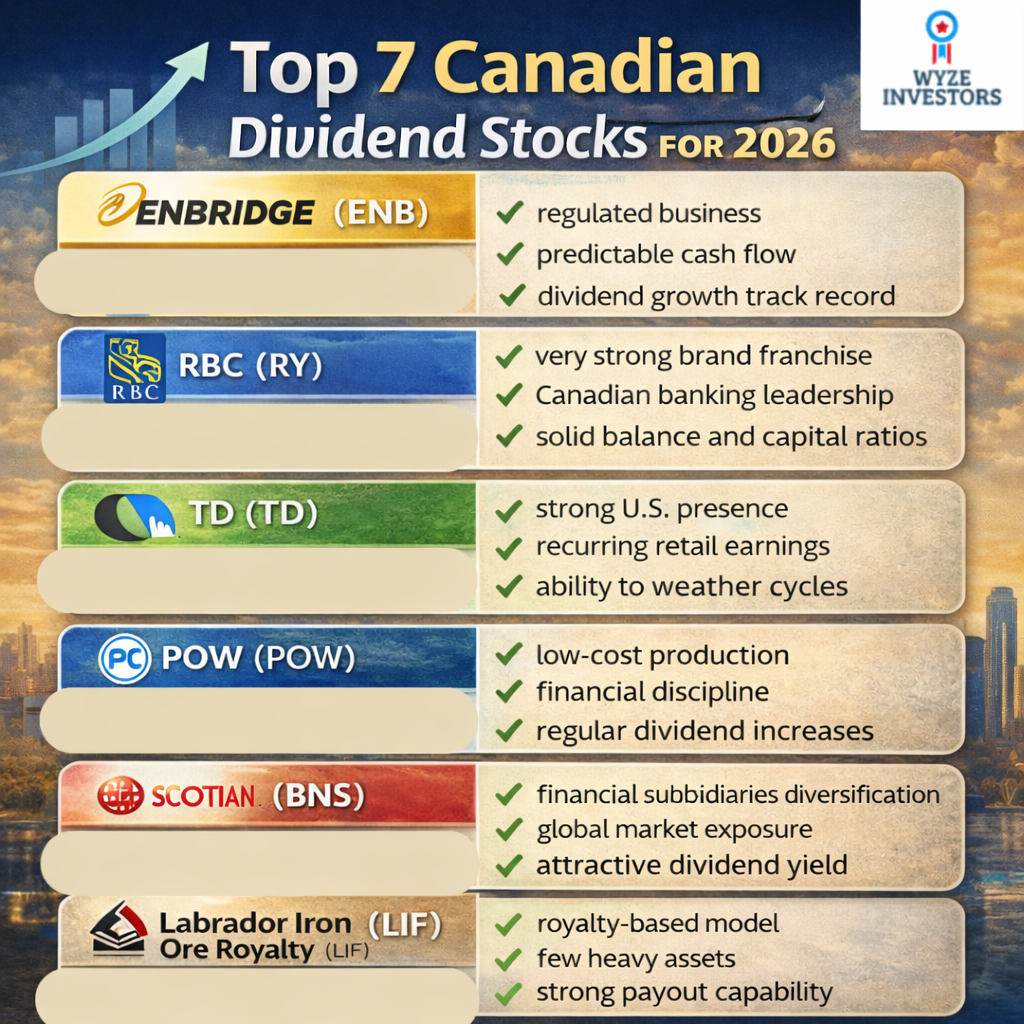
The 7 Best Canadian Dividend Stocks for 2026
1. Enbridge (ENB) — The Energy Infrastructure Pillar
Enbridge is one of Canada’s most popular companies among dividend investors. It operates an extensive network of:
pipelines
Gas infrastructure
Energy utilities
Why does it stand out?
✔ Dividend announced to increase towards 2026 ✔ More than 30 consecutive years of relatively ✔ predictable increase in cash flow distributed
The dividend is based on distributable cash flow (DCF), estimated between:
👉 $5.70 and $6.10 per share for 2026 (guidance)
Investment thesis
regulated activity
Structural energy demand
Long-term infrastructure projects
Enbridge operates in a largely regulated business, making its revenue streams more predictable than those of many energy companies. It benefits from a structural energy demand, linked to the transport of oil and gas necessary for the functioning of the North American economy. Its long-term infrastructure projects provide high visibility into future cash flows through often multi-year contracts. For these reasons, Enbridge is particularly appealing to investors who are looking for stability, resilience and a gradual increase in dividend over time, rather than rapid but uncertain growth.
2. Royal Bank of Canada (RY) — The Canadian Banking Reference
RBC is the country’s largest bank by market capitalization.
It benefits from:
of a dominant national network
an international presence
an image of solidity
Why is RY a “quality” stock?
✔ Uninterrupted dividends for more than 150 years ✔ High profitability ✔ Income diversification (retail banking, insurance, capital markets)
Its yield is not the highest in the industry, but:
👉 It is among the most reliable
Investment thesis
• Strong brand franchise
• Essential positioning
• Balance sheet strength
Royal Bank of Canada has an extremely strong brand franchise, built on more than a century of history and a dominant presence in the country. Its key positioning in personal, commercial and wealth management banking provides it with diversified and resilient revenue streams. The bank also stands out for the strength of its balance sheet, with high capital ratios and prudent risk management. RY is particularly suitable for long-term investors who are looking for security, consistency and regularity of the dividend, rather than speculative bets on more volatile securities.
3. Toronto-Dominion Bank (TD) — North American Growth
TD combine :
Strong Canadian platform
huge presence in the United States
It is one of the banks most exposed to the US market.
Key Points
✔ Yield around 4% ✔ Valuation has become attractive again after recent ✔ challenges Business model focused on retail banking
Investment thesis
future growth related to the United States
Recurring retail profits
Ability to Navigate Economic Cycles
The Toronto-Dominion Bank has significant growth leverage with its strong presence in the U.S., where it continues to expand its retail business. Its recurring profits from retail banking provide a stable revenue base that is less dependent on short-term capital markets. TD has repeatedly demonstrated its ability to navigate economic cycles, maintaining prudent risk management and disciplined capital policy. This stock is particularly suitable for investors looking for both a regular dividend and the potential for a medium-term recovery when economic conditions improve.
Build a reliable monthly income from your portfolio
I’ve created ready-to-use ETF portfolios and a passive income calculator designed specifically for Canadian investors.
4. Canadian Natural Resources (CNQ) — La machine à cash-flow
CNQ is one of the most profitable energy companies in the country.
Why does CNQ attract?
✔ Yield around 5% ✔ 23 consecutive years of dividend ✔ increase Low operating costs
CNQ is recognized for its financial discipline:
Deleveraging
Share buybacks
distributions progressives
Investment thesis
High correlation to the price of oil
Low-cost production
Shareholder-oriented management
Canadian Natural Resources (CNQ) remains highly correlated with the price of oil, which can lead to sharp swings in the stock in the short term. However, the company stands out for its very low-cost production, which allows it to remain profitable even when energy prices fall. Its management adopts a clear management approach to shareholders, combining debt reduction, share buybacks and regular dividend increases. This makes CNQ a flagship stock for investors who accept volatility in exchange for growing dividends and long-term value creation potential.
5. Power Corporation of Canada (POW) — The Heritage Conglomerate
Power Corp owns:
Great-West Lifeco
IGM Financial
Wealthsimple (partial)
Why is POW interesting?
✔ Returns often higher than banks ✔ Global exposure to asset ✔ management Diversified holding structure
Investment thesis
Profits linked to the global financial markets
Growth through acquisitions and subsidiaries
Profits redistributed via dividends
Power Corporation (POW) derives a large portion of its profits from global capital markets through its significant holdings in wealth management and insurance. Its model is based on growth through acquisitions and the development of its subsidiaries, which allows it to diversify its revenue sources and smooth out economic cycles. A significant portion of profits is returned to shareholders in the form of dividends, supported by strong cash flows. POW is therefore particularly attractive to investors who are looking for high returns, geographic and sector diversification, and a long-term stability approach.
6. Bank of Nova Scotia (BNS) — Highest Yield of the Big Banks
Historically, BNS has offered the most generous bank dividend among Canada’s major banks.
Why does SNB attract despite the challenges?
✔ high ✔ performance international presence (especially Latin America) ✔ strategic recovery plan underway
Points of vigilance
Exposure to emerging markets
Restructuring still in place
The Bank of Nova Scotia (NBS) is unique in its strong exposure to emerging markets, particularly in Latin America, which provides it with superior long-term growth opportunities, but with more volatility. The bank is also engaged in a strategic restructuring that is still being rolled out, aimed at improving its profitability, strengthening its risk management and refocusing its activities on its most profitable markets. On the other hand, this adjustment phase can create short-term stock market fluctuations. SNB is therefore mainly aimed at investors who accept a little more risk in exchange for a generally above-average dividend yield.
7. Labrador Iron Ore Royalty (LIF) — Les redevances minières
Unlike traditional mining producers, LIF generates revenue through a royalty model.
It benefits from iron ore sales without directly assuming the costs of operating a mine.
What makes LIF unique?
✔ High ✔ margins, commodity-price-sensitive dividend, ✔ low operating debt
Investment thesis
correlated with iron ore price
Few heavy assets to manage
Good redistributive capacity
Labrador Iron Ore Royalty (LIF) is highly correlated with the price of iron ore, which means that its revenue and distributions can fluctuate with commodity cycles. Its business model is unique: the company holds royalties and therefore few heavy assets to manage, which limits operating costs and operational risks. Thanks to this lean structure, LIF often has a good redistribution capacity in the form of variable dividends. This stock may be attractive to investors looking to add sector diversification related to natural resources, while benefiting from attractive income potential.
Comparison
Stock
Yield
Strength
Risk Level
ENB
~7%
Stable cash flow
Medium
RY
~4%
Strong balance sheet
Low
TD
~4%
US growth
Medium
CNQ
~5%
Cash machine
Cycle risk
POW
~5%
Diversified
Medium
BNS
~6%
High yield
Higher risk
LIF
Variable
Royalty model
High
Conclusion — Dividends yes… but with quality
For 2026, the most reasonable strategy is to focus on strength rather than the search for maximum return at all costs. The aim is to select companies that can maintain and increase their dividends over time, even in times of economic volatility. This means focusing on companies with strong balance sheets, stable cash flows and controlled debt. Conversely, it is prudent to avoid “high-yield traps” – securities that offer very attractive rates but are based on fragile or over-leveraged models.
The seven companies selected—Enbridge, RBC, TD, Canadian Natural Resources, Power Corporation, The Bank of Nova Scotia and Labrador Iron Ore Royalty—embody this central idea: financial quality remains a long-term investor’s best ally. They combine a strong competitive position, the ability to generate cash flow and discipline in the distribution of dividends. This approach does not promise quick wealth, but it does prioritize income sustainability and incremental capital growth. In 2026 and beyond, building wealth is above all about patience, diversification and the rigorous selection of solid companies.
Educational clause
This article is intended to be informative and educational. It does not constitute a recommendation to buy or sell. Each investor should evaluate:
their risk tolerance
its investment horizon
their personal situation
and consult a professional if necessary.
High-income ETFs have become extremely popular with investors looking for monthly cash flow, especially in an environment where market volatility remains elevated and traditional bonds no longer feel “safe enough.”
Among all income ETFs, JEPI and QYLD are two of the most discussed — and most misunderstood.
Both use covered call strategies to generate income. Both offer attractive yields. But their risk profiles, return drivers, and long-term outcomes are very different.
This article breaks down JEPI vs QYLD in plain English, without hype, and explains which ETF fits which type of investor.
Video
What Is a Covered Call Strategy?
Before comparing JEPI and QYLD, it’s critical to understand how covered calls actually work.
A covered call strategy involves owning a portfolio of stocks and selling call options on those holdings. The investor collects option premiums as income in exchange for agreeing to sell the stocks at a predetermined price, which partially caps the portfolio’s upside in strong market rallies.
Why Investors Use Covered Calls
Covered call strategies are most effective in flat, choppy, or slowly rising markets, where stock prices move within a relatively narrow range. In these conditions, option premiums provide a steady source of income, and the risk of missing large upside moves is limited. Investors are essentially being paid for giving up a portion of future gains that may never materialize if markets remain range-bound.
However, covered calls tend to underperform during strong bull markets and explosive rallies. When stocks surge sharply higher, the upside is capped by the call options that were sold, meaning the investor sacrifices capital appreciation in exchange for earlier income. This opportunity cost becomes more visible during sustained market advances, particularly in high-growth segments like technology.
This fundamental trade-off — income today versus growth tomorrow — sits at the core of the JEPI versus QYLD debate. JEPI prioritizes smoother income with some flexibility, while QYLD maximizes current cash flow at the expense of long-term growth potential.
JEPI vs QYLD at a Glance
Feature
JEPI
QYLD
Index Exposure
S&P 500 (low volatility stocks)
Nasdaq 100
Strategy
Active + ELNs
Systematic ATM calls
Yield Range
~7–9%
~12–14%
Volatility
Lower
Higher
Growth Potential
Moderate
Limited
Expense Ratio
~0.35%
~0.60%
Management Style
Active
Passive
At first glance, QYLD looks “better” because of its higher yield. But yield alone does not tell the full story.
Underlying Index: Stability vs Volatility
JEPI: Defensive S&P 500 Exposure
JEPI focuses on low-volatility stocks within the S&P 500, emphasizing sectors such as consumer staples, healthcare, financials, and other defensive large-cap companies. These businesses tend to have stable cash flows, resilient demand, and lower sensitivity to economic slowdowns, which makes them well suited for an income-oriented strategy.
By prioritizing stability over aggressive growth, JEPI aims to reduce drawdowns during periods of market stress. When broader equity markets experience sharp declines, defensive stocks generally fall less, helping preserve capital. This positioning also supports a more consistent income profile, as option premiums and dividends are generated from less volatile underlying assets.
The result is lower overall volatility, smoother and more predictable income, and less capital erosion over time compared to higher-beta strategies. For investors seeking dependable monthly cash flow with reduced downside risk, JEPI’s defensive stock selection plays a critical role in its long-term risk-adjusted performance
QYLD: Nasdaq 100 Exposure
QYLD is tied to the Nasdaq 100, an index that is heavily weighted toward technology and growth-oriented companies. While these stocks offer strong long-term growth potential, they also come with significantly higher volatility and greater sensitivity to changes in interest rates, earnings expectations, and market sentiment.
This elevated volatility allows QYLD to generate larger option premiums, which supports its high headline yield. However, the trade-off is meaningful. During market downturns, Nasdaq-focused portfolios tend to experience deeper drawdowns, and covered call income is often insufficient to fully offset those losses. Over time, consistently capping upside in a volatile growth index can result in long-term capital decay.
This structural difference — defensive low-volatility exposure versus high-beta growth exposure — explains much of the persistent performance gap between JEPI and QYLD across full market cycles.
Strategy Mechanics: Active vs Mechanical
JEPI’s ELN-Based Approach
JEPI does not rely on a simple, mechanical covered call overlay on its stock holdings. Instead, it holds a diversified portfolio of large-cap U.S. equities and generates income primarily through Equity-Linked Notes (ELNs). These instruments are structured to provide option-like income while giving the portfolio manager greater flexibility in how and when upside is capped.
Because JEPI’s strategy is actively managed, exposure can be adjusted based on prevailing market conditions. In stronger or trending markets, the fund can reduce the degree of upside capping, allowing investors to participate more in equity appreciation. In contrast, during volatile or uncertain periods, income generation can be emphasized to enhance cash flow and stability.
This dynamic approach helps preserve capital more effectively, smooth returns across market cycles, and adapt income levels as volatility rises or falls. As a result, JEPI offers a more balanced income strategy than traditional systematic covered call ETFs.
QYLD’s Systematic ATM Calls
QYLD follows a strict, mechanical covered call strategy with no active decision-making. Each month, the fund sells at-the-money call options on the Nasdaq 100, regardless of market conditions, volatility levels, or broader economic trends. There is no discretion involved and no attempt to adjust strike selection or exposure when markets are trending strongly or experiencing regime changes.
This rigid structure produces high and relatively predictable monthly income, which is the primary appeal of QYLD. Option premiums from a volatile, tech-heavy index support an elevated yield that many income-focused investors find attractive. However, this benefit comes with clear trade-offs.
Because calls are sold at the money every month, upside is consistently capped, even during sustained bull markets. When the Nasdaq rallies, those gains are effectively exchanged for short-term income. Over time, this creates structural long-term underperformance in rising markets, particularly when growth stocks lead broader equity returns.
QYLD’s design prioritizes cash flow certainty over adaptability. It is built for investors who value immediate income and predictability, not for those seeking capital appreciation or long-term wealth growth.
Yield Comparison: Why Higher Is Not Always Better
JEPI Yield: 7–9%
JEPI’s yield is:
Lower than QYLD
More stable
Less destructive to capital
Its distributions fluctuate, but over time remain relatively consistent.
QYLD Yield: 12–14%
QYLD’s yield is:
Eye-catching
Very high
Partially a return of capital in many periods
A key issue with QYLD is that:
Income stays high
Net asset value (NAV) trends downward over long horizons
This creates the illusion of sustainability while slowly eroding principal.
Capital Growth and Total Return
JEPI: Income with Partial Growth
JEPI is structured to deliver consistent income while still preserving a degree of long-term growth. Unlike fully systematic covered call strategies, JEPI allows for some upside participation, particularly during moderately rising markets. Because the fund holds high-quality, dividend-paying companies, investors also benefit from dividend growth generated by the underlying equity portfolio. Over time, this combination of option income and equity returns contributes to a stronger long-term total return profile compared to more aggressive income products.
Across full market cycles, JEPI has historically demonstrated greater resilience. It tends to lose less during bear markets, supported by its defensive stock selection and flexible option strategy. When markets recover, JEPI often rebounds faster, as less upside is permanently forfeited. This balance between income generation and capital preservation helps investors maintain purchasing power more effectively, particularly in inflationary environments where pure income strategies may fall behind.
QYLD: Income at the Expense of Growth
QYLD takes a fundamentally different approach. Its strategy sacrifices growth almost entirely in exchange for maximum current income. By selling at-the-money calls on the Nasdaq 100 every month, upside is capped continuously, regardless of market strength. As a result, major technology rallies rarely translate into meaningful net asset value (NAV) growth.
Over long periods, this structure can be detrimental. While distributions remain high, capital erosion and inflation gradually reduce real returns. QYLD is therefore not designed for wealth accumulation or long-term purchasing power preservation. It functions strictly as a cash distribution vehicle, best suited for investors who prioritize immediate income and fully understand the long-term trade-offs.
Volatility and Risk Profile
JEPI: Lower Volatility
JEPI is designed with risk control as a central objective. It benefits from defensive stock selection, focusing on lower-volatility companies within the S&P 500 that tend to be more resilient during economic slowdowns. This is complemented by active option management, which allows the fund to adjust income generation and exposure based on market conditions rather than following a rigid rule set. Combined with its lower beta profile, JEPI typically experiences smaller price swings than the broader equity market.
This risk-aware construction makes JEPI particularly suitable for retirees, conservative income investors, and portfolios that prioritize capital stability alongside monthly income. The goal is not to eliminate volatility entirely, but to reduce it enough that income remains dependable through different market environments.
QYLD: Higher Volatility
Despite being marketed as an income ETF, QYLD can be surprisingly volatile. Its exclusive exposure to the Nasdaq 100 means drawdowns can be severe, especially during technology-led market corrections. Covered call income offers limited protection in these scenarios, as selling calls does not shield investors from sharp downside moves. In deep declines, option premiums are often insufficient to offset capital losses.
As a result, QYLD behaves less like a defensive income fund and more like a yield-enhanced technology product, with higher risk and greater sensitivity to market cycles.
Expense Ratios and Cost Efficiency
JEPI: ~0.35%
QYLD: ~0.60%
JEPI is:
Actively managed
Cheaper
More efficient
QYLD charges a higher fee for a fully mechanical strategy — something investors should factor into long-term returns.
Tax Considerations (High-Level)
Distributions from both ETFs are:
Mostly non-qualified
Often classified as ordinary income or return of capital
This makes them:
Less tax-efficient in taxable accounts
Better suited for tax-advantaged accounts (RRSP, IRA)
Tax treatment varies year to year, so investors should review official distribution breakdowns.
When JEPI Makes Sense
Choose JEPI if you:
Want consistent monthly income
Prefer lower volatility
Care about long-term capital preservation
Are building a core income position
JEPI works well as:
A retirement income foundation
A stabilizer in a broader portfolio
A defensive income ETF during uncertain markets
When QYLD Makes Sense
Choose QYLD if you:
Need maximum current cash flow
Are comfortable with NAV erosion
Understand the trade-offs
Use it as a satellite position, not a core holding
QYLD can be useful for:
Short-term income needs
Cash-flow-focused strategies
Investors who reinvest distributions elsewhere
The Best Strategy: Blend, Don’t Bet
For many investors, the optimal approach is not JEPI or QYLD, but a blend:
JEPI for stability and durability
A higher-yield ETF (like QYLD or alternatives) for incremental income
This balances:
Income
Risk
Capital preservation
The mistake is going all-in on maximum yield without understanding the long-term cost.
Final Verdict: JEPI vs QYLD
JEPI is the better choice for:
Sustainable income
Risk-adjusted returns
Long-term portfolios
QYLD is suitable for:
Aggressive income seekers
Tactical allocations
Investors who fully understand capital decay
For income-focused investors in Canada and the United States, covered call ETFs have gained massive popularity as a source of predictable monthly income. With assets under management reaching tens of billions of dollars, these strategies appeal to investors seeking cash flow and smoother returns in uncertain markets.
However, high income always comes with trade-offs. So how do covered call ETFs really work, and when do they make sense in a portfolio?
Executive Summary
Why Covered Call ETFs Are So Popular
High Income Potential
One of the main reasons covered call ETFs have become so popular is their ability to generate significantly higher income than traditional dividend ETFs. These funds boost cash flow by selling call options on their underlying holdings. The option premiums collected are distributed to investors, often resulting in yields well above standard equity income strategies.
While traditional dividend ETFs typically yield between 2% and 4%, covered call ETFs frequently offer 7% to 12% or more, depending on market conditions and how aggressively calls are written. This makes them especially attractive for investors who prioritize income over capital appreciation, such as retirees or those seeking predictable cash flow.
Lower Volatility Than Holding Stocks Directly
By selling upside potential in exchange for income, covered call ETFs tend to deliver a smoother return profile. The option premiums act as a partial buffer during sideways or mildly negative markets, helping reduce overall volatility compared to owning the underlying stocks outright.
This characteristic makes covered call ETFs appealing to investors who want equity exposure but prefer less dramatic market swings.
Predictable Monthly Cash Flow
Most U.S. covered call ETFs pay monthly distributions, which is a key advantage for income-focused investors. Regular payments simplify budgeting and portfolio planning, making these ETFs popular among retirees and those relying on investment income.
⚠️ Important Trade-Off The downside of this strategy is limited upside participation. In strong bull markets, covered call ETFs usually underperform their underlying indexes because gains above the option strike price are capped. As a result, they are best viewed as income tools, not long-term growth engines.
*Yields are indicative and can fluctuate significantly.
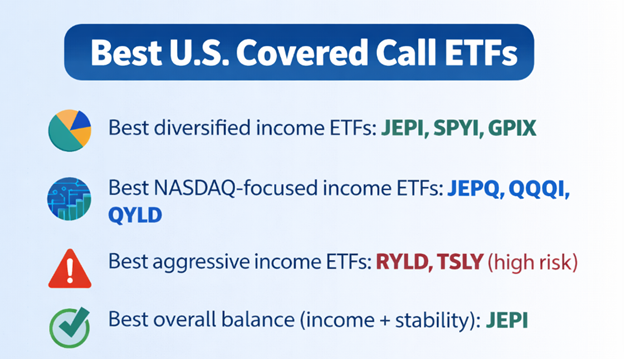
Best Diversified U.S. Covered Call ETFs
JEPI – The Gold Standard for Income Stability
JEPI is widely regarded as one of the most balanced U.S. covered call ETFs available. Rather than selling call options directly on the index, it uses a combination of equity-linked notes (ELNs) and active management to generate income while aiming to preserve capital. This structure allows JEPI to deliver consistent monthly income with lower volatility than traditional equity exposure.
While upside participation is more limited than a pure equity ETF, JEPI provides strong downside protection and a smoother return profile, making it well suited for income-focused investors.
Best for: Investors seeking stable income with lower risk.
SPYI – Higher Yield, More Aggressive
SPYI applies a more systematic covered call strategy on the S&P 500, writing options more aggressively than funds like JEPI. This approach typically results in higher income, especially during periods of elevated market volatility. The trade-off, however, is greater price fluctuation and less downside protection during market drawdowns. While SPYI can deliver attractive monthly distributions, its returns tend to be more sensitive to market movements than more conservatively managed income ETFs. As a result, SPYI is better suited as a satellite holding rather than a core income position.
Best for: Income investors willing to accept higher volatility in exchange for higher yield.
GPIX – Low Fees, Conservative Approach
GPIX stands out primarily for its very low expense ratio (0.29%), making it one of the most cost-efficient covered call ETFs in the U.S. market. Its premium-income strategy is more conservative, prioritizing capital preservation and steady income rather than maximizing yield. As a result, GPIX typically offers lower distributions than more aggressive peers, but with a smoother risk profile and improved long-term efficiency. This makes it an appealing option for investors who value cost control and stability over headline yield.
Best for:Cost-conscious investors prioritizing efficiency, discipline, and long-term sustainability over maximum income.
Best NASDAQ-Focused Covered Call ETFs
JEPQ – Tech Income, Done Right
JEPQ applies the same philosophy as JEPI but focuses on the NASDAQ-100, making it one of the most balanced ways to generate income from technology-heavy equities. Instead of writing calls directly on the index, JEPQ uses equity-linked notes (ELNs) and active management to generate option income while aiming to preserve capital. This structure allows the fund to deliver attractive monthly distributions without fully sacrificing downside protection.
Compared to more aggressive NASDAQ covered call ETFs, JEPQ tends to experience lower volatility and better capital stability, particularly during market drawdowns. While upside participation is capped, it is not eliminated entirely, making JEPQ more suitable for long-term income investors than pure buy-write strategies.
Best for: Investors seeking technology exposure with disciplined income generation and a more defensive risk profile.
QQQI – Higher Income, Higher Risk
QQQI is designed to maximize income from the NASDAQ-100 by writing call options more aggressively than funds like JEPQ. This results in higher yields, especially in volatile or range-bound markets, but also introduces greater sensitivity to market swings. The more assertive call-writing approach limits upside participation more quickly and provides less downside cushioning during sharp corrections.
As a result, QQQI can deliver impressive monthly income, but long-term capital preservation is less consistent than with more conservatively managed strategies. Investors should view QQQI as an income-focused satellite holding, rather than a core portfolio position.
Best for: Investors prioritizing maximum income from technology stocks, who are comfortable with higher volatility and capped growth.
QYLD – The Original, But Aging
QYLD is one of the earliest and most widely recognized covered call ETFs, built around a systematic at-the-money (ATM) call-writing strategy on the NASDAQ-100. While this approach produces consistently high income, it has historically resulted in weak long-term capital preservation, as gains are frequently capped and losses are not fully offset.
Over time, this structure has led to limited total return growth compared to newer, more flexible strategies. QYLD remains effective in flat or mildly bearish markets, but it tends to lag significantly during strong bull markets.
Best for:Short-term income seekers focused primarily on cash flow. Not ideal for: Investors targeting long-term total return or capital growth.
Sector & Aggressive Income ETFs
RYLD – Small Caps, Big Yield
RYLD applies a covered call strategy to the Russell 2000, an index composed of U.S. small-cap stocks. Because small caps tend to be more volatile than large caps, option premiums are generally higher, allowing RYLD to generate attractive monthly income compared to large-cap covered call ETFs. This makes RYLD an effective tool for boosting portfolio yield.
However, the higher income comes with greater volatility and weaker capital stability. Small caps are more sensitive to economic cycles, rising interest rates, and market stress, which can lead to larger drawdowns. While the covered call overlay helps monetize volatility, it does not eliminate downside risk.
RYLD works best in range-bound or choppy markets, but it often underperforms during strong small-cap bull markets due to capped upside.
Best for: Investors looking to diversify income sources beyond large caps, with an understanding of the higher risk profile.
TSLY – Extreme Income, Extreme Risk
TSLY is fundamentally different from traditional covered call ETFs. Instead of holding a diversified portfolio, it sells options on a single stock—Tesla. This concentrated approach can produce extremely high yields, especially during periods of elevated volatility, which is common for Tesla shares.
However, this income comes with very high capital risk. Because the strategy depends on one underlying stock, investors are exposed to sharp price swings, long drawdowns, and significant erosion of capital. While monthly distributions can appear impressive, total return can be highly unstable and unpredictable.
TSLY should not be viewed as a long-term income foundation. It is a tactical, speculative instrument, not a diversified ETF.
⚠️ This is not a core income ETF. Best for: Experienced investors who understand the risks and are seeking short-term, high-risk income exposure only.
Final Takeaways
overed call ETFs are best understood as income tools, not long-term growth vehicles. Their primary objective is to convert market volatility into regular cash flow, not to maximize capital appreciation. Investors who approach these ETFs with a growth mindset often end up disappointed, especially during strong bull markets where upside participation is capped.
One of the most important principles to remember is that higher yield usually comes with a higher opportunity cost. ETFs offering double-digit yields often achieve this by writing calls more aggressively or concentrating exposure, which limits upside and can weaken long-term total returns. Yield alone should never be the sole selection criterion.
Among the broad universe of U.S. covered call ETFs, JEPI and JEPQ remain the strongest core holdings. They strike a better balance between income generation, capital preservation, and volatility management, making them suitable as long-term income foundations for many investors.
More aggressive ETFs such as QYLD, RYLD, and TSLY should be treated as satellite positions only. While they can enhance portfolio income in the short term, their higher risk profiles and weaker capital preservation make them unsuitable as core income holdings.
📌 Best strategy: For balanced monthly income, consider blending one diversified covered call ETF (such as JEPI or SPYI) with one technology-focused income ETF (such as JEPQ or QQQI). This approach helps diversify income sources, smooth volatility, and avoid over-reliance on a single strategy.
When used intentionally and in moderation, covered call ETFs can play a valuable role in an income-focused portfolio.
Bottom Line
U.S. covered call ETFs can play a powerful role in an income-focused portfolio, but only when used with clear expectations. They are designed to monetize volatility, not to outperform in bull markets.
Used correctly, they provide:
Reliable cash flow
Lower volatility
Predictable monthly income
Used incorrectly, they can erode long-term returns.
For Canadian investors focused on maximizing income, covered call ETFs have become some of the most popular investment choices. Many of these funds now manage billions of dollars in assets, showing just how much demand there is for predictable cash flow.
But what makes them so attractive for income seekers?
1. High Dividend Yields
Covered call ETFs generate extra income by selling call options on their holdings. The premiums collected can significantly boost distributions, often resulting in yields much higher than traditional dividend ETFs.
2. Smoother Ride (Lower Volatility)
The covered call strategy is designed to provide more stability. By selling upside potential in exchange for income, these ETFs tend to be less volatile than holding the underlying stocks directly.
3. Reliable Passive Income
If your main objective is to earn high monthly or quarterly distributions, covered call ETFs can be an appealing choice. They’re especially popular among retirees and income-focused investors who prioritize cash flow over long-term growth.
⚠️ Important Trade-off: The high yields come at a cost—limited capital appreciation. Because the upside is capped when call options are exercised, these ETFs usually underperform in strong bull markets.
What We’ll Cover in This Post
In this article, we’ll go beyond theory and look at the most popular covered call ETFs in Canada. We’ll break them down into two categories:
Diversified Income ETFs – funds that provide broad exposure across sectors while still generating high income.
Sector-Specific Covered Call ETFs – funds that focus on one sector (like banks, energy, or tech) and use covered calls to maximize income from those industries.
Finally, we’ll highlight our top picks in each category, so you can see which covered call ETFs may fit best into your portfolio.
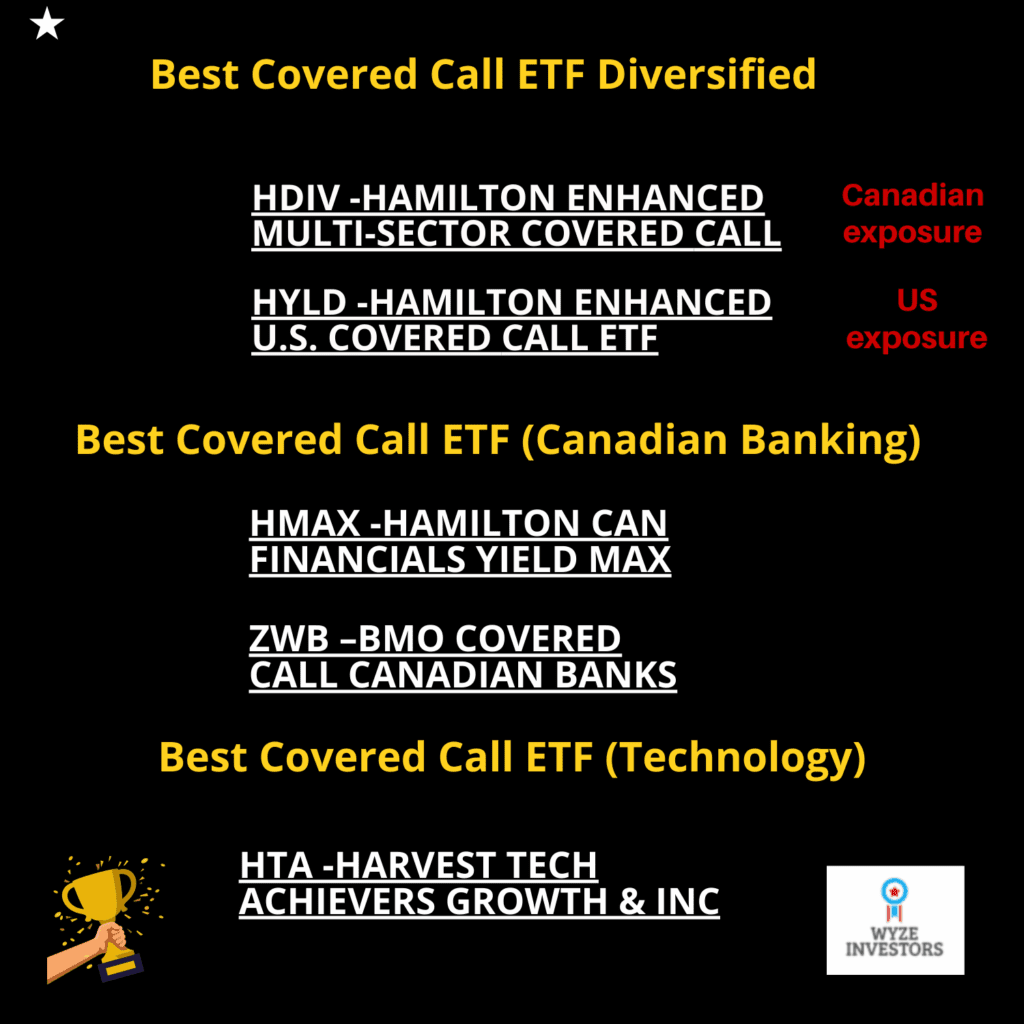
Among the diversified funds, HDIV (Hamilton Enhanced Multi-Sector Covered Call) really stands out. It invests in seven different sector ETFs and adds modest leverage (25%) to enhance both yield and performance. With a 10.02% yield and the best 3-year total return in the group (28.86%), HDIV remains the strongest all-around option for investors who want high monthly income without betting on a single sector.
For those seeking U.S. exposure, HYLD (Hamilton Enhanced U.S. Covered Call) deserves attention. It focuses entirely on U.S. covered call ETFs and, like HDIV, uses 25% leverage. The result is a very attractive 11.78% yield and a strong 3-year total return of 19.45% (with 20.78% over 5 years). This makes HYLD a convenient way for Canadians to tap into U.S. income opportunities without having to piece together multiple funds.
HYLD (Hamilton Enhanced U.S. Covered Call)
HDIF (Harvest Diversified Monthly Income) plays a similar role but without leverage. It’s built as a “fund-of-funds,” spreading investments across banks, utilities, technology, healthcare, and global brands. Its yield remains close to double-digits at 9.97%, and it posted a 3-year total return of 7.94% (5-year data not available). For more conservative income seekers, HDIF can offer peace of mind thanks to a diversified structure and monthly distributions.
ZWC (BMO Canadian High Dividend Covered Call)
If you prefer a purely Canadian option, ZWC (BMO Canadian High Dividend Covered Call) remains a reliable choice. With a 5.93% yield and steady total returns (17.49% over 1 year and 12.27% over 5 years), it offers broad Canadian exposure with a covered call overlay designed to smooth volatility. It won’t match the yield of HDIV or HYLD, but it can be a more conservative, Canadian-focused core income holding.
Finally, HBF (Harvest Brand Leaders Plus Income) offers something different: exposure to global “top brands” combined with a covered call strategy. With a 7.22% yield and a solid 3-year total return of 14.08% (and 9.49% over 5 years), it’s attractive for investors who want blue-chip global exposure while still receiving monthly income.
Verdict – Diversified ETFs (Updated):
Best overall:HDIV, thanks to top-tier diversification and the strongest 3-year performance (28.86%) alongside a 10.02% yield.
Best U.S. play:HYLD, for high monthly income (11.78% yield) plus strong multi-year returns (19.45% / 3Y; 20.78% / 5Y).
Best conservative Canadian core:ZWC, lower yield but steady long-term profile (12.27% / 5Y) and Canadian exposure.
Best Sector-Focused Covered Call ETFs
For investors who want to concentrate on specific industries, banks and technology continue to dominate the sector ETF space.
ZWB (BMO Covered Call Canadian Banks) remains the benchmark. It’s the most established bank covered call ETF built on Canada’s Big Six. With a 5.56% yield and an excellent 3-year total return of 15.66% (and 14.43% over 5 years), ZWB continues to be a strong core option for investors who want Canadian bank exposure with smoother volatility and consistent income.
For those prioritizing maximum cash flow, HMAX (Hamilton Enhanced Canadian Bank ETF) remains hard to beat. Its 12.56% yield is among the highest in the category, supported by aggressive call-writing and leverage. Performance data shows a strong 1-year total return of 21.99% (longer-term data not available). The trade-off remains the same: higher yield usually comes with higher strategy risk and less long-term upside capture.
On the technology side, HTA (Harvest Tech Achievers) remains one of the best “growth + income” covered call ETFs. Even with call-writing capping part of the upside, it has delivered an impressive 5-year total return of 16.02%, while still yielding 8.91%. For investors who want exposure to tech leaders but prefer more stability and monthly income, HTA continues to stand out.
Lastly, ZWK (BMO Covered Call U.S. Banks) provides targeted U.S. financial exposure. With a 6.71% yield, total returns are more modest (6.19% over 1 year, 7.52% over 3 years, 10.04% over 5 years). It can still be useful as a complement for investors who want U.S. bank diversification, but it has lagged Canadian bank options over the last few years.
Verdict – Sector ETFs (Updated):
Best Canadian bank play:ZWB for stability and long-term track record (14.43% / 5Y).
Best high-yield bank play:HMAX for maximum monthly income (12.56% yield) with strong recent performance (21.99% / 1Y).
Best technology play:HTA for a strong blend of income (8.91% yield) and long-term performance (16.02% / 5Y).
📘 Get your free guide to start investing
Includes 4 passive growth portfolios
Final Takeaways
If you want maximum yield, look at HMAX, HYLD, and HDIV, but be aware they rely on leverage and/or more aggressive call-writing.
If you want stability and Canadian exposure, ZWC and ZWB remain solid choices with more moderate yields.
If you want long-term growth with income, HTA and HDIV stand out based on the updated multi-year performance data.
📌 A practical approach for Canadian income investors is to blend diversified funds (HDIV, HYLD, ZWC) with sector-focused ETFs (ZWB, HMAX, HTA) to combine monthly cash flow, diversification, and exposure to sectors that tend to drive returns.
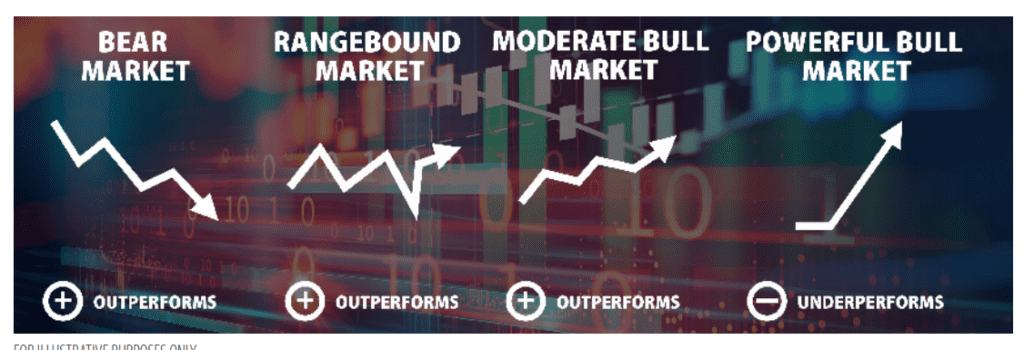
How had Covered call ETF’s performed historically?
In historical contexts characterized by bear markets, range-bound markets, and moderate bull markets, a covered call strategy has typically demonstrated the ability to outperform its underlying securities. However, during robust bull markets, when the underlying securities experience frequent rises beyond their strike prices, covered call strategies have historically exhibited slower growth. Nevertheless, even in these bullish phases, investors typically realize moderate capital appreciation alongside the accrual of dividends and call premiums.
How writing a call option works?
Options make it possible to hedge a possible decline in a security and thus limit its loss through a gain on the option. To apply this hedging strategy, you have to take a short position on a call option, in other words sell a call.
The sale of calls achieves two objectives:
· Set the sale price of these securities (exercise price) and therefore set an acceptable loss.
· Collect a premium, i.e. additional income, or limit losses if the strike price is reached.
The option seller will be obligated to deliver the securities if exercised at the price fixed in advance. In this case the market will have evolved contrary to these expectations, it will have appreciated. The option investor will sell his securities for less than the market price.
Covered call options protect against downside risk. This being said, the covered call strategy provides limited downside protection. Also, when you write a covered call, you give up some of the stock’s potential gains. Covered call ETFs will tend to have a higher yield and a lower performance.
Popular Covered Call ETFs in Canada
ETF
Focus / Objective
Sectors / Geography
Investor Appeal
ZWB – BMO Covered Call Canadian Banks
Canadian banks + call premiums
100% Canadian Big 6 banks
Stable, income-focused play on Canadian banks
ZWC – BMO Canadian High Dividend CC
Broad Canadian high dividend portfolio
Financials & Energy = ~53%
Conservative, tax-efficient, steady monthly income
ZWP – BMO Europe High Dividend CC
European dividend payers + options
Switzerland, Germany, UK, France
Diversifies income outside North America
ZWH – BMO U.S. High Dividend CC
U.S. large-cap dividend names
Broad U.S. exposure, ~23% Tech
U.S. exposure with yield + lower volatility
ZWK – BMO Covered Call U.S. Banks
U.S. banking sector
100% U.S. banks (~38 names)
Higher yield (~6%), targeted U.S. financials
HTA – Harvest Tech Achievers
Global tech leaders + covered calls
Heavy in semis + software
Tech growth exposure with reduced volatility
HBF – Harvest Brand Leaders
20 global “top brands”
~20% Financials, 20% Tech, 15% Comm. Services
Blue-chip global exposure, monthly distributions
ZWB – BMO Covered Call Canadian Banks
The ZWB aims to provide exposure to a portfolio of dividend-paying securities (Canadian Banks), while collecting premiums related to call options. The portfolio is chosen on the basis of the criteria below:
• dividend growth rate; • yield; • payout ratio and liquidity.
ZWB holdings
Name
Weight
BMO Equal Weight Banks ETF
27.2%
Bank of Montreal
12.9%
Canadian Imperial Bank of Commerce
12.7%
Royal Bank of Canada
12.1%
National Bank of Canada
11.9%
The Toronto-Dominion Bank
11.9%
Bank of Nova Scotia
11.4%
Please visit issuers’ website for up-to-date figures – Best Covered Call ETF Canada
ZWC –BMO CDN High Div Covered Call
The BMO Canadian High Dividend Covered Call ETF (ZWC) has been designed to provide exposure to a dividend focused portfolio, while earning call option premiums. The underlying portfolio is yield-weighted and broadly diversified across sectors.
The fund selection methodology uses 4 factors: – Liquidity; – Dividend growth rate; – Yield and payout ratio.
ZWC is an excellent option for conservative investors looking for a steady income and low volatility. It’s tax-efficient because the dividends are all coming from Canadian companies. The financial sector and Energy represents 53% of the total overall sector allocation.
ZWC ETF Holdings
Company Name
Allocation
Canadian National Railway Co
5.4%
BCE Inc
5.2%
TELUS Corp
5.1%
Enbridge Inc
5.0%
Royal Bank of Canada
5.0%
Canadian Imperial Bank of Commerce
4.9%
Bank of Nova Scotia
4.7%
The Toronto-Dominion Bank
4.6%
Manulife Financial Corp
4.3%
Please visit issuers’ website for up-to-date figures – Best Covered Call ETF Canada
ZWP – BMO Europe High Dividend Covered Call ETF
The BMO Europe High Dividend Covered Call ETF (ZWP) has been designed to provide exposure to a dividend focused portfolio. These dividend paying companies are selected based on:
dividend growth rate,
yield,
payout ratio and liquidity.
ZWP Dividend ETF Holdings
Company Name
Allocation
Roche Holding AG
4.0%
Nestle SA
4.0%
Novartis AG
4.0%
GlaxoSmithKline PLC
4.0%
Sanofi SA
3.8%
TotalEnergies SE
3.7%
Unilever PLC
3.7%
Enel SpA
3.7%
Please visit issuers’ website for up-to-date figures – Best Covered Call ETF Canada
Geographic allocation
Countries
Weight
Switzerland
23.66%
Germany
24.24%
United Kingdom
18.76%
France
16.72%
Other (multiple countries)
16.62%
Please visit issuers’ website for up-to-date figures
Sector allocation
Type
Fund
Information Technology
6.22
Industrials
12.18
Consumer Discretionary
11.56
Consumer Staples
11.78
Health Care
16.56
Financials
14.79
Materials
9.48
Communication
8.10
Energy
3.89
Utilities
3.66
Please visit issuers’ website for up-to-date figures – Best Covered Call ETF Canada
ZWH – BMO US High Dividend Covered Call ETF
ZWH has been designed to provide exposure to a dividend focused portfolio, while earning call option premiums. The underlying portfolio is yield-weighted and broadly diversified across sectors. The Fund utilizes a rules-based methodology that considers the following criteria:
dividend growth rate,
yield,
payout ratio,
liquidity.
ZWH Dividend ETF Holding
Company Name
Allocation
Apple Inc
4.2%
Microsoft Corp
4.2%
Coca-Cola Co
4.1%
AbbVie Inc
4.1%
The Home Depot Inc
4.1%
Procter & Gamble Co
4.1%
Pfizer Inc
4.0%
Please visit issuers’ website for up-to-date figures
Geographic allocation
Country
Fund
USA
100.0%
Please visit issuers’ website for up-to-date figures
Please consult issuers’ website for up-to-date figures
ZWK -BMO Covered Call US Banks
The BMO Covered Call U.S. Banks ETF (ZWK) is professionally managed by BMO Global Asset Management. The fund has been designed to provide exposure to a portfolio of U.S. banks while earning call option premiums.
The fund invests in 38 US Banks. It’s ideal for investors looking for dividend income. The dividend yield on November 24th was 6.19%!
The fact that the fund uses call options accomplishes two things:
increases the dividend yield;
reduces volatility but also growth potential. So, it’s something to keep in mind.
HTA is an ETF that invests in an equally weighted portfolio of 20 large-cap technology companies (globally). In order to generate an enhanced monthly distribution yield, an active covered call strategy is engaged.
Covered call strategies are great as they generate additional income for investors (in the form of premiums). The strategy is somewhat conservative and aims at preserving the capital invested primarily. On the other hand, the strategy limits potential growth.
Name
Weight
Sector
NVIDIA Corporation
6.9%
Semiconductors
Advanced Micro Devices, Inc.
6.5%
Semiconductors
QUALCOMM Inc
6.5%
Semiconductors
Intuit Inc.
5.5%
Software
Apple Inc.
5.3%
Technology Hardware
Applied Materials
5.2%
Semiconductors
Keysight Technologies
5.2%
Electronic Equipment
Broadcom Inc.
5.1%
Semiconductors
Microsoft Corp
5.1%
Software
Adobe Inc.
5.0%
Software
HBF – Harvest Brand Leaders Plus Income
HBF is an equally weighted portfolio of 20 large companies selected from the world’s Top 100 Brands. The ETF is designed to provide a consistent monthly income stream with an opportunity for growth. In order to generate an enhanced monthly distribution yield, an active covered call strategy is engaged.
HDIF is a relatively new fund from Harvest ETFs (created on Feb 2022). It’s a covered call ETF and its main target audience are income/dividend investors.
HDIF is a fund of funds. It means this ETF invests in other ETFs to provide investors with diversification across various sectors of the economy ( Healthcare, Global Brands, Technology, Utilities, and US Banks). The primary objective is to provide a higher yield than traditional dividend ETFs by using a covered call strategy.
Additional facts about HDIF:
– The portfolio is reconstituted and rebalanced quarterly (minimum);
– The covered call strategy is applied on up to 33% of each equity securities held in underlying portfolios.
Sector allocation
Sector
% Allocations
Financial Services
31.8%
Healthcare
21.8%
Technology
23.4%
Comm. Services
15.0%
Utilities
13.7%
HDIF ETF review: Portfolio
ETF
Allocation
HUTL Harvest Equal Weight Glbl Utilts Inc
20.5
HHL Harvest Healthcare Leaders Inc
20.3
HBF Harvest Brand Leaders Plus Inc
20.7
HUBL Harvest US Bank Leaders Income Cl A
20.7
HTA Harvest Tech Achievers Gr&Inc
20.7
HLIF Harvest Canadian Equity Income Leaders ETF
23.3
Cash and other Liabilities
(26.2)
Please visit issuers’ website for most up-to-date data
HDIV -Hamilton Enhanced Multi-Sector Covered Call
HDIV is a passive covered call ETF. It’s ideal for investors who seek high dividend income and low volatility. HDIV invests in a basket of 7 covered call & sector focus ETFs. The fund manager uses also cash leverage of 25% to enhance yield and growth potential. The index tracked is The Solactive Multi-Sector Covered Call ETFs Index TR x 1.25.
The ETFs held within HDIV invest primarly in large corporations. In addition to using the covered call strategy, the funds ensure diversification of your investments across various sectors. See below the list of the 7 ETFs that make up HDIV:
All the funds that make up HDIV are covered call ETFs offered by various issuers such as: Harverst, BMO, CI Financial and Horizons.
Video HDIV overview
HMAX – Hamilton Canadian Financials Yield Maximizer
HMAX ETF is a new fund offered by Hamilton ETF. The fund invests in the Canadian banking sector. This fund aims to provide an attractive dividend yield (target 13%) using a covered call strategy. The strategy consists of writing call options on (50% of the portfolio) to collect premiums and maximize monthly distributions.
Objective: Designed to provide attractive monthly income by investing in a diversified portfolio of U.S. equity covered call ETFs and applying modest leverage (25%) to enhance yield and growth potential.
Strategy:
Invests primarily in U.S.-focused covered call ETFs across different sectors (technology, healthcare, financials, etc.).
Uses covered call writing to generate option premiums.
Adds 25% cash leverage to boost distributions.
Investor Appeal: Suitable for Canadian investors seeking high monthly distributions from U.S. equities, while accepting capped upside and slightly higher risk due to leverage.
Q&A
Do covered call ETFs pay dividends?
Yes, Covered call ETF’s offer an excellent dividend yield. Their dividend yield is usually superior to ‘regular’ dividend ETF’s. Thanks to premiums collected issuing covered calls, the manager boost the fund distributions (Dividends plus Premiums), thus the dividend yield is usually high.
Some Covered Call ETFs use leverage to enhance returns even higher.
Do covered calls beat the market?
During market corrections, the answer would be probably yes. In essence, the covered call strategy is a convervative strategy that tends to forego profits for stability and income.
In a bull markets, covered call ETFs would have a lousy performance. A ‘regular’ dividend ETF would definitely perform better in bull market that a Covered call ETF.
If you are retired or close to retiring, a covered call ETF could be a better option for you. For young investors building wealth, covered call ETFs are not a good choice because they deprive their holders of growth perspective.
How risky is covered calls?
Covered call ETFs are generally low to medium risk funds. However, if the fund manager uses leverage, the fund would be considered medium to high risk.
The Hamilton Enhanced U.S. Covered Call ETF (HYLD) is attracting a lot of investors in Canada, particularly for its high monthly return. But behind the impressive casts is a question that many are asking:
👉 Does HYLD really pay dividends… or is it mainly a return of capital (ROC)?
In this comprehensive analysis, based on your Q&A, we clarify how distributions actually work, the difference between price and total return, and why ROC is not a danger sign — contrary to what many believe.
🟨 1. HYLD: A high-income ETF
HYLD is designed to offer a monthly cash flow through a combination of:
🎯 Target: ~12% return per yearHYLD explicitly targets high income, not unit price growth.
🟦 2. Price performance: an incomplete indicator
Many investors judge HYLD based solely on price. For example, over 5 years, the graph shows a relatively stable or even slightly declining performance.
But here’s the problem:
👉 The price does NOT reflect the actual performance of an income-oriented ETF.
This is because HYLD redistributes a large portion of the earnings in the form of monthly distributions, resulting that:
The net asset value rises less
But the total cash flow generated is very high
Looking only at the price is therefore ignoring 80–90% of the real return.
🟧 3. Total Return = Price + Dividends
To understand HYLD, you have to think in terms of total return.
📌 Formula:
Price Performance + Dividends = Total Return
The table shown in the video shows higher total return returns:
1 year: +25.9%
3-year annualized: +23%
Since 2022: +11.5%/year
YTD: +21.9%
➡️ Very solid figures, despite a price that is not exploding.
🟩 4. Distribution history: what the numbers tell us
By analyzing the distribution history, we notice:
Stable monthly payments
sometimes a drop in distribution during difficult market periods
the introduction of ROC as a major component in some years
A clear example: 📉 In 2022, the bear market forced HYLD to reduce its distributions (visible in April).
This shows that distributions are not guaranteed. They depend on option premiums and the health of the US market.
🟥 Article 5. Return of Capital (ROC): danger or simple tax classification?
Among the elements that most resonate with investors: 👉 Why does HYLD distribute so much ROC?
Here is the essential clarification:
ROC does NOT mean that the fund gives you back your own money.
This is NOT a sign that the fund is in trouble.
This is often the consequence of hedged options strategies.
When the gains generated by the options offset the decline in the underlying assets, there may be no taxable net gain. As a result, the distribution is classified as an ROC.
🟩 Significant tax effect:
ROC reduces the adjusted cost base (ACB), which can defer tax later.
So that’s not a bad thing — it’s an accounting reality linked to the fund’s strategy.
🟫 6. Simple example: GOOGL to understand the ROC
In the video, a clear example with GOOGL illustrates the phenomenon:
The manager sells covered options.
It generates bonuses every month.
But if the stock falls during the year… → the options offset the loss→ there is no taxable gain
Distributions cannot be reported as dividends or capital gains
They therefore become Return of Capital
🎯 ROC = a tax adjustment, not a hidden risk.
🟦 7. Why HYLD Needs to Be Evaluated Differently
HYLD is not a growth ETF. It should not be evaluated as VFV or VOO.
Here’s what really matters:
stable distributions
Ability to generate bonuses
Total Yield
Adequacy with the income profile
The main conclusion:
👉 HYLD actually generates income through options. The ROC simply reflects how these revenues are classified.
HYLD is not a growth ETF and therefore should not be evaluated as VFV or VOO. Its main objective is to provide a high income, which involves using different criteria to measure its performance. What really matters is the stability of distributions, the fund’s ability to generate premiums, total return and its suitability for an income-oriented profile. In practice, HYLD does generate income through its hedged options strategies. The ROC is only a tax classification of these distributions, and not a sign of fragility.
🟨 8. Key points to remember
HYLD is designed for high income, not growth.
The ROC is not a sign of danger, but a fiscal reality.
Distributions vary by market.
The total return is much higher than the price suggests.
HYLD is suitable for income-oriented investors, not extreme growth hunters.
Hedged options limit upside potential, but stabilize revenues.
HYLD is primarily an ETF designed to generate high income, not to offer strong capital growth. This orientation explains why its price may seem stable or not very dynamic, while its total return, including monthly distributions, is actually much higher than what an investor who only sees the price chart. A point that is often misunderstood concerns the Return of Capital (ROC): far from being a sign of weakness, it reflects above all a tax reality resulting from the hedged option strategies used by the fund. Distributions can also vary over the course of the market, as they depend on the premiums generated and broader economic conditions. HYLD is therefore primarily suitable for investors focused on income and cash flow stability, rather than those looking for aggressive growth comparable to a traditional index ETF. Finally, it should be understood that the hedged options used in the fund’s strategy naturally limit the potential for appreciation in times of strong bullish rally, but they also help to stabilise income, making HYLD an attractive tool for a sustainable income strategy.
🟩 Conclusion
In conclusion, HYLD is a powerful ETF for investors looking for:
high monthly income
A simple solution to generate cash flow
A diversified and option-optimised strategy
An attractive total return despite a stable price
Return on Capital is an integral part of the operation of this type of fund and should be understood as a tax concept, not as an alarm.
➡️ HYLD can be a great component of an income portfolio, as long as you understand how it generates its distributions and what trade-offs this strategy entails.
Executive summary
JEPI and JEPQ are two leading income-focused ETFs using covered call strategies, but they serve different investors. JEPI offers stable income with broad diversification and lower volatility, while JEPQ provides higher yield driven by tech exposure. Understanding their objectives, risks, and market behavior helps identify which ETF fits your strategy best.
JEPI
Investment objective
The JPMorgan Equity Premium Income ETF (JEPI) is an income focused covered call ETF. It’s ideal for conservative investors who are seeking income and moderate growth. The manager of JEPI invests in a portfolio of stocks that combine 3 characteristics:
Part of the S&P 500, so in other word large cap stocks only;
Low volatility stocks, meaning, stocks that fluctuate far less than the market. This is generally the case of defensive stocks operating in stable industries. The main metric used by the fund manager of JEPI to assess volatility is the Beta. Beta is a coefficient risk, for instance a Beta of 0.5 would indicate that the stock exhibits 50% of the volatility of the stock market;
Value stocks: the analysts’ team of JEPI will conduct a fundamental bottom up approach to select only stocks that are considered undervalued.
Advantages
JEPI, an ETF focused on issuing call options, offers several advantages that might appeal to certain investors. Firstly, it boasts an attractive yield derived from the money earned through call option writing. Moreover, JEPI exhibits lower volatility compared to investing directly in an S&P 500 index ETF like SPY, making it a suitable option for conservative investors and income seekers.
Another positive aspect of JEPI is its ability to capitalize on high volatility, which often translates to increased premiums for the fund. Additionally, investors can save valuable time and effort by avoiding the need to personally write call options on the S&P 500, as JEPI handles this strategy on their behalf. Furthermore, with relatively low fees of 0.35% total expense ratio, JEPI presents a cost-effective investment choice. The ETF’s diversification across various sectors adds another layer of appeal, spreading risk across different industries.
However, JEPI does have some drawbacks that potential investors should consider. In bull markets, it is expected to underperform the S&P 500 index due to the call option writing strategy, which reduces volatility but also limits its performance during bullish periods.
Recap
Positives
Attractive yield thanks to money earned issuing call options;
Lower volatility than investing in a S&P500 index ETF such as SPY;
Suits conservative investors and income seekers;
High volatility usually increases the premiums earned by the fund;
Saves you time and effort (if you were yourself interested on writing call options on the S&P 500);
Relatively low fees (0.35% total expense ratio);
Diversification: JEPI is highly diversified across various sectors.
Negatives
In bull market, investors should expect a lower performance than the S&P 500 index. Issuing call options reduces volatility at the expense of higher performance in bull markets;
JEPQ
Investment objective
JEPQ (JPMorgan Nasdaq Equity Premium Income ETF) is a high distribution yield ETF. It focuses on providing investors with a monthly income stream using covered call strategies. These strategies enhance yield by collecting premiums on call options. JEPQ invests in large cap Teck stocks that are part of the NASDAQ. Using a proprietary selection criteria, the manager would select companies with the highest prospects for growth seeking the highest adjusted return possible (low volatility combined with high returns).
Advantages
JEPQ ETF, focused on writing call options on the NASDAQ 100, offers similar benefits to JEPI. It provides an attractive yield from call option writing and boasts lower volatility compared to a NASDAQ 100 ETF like QQQ, appealing to conservative investors and income seekers.
However, JEPQ has some significant negatives that investors need to be aware of. It tends to perform poorly during bullish market conditions, as the covered call strategy curtails the upside potential of the NASDAQ 100.
Furthermore, JEPQ’s lack of diversification is a notable concern, with a heavy concentration in tech firms dominating the fund. This lack of diversification exposes investors to higher risks compared to a more balanced investment approach.
Recap
Positives
Attractive yield thanks to money earned issuing call options;
Lower volatility than investing in a NASDAQ 100 ETF such as QQQ;
Suits conservative investors and income seekers;
High volatility usually increases the premiums earned by the fund;
Saves you time and effort (if you were yourself interested on writing call options in the NASDAQ 100;
Relatively low fees (0.35% total expense ratio).
Negatives
Poor performance (compared to the index in bull markets). You are essentially giving up on the upside potentiel of the NASDAQ 100;
The strategy of covered calls becomes ineffective in an unpredictable market;
JEPQ is dominated by Tech firms so it’s far from being a diversified investment;
Yahoo finance as of December 10th
Conclusion
Ultimately, whether JEPI or JEPQ is a good investment depends on individual investor preferences, risk tolerance, and market outlook. JEPI’s lower volatility and diversification across sectors could be attractive to those seeking stability and income, while JEPQ’s focus on the NASDAQ 100 may appeal to tech-focused investors. It is crucial for investors to conduct thorough research, consider their financial goals, and consult with a financial advisor to make informed investment decisions.
Additional info (Video)
JEPQ (JPMorgan Nasdaq Equity Premium Income ETF) is a high-yield ETF designed for investors who want monthly income without having to trade options themselves. The fund uses a covered call strategy to enhance yield by selling call options on Nasdaq-100 exposure, allowing it to generate consistent premiums.
This makes JEPQ particularly appealing for beginner investors, retirees, and anyone focused on building a predictable income stream.
Video
What JEPQ Invests In
JEPQ holds large-cap technology and growth companies from the Nasdaq index. Using a clear selection process, the portfolio manager chooses companies that demonstrate:
strong long-term growth potential
relatively lower volatility than peers
attractive risk-adjusted returns
This blend allows JEPQ to offer exposure to some of the world’s strongest tech companies—while smoothing out the high volatility often associated with the Nasdaq.
How the Covered Call Strategy Helps Beginners
Covered call ETFs such as JEPQ have become increasingly popular with passive-income investors because they offer several advantages that are easy to understand, even for beginners. First, they generate high monthly income. By selling call options on their holdings, these ETFs collect option premiums, which significantly boost distributions compared to traditional dividend ETFs. Second, covered call ETFs tend to reduce volatility, since the premiums collected help cushion the impact of market downturns and sudden price swings.
Another major benefit is that they require no options knowledge. Investors do not need to actively manage option trades, yet they still receive the income generated from call-writing. This makes JEPQ especially appealing for individuals who want a simple, hands-off way to earn recurring income. Finally, these ETFs fit naturally into passive-income portfolios, offering predictable monthly cash flow.
However, beginners should understand the main trade-off: covered calls limit upside potential during strong bull markets, since gains are capped once the call strike price is reached.
Recap:
Covered call ETFs like JEPQ provide high monthly income through option premiums.
They tend to reduce volatility, offering more stability than traditional growth ETFs.
Investors benefit from a hands-off structure, with no need to manage options.
JEPQ fits naturally into passive income portfolios, offering predictable cash flow.
Main trade-off: upside potential is capped, so performance lags in strong bull markets.
Is JEPQ a Good Investment?
JEPQ offers several advantages for income-focused investors, especially beginners:
Positives
High monthly income generated from call option premiums
Lower volatility than a traditional Nasdaq 100 ETF like QQQ
Appealing to conservative or income-focused investors
Benefits from high market volatility, which increases premiums
Hands-off structure — investors don’t need to manage options
Low management fee (0.35%)
JEPQ offers several advantages that make it attractive for investors seeking predictable passive income. Its primary strength is the high monthly income generated from selling call options, which enhances distributions well beyond those of traditional dividend ETFs. This income-focused approach also helps reduce volatility, providing a smoother investment experience compared to growth-oriented Nasdaq funds like QQQ. JEPQ is particularly appealing to conservative or income-driven investors, as it combines exposure to leading technology companies with a strategy designed to moderate large price swings.
The ETF can also benefit during periods of elevated market volatility, since option premiums tend to rise when markets are more turbulent, potentially increasing income. Another advantage is its hands-off structure—investors receive premium-driven income without needing to understand or trade options. Finally, JEPQ features a relatively low management fee of 0.35%, making it a cost-efficient way to access a professionally managed options-based strategy.
Negatives
Underperforms Nasdaq 100 in strong bull markets due to capped upside
Less effective during unpredictable market swings
Highly concentrated in technology, offering limited diversification
The main drawback of JEPQ is its tendency to underperform the Nasdaq 100 during strong bull markets, since the covered call strategy caps upside potential once option strikes are reached. This makes it less suitable for investors seeking maximum growth. JEPQ may also become less effective in unpredictable or rapidly moving markets, where call-writing can limit both recovery potential and returns. Additionally, the ETF is highly concentrated in technology, offering limited sector diversification. This means performance is closely tied to the tech sector’s health, which may increase risk for investors who prefer broader market exposure.
Why Covered Call ETFs Are So Popular
Covered call ETFs attract billions of dollars because they combine:
High yields
Lower volatility
Simple, hands-off investing
Predictable monthly income
For Canadians and Americans seeking passive income, these ETFs offer a practical way to generate cash flow—even though they may sacrifice long-term growth.
JEPQ Performance and Yield
As of the latest available data, JEPQ has delivered strong results driven by tech-sector resilience and steady option premium income.
Trailing Total Returnsas of December 9th
YTD:14.39%
1-Month:0.33%
3-Month:8.18%
1-Year:14.87%
3-Year:22.30%
These returns reflect two components:
Growth from Nasdaq-100 exposure, and
Income from covered call premiums, which help cushion volatility but reduce upside in strong bull markets.
For income-focused beginners, this balance between stability and growth can be appealing—especially if monthly cash flow is a priority.
JEPQ vs JEPI: Key Differences
For investors comparing income-focused ETFs, JEPQ and JEPI often appear side by side—but they serve different purposes. Both funds use covered call strategies to generate attractive monthly income, yet their underlying exposures, risk profiles, and performance characteristics are not the same. Understanding these differences is essential, especially for beginners seeking passive income.
JEPI is built around a diversified, low-volatility selection of S&P 500 companies, making it more defensive and stable. JEPQ, on the other hand, focuses on high-growth Nasdaq technology stocks, offering higher income potential but also greater concentration risk.
The comparison below highlights the key distinctions to help readers understand how each ETF behaves in
Feature
JEPI
JEPQ
Underlying Index
S&P 500
Nasdaq 100
Focus
Defensive, value-tilted
Growth, tech-heavy
Yield
Attractive
Attractive
Volatility
Lower than SPY
Lower than QQQ but higher than JEPI
Ideal For
Conservative income investors
Income investors comfortable with tech exposure
Diversification
Broad
Limited (tech-dominant)
Performance in Bull Markets
Underperforms SPY
Underperforms QQQ even more
Fees
0.35%
0.35%
Summary: Choose JEPI for stability and diversification. Choose JEPQ for income + tech exposure.
Conclusion
JEPQ is a strong choice for investors seeking high monthly income with exposure to leading technology companies, without the need to trade options. Its combination of income generation, reduced volatility, and simplicity makes it especially attractive to beginners, conservative investors, and passive income seekers.
However, JEPQ is not designed for maximizing long-term growth. Its covered call strategy limits upside potential—especially during strong tech bull markets—and its tech concentration means it is not a fully diversified investment.
Before investing, beginners should consider:
their income needs
their tolerance for volatility
their willingness to sacrifice growth for yield
As always, investors should evaluate their personal financial goals before selecting any ETF.
Dividend investing is one of the most popular strategies in personal finance. The idea is simple: own shares in profitable companies, and those companies pay you a portion of their earnings on a regular basis — monthly, quarterly, or annually. You build wealth and generate income simultaneously.
For Muslim investors, the question is whether this strategy is compatible with Islamic finance principles. The answer, as with most things in halal investing, depends on the details.
The short answer: yes, dividend investing can be halal — but not all dividends are created equal. The permissibility depends on what company is paying the dividend, how that company earns its money, and whether the dividend itself represents a share of real business profits.
What Is a Dividend — And Why It Matters for Halal Investing
A dividend is a distribution of a company’s profits to its shareholders. When a company earns more money than it needs to reinvest in its business, it can return that surplus to the people who own shares.
From an Islamic finance perspective, this is fundamentally different from interest. Interest is a guaranteed, predetermined payment that has no connection to actual business performance. A dividend, by contrast, is a share of real profit — it goes up when the business does well, it can be cut or eliminated when the business struggles, and it reflects genuine economic activity.
This distinction — profit-sharing versus interest — is at the heart of why dividend investing can be permissible while bond investing is not.
Dividend vs Interest — The Core Distinction Dividend: Share of actual company profits. Variable. Tied to real business performance. → ✅ Principle is permissible Interest: Fixed, guaranteed payment regardless of business performance. → 🔴 Riba — not permissible The source of the payment matters. A dividend from a halal company is permissible. Interest from any source is not.
When Is a Dividend Halal?
A dividend is halal when all of the following conditions are met:
The company’s primary business is permissible — it does not derive its main revenue from alcohol, tobacco, gambling, conventional banking, weapons manufacturing, adult entertainment, or pork products
The company passes the financial screening tests — interest-bearing debt is below 33% of total assets, and prohibited revenue is below 5% of total revenue
The dividend represents a genuine share of business profits — not a disguised interest payment (as is sometimes the case with preferred shares)
If the company has minor prohibited revenue below the 5% threshold, the investor purifies the corresponding portion of the dividend by donating it to charity
If these conditions are met, collecting dividend income from that company is entirely permissible — and many scholars consider it one of the most clearly halal forms of investment income available.
When Is a Dividend NOT Halal?
There are several situations where a dividend, despite appearing to be a straightforward profit distribution, is not permissible.
Dividends from Haram Companies
The most obvious case: if the company paying the dividend operates primarily in a prohibited industry, the dividend is not halal regardless of how it is structured. A dividend from a conventional bank, a beer company, or a casino is not permissible — even though it is technically a share of profits.
The profits themselves were generated through haram means. You cannot purify the income by simply donating a portion of it. When the core business is impermissible, the entire investment is excluded.
Dividends from Conventional Preferred Shares
This is a gray area that many investors miss. Preferred shares look like dividend-paying investments, but most conventional preferred shares pay a fixed, predetermined dividend that functions essentially like interest. The payment does not vary with company performance. The rate is set in advance. This structure resembles riba more than genuine profit-sharing.
Most Islamic scholars classify conventional preferred shares as not permissible for this reason. The dividend label does not change the underlying economic reality.
Dividends from High-Debt Companies That Barely Pass the Threshold
A company with interest-bearing debt at 32% of total assets technically passes the AAOIFI screening threshold. But if that debt is a structural feature of the business model — rather than an incidental financing choice — some scholars recommend caution. In practice, use your screening app and verify annually.
The Best Halal Dividend Stocks for Canadian Investors
Some of the world’s strongest dividend-paying companies pass Sharia screening with relatively clean results. Here are categories and examples worth investigating (always verify with a current screening app before buying):
Company
Ticker
Sector
Sharia Status
Apple
AAPL
Technology
✅ Generally compliant — minor purification
Microsoft
MSFT
Technology
✅ Generally compliant — minor purification
Johnson & Johnson
JNJ
Healthcare
✅ Generally compliant — verify
Procter & Gamble
PG
Consumer Staples
✅ Generally compliant — verify
Shopify
SHOP.TO
Technology
✅ Generally compliant
CN Rail
CNR.TO
Industrials
⚠️ Generally compliant — monitor debt ratio
Royal Bank
RY.TO
Financials
🔴 Not halal — core business is banking
Enbridge
ENB.TO
Energy/Pipelines
⚠️ Check debt ratio — often near threshold
Notice that two of the most popular Canadian dividend stocks — Royal Bank and Enbridge — present problems. RBC is categorically excluded. Enbridge requires careful monitoring because pipeline companies often carry significant debt to finance their infrastructure.
Halal Dividend ETFs — The Easier Approach
Picking individual dividend stocks requires ongoing monitoring and annual re-verification. For most investors, a simpler approach is to use a halal dividend-focused ETF, which does the screening work for you.
While there are no ETFs in Canada specifically marketed as halal dividend ETFs, the major Sharia-compliant equity ETFs do pay dividends from their underlying holdings. WSHR.TO, SPUS, HLAL, and SPWO all distribute income from the dividends paid by their constituent companies.
The advantage of this approach is that you get immediate diversification across hundreds of halal-screened companies, you receive the aggregate dividend income automatically, and the fund manager handles the ongoing compliance monitoring.
Halal Dividend ETFs Available to Canadian Investors WSHR.TO — Wahed FTSE World Shariah ETF — global halal equity, pays quarterly distributions SPRE.TO — SP Funds S&P 500 Sharia ETF (CAD) — U.S. halal equity, distributions included SPUS — SP Funds S&P 500 Sharia ETF (USD) — publishes quarterly purification ratios HLAL — Wahed FTSE USA Shariah ETF (USD) — U.S. halal equity with distributions SP Funds publishes purification ratios quarterly — making it easy to calculate your annual purification amount.
What About High-Yield Dividend Strategies?
Canadian investors love high-yield dividend strategies. Canadian banks, pipelines, telecoms, and REITs are the backbone of many income portfolios — and they yield 4-6% or more. Hamilton ETFs, Global X (formerly Horizons), and CI Financial have built entire product lines around high-yield Canadian dividends.
Unfortunately, most of these high-yield strategies fail Sharia screening. Canadian banks — the single largest source of high dividend yield in Canada — are categorically excluded. Many pipeline companies carry too much debt. Telecoms like Bell and Telus require case-by-case verification.
This is the honest trade-off of halal dividend investing: your yield will likely be lower than a conventional Canadian dividend portfolio. A halal dividend approach might generate 2.5-3.5% annually compared to the 4-6% that conventional Canadian dividend investors target.
But this is not as large a practical difference as it appears. The halal portfolio grows its underlying value over time through capital appreciation, while a high-yield conventional portfolio often sees less capital growth. Over a 20-year horizon, the total wealth difference tends to be much smaller than the yield gap suggests.
Purification — The Final Step
Even when investing in halal dividend stocks or ETFs, most companies will have some minor exposure to prohibited activities — a tech company earning bank interest on its cash holdings, for example. Scholars require investors to purify this portion by donating it to charity.
The calculation is straightforward. If Apple’s prohibited income ratio is 0.8% and you received $300 in Apple dividends, you donate $2.40. If SPUS has a 1.4% purification ratio and you received $500 in distributions, you donate $7.00. Most halal investors find the annual purification amount is well under $50, even on substantial portfolios.
Purification Quick Reference Step 1: Find purification ratio for each holding (Zoya app or fund website) Step 2: Multiply total dividends received × purification ratio Step 3: Donate the result to any recognized charity Example: $2,000 total dividends at an average 1.2% ratio = $24 to donate per year
Final Verdict
Is Dividend Investing Halal? — The Bottom Line Yes — dividend investing is permissible in Islam when done correctly. The key conditions: the company must pass sector screening (no haram industries), pass financial screening (debt below 33%, prohibited revenue below 5%), and any minor prohibited income must be purified through charitable donation. Preferred shares and conventional bank dividends are not permissible regardless of the dividend label. For most investors, the simplest approach is a halal ETF (WSHR.TO or SPUS) which handles the screening automatically and publishes purification ratios.
Want to check whether a specific dividend stock is halal? Use our Free Halal ETF & Stock Screener at halaletfhub.com/screener for an instant Sharia compliance analysis.
— Rachid Fouadi, M.Sc., CPA · halaletfhub.com
Investment Objective
Hamilton introduced a new ETF called UMAX, which focuses on the utilities sector (UMAX was launched June 14th 2023). This ETF is designed to provide investors with attractive monthly income while offering exposure to a diversified portfolio of utility services equity securities primarily listed in Canada and the U.S. UMAX aims to reduce volatility and enhance dividend income by employing an active covered call strategy. This post is also available in Video format.
Unlike some other income ETFs, UMAX does not utilize leverage. However, it still aims to generate higher monthly income for investors. It offers exposure to blue-chip Canadian utilities, including pipelines, telecoms, and railways. By implementing the covered call strategy, UMAX seeks to enhance monthly income and reduce volatility. Currently, the coverage through covered calls is approximately 50%.
UMAX targets a yield of 13% or more, with monthly distributions to provide consistent income.
Investors can access UMAX, along with other Hamilton ETFs, on the Toronto Stock Exchange (TSX). These ETFs can be included in various portfolios, such as RRSP, RRIF, DPSP, RDSP, FHSA, RESP, and TFSA. Additionally, for investors interested in a Dividend Reinvestment Plan (DRIP), they can contact their individual brokerage for setup details.
Similar funds from Hamilton ETFs
In addition to UMAX, Hamilton offers other notable ETFs in their lineup, including HMAX Hamilton Canadian Financials Yield Maximizer and HYLD Hamilton Enhanced U.S. Covered Call ETF.
HMAX is designed to maximize yield within the Canadian financials sector. It aims to provide investors with attractive monthly income by investing in a diversified portfolio of Canadian financial companies. On the other hand, HYLD focuses on the U.S. market and utilizes a similar covered call strategy to generate income and reduce volatility. It seeks to provide enhanced yield potential by investing in a diversified portfolio of U.S. securities, primarily in the large-cap segment.
How UMAX is able to set such high dividend yield target?
According to the issuers’ website, UMAX is able to provide higher monthly income for two reasons:
UMAX writes covered call options on approximately 50% of the portfolio
The fund is currently writing option At The Money (ATM) wheras similar funds are writing options OTM (Out of The Money).
UMAX vs ZWU vs HUTE ETF
Strategy
UMAX: This ETF allocates 50% of its portfolio and uses at-the-money (ATM) options. It offers a dividend yield of approximately 13%* and does not employ leverage.
ZWU: Similar to UMAX, ZWU also allocates 50% of its portfolio, but it utilizes out-of-the-money (OTM) options. It has a dividend yield of approximately 8.6% and does not employ leverage.
HUTE: HUTE allocates 33% of its portfolio using OTM options and offers a dividend yield of 9.8%. It employs 25% leverage to amplify returns.
% potfolio
Option strategy
Divdend Yield approx
Leverage
UMAX
50%
ATM
13%*
No
ZWU
50%
OTM
8.6%
No
HUTE
33%
OTM
9.8%
25%
Covered call strategy
ATM vs OTM Options
I invite you to consult the table below to understand the difference. As you can see, the UMAX fund has chosen to issue ATM call options because they are more profitable than OTM options. First, the premium is higher than that generated by an OTM strategy. However, the risk of loss is also higher.
The risk for an option always corresponds to the probability that the buyer will exercise it. If the strike price is higher than the current price (OTM), the chances of the option being exercised are low. However, the probability of the option being exercised is more plausible for an ATM option where the strike price is very close or equal to the stock’s current price.
Table
Premium or option price
Risk
Reward
ITM (In the money call option) Stock price > Strike price
High
High
High
OTM (Out of the money call option) Stock price < Strike price
Typical expected result when writing a covered call option
Interest Rates and the Impact on Utilities and REITs
The performance of income-focused sectors like utilities and REITs is highly sensitive to changes in interest rates. Both sectors share similar characteristics: they generate stable, predictable cash flows and often distribute a large portion of earnings as dividends. When interest rates rise, however, the relative attractiveness of these yields declines, leading to downward pressure on prices.
The chart above illustrates this relationship clearly. It compares the Solactive Canada Utility Index (in blue) with the Bank of Canada 3-Month Treasury Bill rate (in orange) throughout 2024. As interest rates began to decline after peaking in mid-June, the utilities index rebounded sharply. This inverse correlation highlights a fundamental principle: when borrowing costs fall and bond yields decline, investors often rotate back into dividend-oriented sectors such as utilities and REITs, seeking higher income and potential capital gains.
Higher interest rates increase financing costs for these capital-intensive companies, reduce profitability, and compress valuations. Conversely, as rates ease, utilities and REITs benefit from cheaper debt refinancing and renewed investor appetite for stable income. This dynamic explains the recent recovery of the Solactive Canada Utility Index as expectations of rate cuts grew toward mid-2024.
For UMAX, which derives its yield from dividend-paying utilities combined with a covered call strategy, this environment is particularly supportive. Lower rates improve both price stability and option premiums, helping sustain its double-digit yield target. If the Bank of Canada continues its easing trajectory, utility stocks and REITs may continue to outperform, reinforcing UMAX’s potential as a powerful income generator for investors seeking diversification away from pure fixed income.
Video
Summary table Risk vs Benefits of a covered call strategy
Aspect
Description
Strategy
Selling call options on a security already owned in the portfolio
Name
Covered call strategy
Risk
Potential for limited upside if the stock price rises above the strike price
Benefit
Generates additional income through premium payments received from selling call options
Goal
To earn income from stock holdings while potentially reducing downside risk
Use
Often used by investors who are willing to sell their stock at a certain price if it reaches that level
Outcome
If the stock price stays below the strike price, the option expires worthless, and the investor keeps the premium payment. If the stock price rises above the strike price, the option buyer may exercise their right to buy the stock, and the investor must sell the stock at the strike price, but still keeps the premium payment.
UMAX Portfolio of stocks
TICKER
NAME
WEIGHT
BCE
BCE Inc
7.7%
TRP
TC Energy Corp
7.7%
ENB
Enbridge Inc
7.7%
RCI/B
Rogers Communications Inc
7.7%
FTS
Fortis Inc/Canada
7.7%
EMA
Emera Inc
7.7%
PPL
Pembina Pipeline Corp
7.7%
WCN
Waste Connections Inc
7.7%
CNR
Canadian National Railway Co
7.7%
H
Hydro One Ltd
7.7%
T
TELUS Corp
7.7%
NPI
Northland Power Inc
7.7%
CP
Canadian Pacific Kansas City Ltd
7.7%
Management fees
Management Fee
0.65%
UMAX Dividends
Sector Allocation
UMAX ETF provides a diversified portfolio with sector allocations designed to capture opportunities across different segments of the market. The fund’s sector allocation includes Communication Services (23.5%), Pipelines (23.1%), Industrials (23.9%), and Utilities (30.9%).
Communication Services focuses on telecommunications, media, and entertainment. Pipelines offer exposure to essential energy infrastructure. Industrials cover manufacturing, transportation, and construction. Utilities provide stability and income generation potential.
The UMAX ETF’s sector allocation aims to balance growth potential, income generation, and stability, offering investors a well-rounded investment approach. As with any investment, thorough research and consideration of personal circumstances are recommended. Consulting with a financial advisor is advised.
Final thought: is UMAX is the right ETF for you?
If you’re in pursuit of consistent dividend income, you’ve likely come across the UMAX ETF, which offers an alluring yield through its covered call strategy. This approach can indeed provide an attractive stream of income, but there are some key considerations to bear in mind.
Firstly, the high distribution offered by UMAX can be a double-edged sword. While it’s great for generating income, it may also increase your tax burden, so it’s wise to consult with a tax advisor to understand the implications for your specific situation.
Secondly, it’s important to understand that the covered call strategy comes with limitations. By design, it can cap the potential for growth. As highlighted in this post, roughly 50% of the UMAX portfolio is impacted by this strategy. The use of at-the-money (ATM) options is primarily aimed at boosting income, often at the expense of significant growth.
So, who is UMAX best suited for? This ETF is more aligned with investors who have a genuine need for a monthly income source and are willing to tolerate moderate volatility. If you can stomach the ups and downs and prioritize income over the potential for substantial long-term price appreciation, then UMAX may align with your financial goals.
However, it’s crucial to remember that no investment comes without trade-offs. The covered call strategy provides stability and income, but it may not deliver the same growth prospects as other investments. Your choice should depend on your unique financial circumstances, risk tolerance, and investment objectives.
In conclusion, UMAX can be a valuable tool for income-focused investors, but it’s not a one-size-fits-all solution. Consider your long-term goals, tax implications, and willingness to accept moderate volatility when deciding if this ETF is the right fit for your portfolio.