In this post, we will be going over the Best Global Dividend ETFs in Canada. Only, Global ETFs that invest primarily outside of North America were considered.

Methodology: we started by selecting the most popular ETFs based on Asset under management. Then, we compared these ETFs based on the dividend yield, performance over a 3 years period and volatility. For each ETF, we provide the funds’ objective, holdings and sector/geographic allocation.

Global Dividend ETFs are a great way to get exposure to international markets. However, in comparison with US or Canadian Dividend ETFs, Global Dividend ETFs are much less popular in Canada. Overall, the performance has been the main reason behind this lack of interest. We were able to identify only 4 ETFs that have more than 100 Million dollar in assets and who are truly global (invest in international market excluding US and Canada). As you would see below, BMO dominates the list with their offering especially with their European high dividend covered call ETFs.

Comparison MER or Volatility

Refer to the 2 tables below (The yields and performance data were updated as of March 27th). Note: Past performance does not mean necessarily that the fund will do well in the future).

NameAUM *MER
ZWP – BMO Europe High Div Cov Call ETF8860.71%
ZWE – BMO Europe High Div CC CAD Hedge ETF7500.67%
ZDI – BMO International Dividend ETF4520.44%
RID – RBC Quant EAFE Dividend Leaders ETF1480.54
Source: barchart.com and Issuers website / AUM is asset under management

– ZDI – BMO International Dividend ETF has the lowest MER among our list at 0.44%! While, ZWP – BMO Europe High Div Cov Call ETF has the highest MER at 071%.

Comparison Yield and performance

SymbolDiv Yield
%
YTD
%
1 yr
%
3 yr
%
Beta*
 ZWP7.082.017.89n/an-a
 ZWE7.330.98-1.611.300.98
 ZDI4.652.736.420.411.17
RID3.271.2413.031.960.97
Source: Yahoo Finance April 1st, 2021 / Beta is a measure of risk, the higher the Beta the higher is the volatility

– ZWP – BMO Europe High Div Cov Call ETF and ZWE – BMO Europe High Div CC CAD Hedge ETF are the highest dividends paying ETFs in our list. They both pay a little bit over 7% in dividend which is great. But, investors should know that a portion of these payouts are dividends, the other portion are options’ premiums. In fact, because both of these ETFs write covered calls dynamically, they generate additional income through option premiums in certain conditions. This strategy overall has a negative impact on the performance of these ETFs. When you are writing covered calls, you are in essence giving up on the upside potential of the stocks you own.

– RID – RBC Quant EAFE Dividend Leaders ETF has the best performance among the selected ETFs in our list.

Subscribe to Wyzeinvestors.com

* indicates required

Access for free your Equifax credit report with Borrowell

ZWP – BMO Europe High Div Cov Call ETF

The BMO Europe High Dividend Covered Call ETF (ZWP) has been designed to provide exposure to a dividend focused portfolio. These dividend paying companies are selected based on:

  • dividend growth rate,
  • yield,
  • payout ratio and liquidity.

What’s unique about this ETF is that it uses covered calls to protect against downside risk. This being said, the covered call strategy provides limited downside protection. Also, when you write a covered call, you give up some of the stock’s potential gains. These ETFs will tend to have a higher yield and a lower performance.

Holdings

Weight (%)Name
4.88%VOLKSWAGEN AG PFD
3.97%ALLIANZ SE
3.94%SIEMENS AG
3.91%UNILEVER PLC
3.89%NESTLE SA
3.84%BASF SE
3.84%TOTAL SE
3.66%ZURICH INSURANCE GROUP AG
3.62%ENEL SPA
3.46%SANOFI

Geographic allocation

CountriesWeight
Switzerland23.64%
Germany22.91%
United Kingdom19.48%
France17.10%
Other (multiple countries)16.87%

Sector allocation

TypeFund
Information Technology6.30
Industrials12.26
Consumer Discretionary10.13
Health Care16.82
Financials14.63
Materials10.56
Communication8.08
Energy4.32
Utilities3.58
Issuers’ website as of Feb 26th 2021

ZWE – BMO Europe High Div CC CAD Hedge ETF

The BMO Europe High Dividend Covered Call ETF (ZWP) has been designed to provide exposure to a dividend focused portfolio. This ETF is similar to ZWP – BMO Europe High Div Cov Call ETF. The only additional feature ZWE has is the fact that it’s Canadian hedged to reduce exchange risk.

Holdings

Weight (%)NameBloomberg Ticker
99.83%BMO EUROPE HIGH DIVIDEND COVERED CALL ETFZWP
0.17%CASH
Issuers’ website

For geographic allocation and Sector allocation, please see ZWP – BMO Europe High Div Cov Call ETF.

ZDI – BMO International Dividend ETF

The BMO International Dividend ETF (ZDI) has been designed to provide exposure to a yield weighted portfolio of dividend equities domiciled in international developed markets (outside North America).

Criteria used to select dividend paying stocks:

  • three-year dividend growth rate
  • yield
  • payout ratio

Holdings

Weight (%)Name
2.57%ALLIANZ SE
2.50%SANOFI
2.50%NESTLE SA
2.48%ENEL SPA
2.48%UNILEVER PLC
2.47%TOYOTA MOTOR CORP
2.46%ROCHE HOLDING AG
2.46%TOTAL SE
2.44%GLAXOSMITHKLINE PLC
2.42%RIO TINTO PLC
Issuers’ website

Geographic allocation

CountriesWeight
Japan17.58%
Germany16.15%
United Kingdom13.31%
France12.18%
Switzerland11.90%
Other (multiple countries)28.88%

Sector allocation

TypeWeight (%)
Information Technology2.99
Industrials11.78
Consumer Discretionary7.26
Consumer staples11.98
Health Care14.56
Financials15.53
Materials13.15
Communication8.80
Energy3.06
Utilities8.31
Issuers’ website as of Feb 26th 2021

RID – RBC Quant EAFE Dividend Leaders ETF

RID seeks to provide unitholders with exposure to the performance of a diversified portfolio of high-quality dividend-paying equity securities in markets in Europe, Australasia and the Far East (EAFE) that will provide regular income and that have the potential for long-term capital growth.

Holdings

HoldingsAssets
ROCHE HOLDING AG3.2%
KONE OYJ2.7%
KUEHNE + NAGEL INTERNATIONAL AG2.6%
ALLIANZ SE2.1%
JAPAN TOBACCO INC2.0%
OBAYASHI CORP1.9%
ASML HOLDING NV1.6%
DAIMLER AG1.5%
NINTENDO CO LTD1.4%
INDUSTRIA DE DISENO TEXTIL SA1.4%

Geographic allocation

CountriesWeight
Japan27.1%
Germany10.2%
United Kingdom12.4%
Australia7.5%
France6.4%
Spain5.7%
Other (multiple countries)30.7%
as of March 31st

Sector allocation

TypeWeight (%)
Information Technology6.9
Industrials14.70
Consumer Discretionary12.3
Consumer staples10.9
Health Care10.4
Financials18.30
Materials7.0
Communication8.7
Energy2.5
Utilities5.1
Issuers’ website as of March 31st

Disclaimer

The data on this website is for your information only. It does not constitute investment advice, or advice on tax or legal matters. Any information provided on this website does not constitute investment advice or investment recommendation nor does it constitute an offer to buy or sell or a solicitation of an offer to buy or sell shares or units in any of the investment funds or other financial instruments described on this website. Should you have any doubts about the meaning of the information provided herein, please contact your financial advisor or any other independent professional advisor.
What is behavioral finance

Behavioral finance is relatively a new field in the academic world of Finance. In a nutshell, it’s a combination of psychology and conventional economics. Research in this new field have contributed greatly in understanding retail investors’ behavior and its impact on market efficiency. If you are a retail investor, it’s probably the theory you should most understand and apply before making investments decisions. The good news is there is no complicated formulas here! Just common sense and principles we tend to overlook.

How emotions ruined my first investments’ plan

My initial plan

I remember the first time I had 5,000 $ to invest. I started by putting forward a plan to diversify my investments. I chose 50% fixed income and 40% equities. And, I made a decision to put a 10% of my investments in risky assets. To find this risky asset, I used google search and started randomly reading articles.

Poor research lead to poor decisions

Then, the idea to invest in a Natural Gas ETF came about. After just half an hour of research, Natural gas seemed like the best next move I could ever make! Why? It took me just a look at one graph describing the relationship between Oil and Natural Gas since the 1930’s. According to the author of the graph, the ratio was always almost 1/10. He was arguing you can’t have oil trading at 100$ a barrel (at that time) and Natural Gaz lingering below 3$. Natural Gaz was undervalued and should be at 10$. It just didn’t make sense according to him. He concluded every investor should rush and invest in Natural Gaz. Boy, the article was intentionally deceiving and omitted serval other factors that determine Natural Gaz price. For me, however, at that time, it made all the sense of the world.

Greed

I was checking my investments everyday. Most of my portfolio wasn’t moving much with the exception of the Natural Gas ETF that I have picked which was soaring by 5% on a daily basis. I have to insist ‘I have picked’. Without knowing I became attached to this single investment decision. It kind of made me proud!

Soon later, I decided to change my plans. I invested 80% of the 5,000 $ in the Natural Gas ETF. Why? Just out of greed. I felt it’s the right thing to do! After all, the past weeks have showed me I was a genius!

3 weeks later, after my ETF had gone up 30%, it started dropping rather quickly. Did I sell? Off course, No way. I was proud of my move. This sudden dip wouldn’t scare me. Did I research why Natural Gaz was losing ground? Obviously No. I was confident that my investment will pick up!

Refusal to admit my mistake

A week later, I realized I lost 2,000 $ just because of that ETF. What shocked me is I was still convinced it would go up. I had hope in my heart and it gave me confidence to carry on. I started watching BNN and reading every article that talks about Natural Gas to get some information that can back me up in my denial.

2 months later, I was watching a guest at a BNN program. The guest was asked about Natural Gaz prospects and how many investors believe it would go up! The guest seemed really frustrated by the question and the premise of Natural Gaz going up. He answered there is no way. There is ample supply because of a new technology called fracking. This technology allowed supply to go to levels unseen before, while the demand did not change at all. He concluded there is basically not a single evidence pointing otherwise.

2 seconds later, I had sold my Natural Gas ETF at a loss of over 65% of the amount invested. It really served as a lesson. And, it was a relief getting over this investment ☹

Subscribe to Wyzeinvestors.com

* indicates required

How understanding behavioral finance would have helped me?

Behavioural finance help us understand our bias. Researchers identified four of those:

Overconfidence

As retail investors, we are all overconfident. It’s by far the most common bias! After all, a retail investor relies on himself to make an investment decision. It’s hard to question our own research and be the judge on our own analysis.

My advice is to change our attitude and develop a disciplined methodology.

  • Our research should be only from a trusted source! We should give more credit to information from serious sources and less to unverified sources;
  • We should make sure to cover the topic we are investigating from all sides. If I am contemplating investing in a commodity for instance, I need to understand the supply of it and the demand. I should also look at what could shake up the status quo (new technologies or any major structural change in the short term).

Reducing regret

We all have done this. We get attached to a lousy investment. We can’t admit it was a mistake. As my former university professor described this, it’s like refusing to concede that your girlfriend dumped you, so you spend months next to the phone awaiting her phone call.

As humans, we try to avoid the feeling of regret. And this behavior can be costly in the world of investing. Let’s say you picked a value stock. You did your research and was convinced it’s the right move. Soon later, you realize this company is struggling and can’t deliver the outcome you are hoping. Moreover, the price of its shares start falling. Instead, of re-assessing your research and admitting it was not a good choice, you keep hoping it will comeback. Your hope is solely nourished by the fact that you can’t admit the reality. Consequently, instead of accepting a small loss and turning the page, you stay long and lose more money.

Limited Attention Span

We live in the age where distraction is everywhere. Media and social networks magnify news surrounding certain stocks or investment opportunities and thus condition us to act on these information bubbles. Psychologist Herbet Simon calls this ‘Bounded rationality’. As humans we want to reach decisions based on the limited knowledge we accumulate. Most of this knowledge is from specific pieces of news that social networks and media choose to emphasize. Ton of other information goes absolutely under the radar.

The media covers only a small portion of the equity market. We have to dig deeper in our research to find real valuable piece of information. This extra research will help find businesses full of potential and no one is talking about yet! To overcome this bias, we definitely need to diversify our source of information so we don’t limit ourselves to what the main stream media is covering. Finally, don’t let the media noise impact your decisions!

Chasing Trends

Humans love trends! In fact, research show that 39% of all new money committed to mutual funds went into the 10% of funds with the best performance the prior year. We tend to believe pattern will repeat themselves which is not true. In fact, we will end up buying the highs and sometime we enter right when the stock starts retreating.

If a stock has been going up steadily. It means simply that investors identified its potential a long time ago before you noticed. While they reap the fruits of their investments, you are embarking too late to see any profits coming your way.

As Warren Buffet mentioned in his approach: buy when others are fearful and sell when they’re confident.

Conclusion:

We are all guilty to a certain degree for letting these biases decide our financial moves. The best strategy is to have principles in place:

  • The investment plan where you have determined the allocation that best fit your personality and investments’ objective is a long term plan. You have to stick it. Do not replace your long term plan, with short term trading strategies. Research studies have all shown that retail investors who frequently trade have a much lower performance than buy and hold retail investors who trade far less;
  • Analyze your investments choices with objectivity. Do not act on feelings or media noise!
  • Base your decisions mainly on information from valuable sources.

Great Books on investing on Amazon!

The Intelligent Investor: The Definitive Book on Value Investing The Behavior Gap: Simple Ways to Stop Doing Dumb Things with Money Financial Freedom: My Only Hope: The bestselling guide to mastering the ‘game of money’


Determine what type of COVID related relief payments you received


First, if you received payments under any of these programs, you will have to add the amount received to your 2020 taxable income:


Canada Emergency Response Benefit (CERB),
• Canada Emergency Student Benefit (CESB),
• Canada Recovery Benefit (CRB),
• Canada Recovery Sickness Benefit (CRSB),
• Canada Recovery Caregiving Benefit (CRCB)


You should have received already your T4A (for benefits issued by the CRA) and/or a T4E (for benefits issued by Service Canada) tax slip in the mail. Residents of Quebec should receive both a T4A and RL-1 slip.

Determine your tax bracket


Second, you need to determine your taxable income for 2020 excluding any CERB benefits received. The easiest way is to use an online calculator. I found one on Turbotax website, it will quickly calculate for your Federal and provincial tax. Keep in mind, this is just an estimation (assuming you did not claim any tax credits for 2020).


Start by choosing your province of residence. After, you should enter your income in the appropriate field shown in the website.


https://turbotax.intuit.ca/tax-resources/canada-income-tax-calculator.jsp#

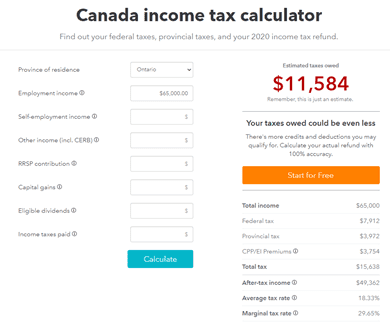
For example, if you live in Ontario and your taxable employment income is 65,000 $ excluding any CERB benefits. Then, total amount of taxes due is $11,584.

Access for free you credit score and start monitoring closely your financial situation with Borrowell

Was any tax deducted?

The third step is to determine if any taxes were deducted in your Tax slips.


Rule of thumb:
• If you received the CERB or CESB, no tax was withheld when payments were issued.
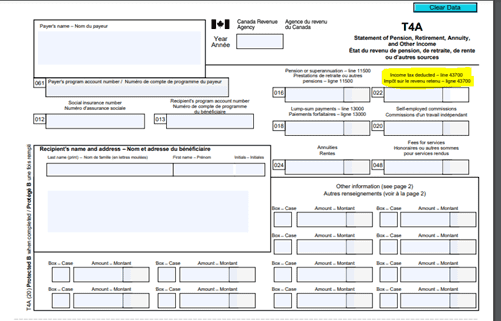
• If you received the CRB, CRSB, or CRCB, 10% tax was withheld at source. This does not mean you will no return a portion. It will depend on your tax rate for 2020. If your tax rate is higher than 10%, then you may have to pay back the difference between your real tax rate and the 10% withheld.


Once you receive your tax slips, you can check if an amount of tax was withdrawn at the source. See below the highlighted field.

How much should I pay back?


The fourth step you to use the calculator to estimate the taxes owing on your income without, and with, the government’s relief benefits — the difference between the two is how much extra money you should set aside for the 2020 tax year.


Let’s go through one example:
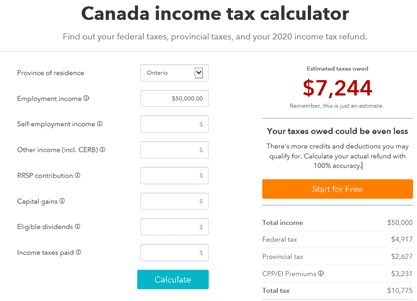
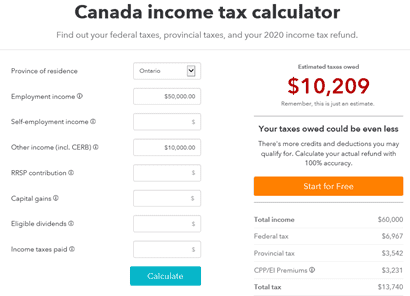
David resides in Ontario and his employment income for 2020 was 50,000$. Because his hours of work were reduced, he had to apply to CERB program. Following his application, he received 10,000$ in CERB support benefits.


Using the turbotax website, his federal and provincial income taxes for 2020 (excluding CERB) are 7,244 $ (see image A). If we include the CERB payments received, his total taxes becomes 10,209$. David will have to reimburse the difference 2,965 $.
The method above provides an estimation only. The calculation does not include any tax credit that David might be entitled to.


Image A

Image B

Will there be any interest charges?


No interest will be charged on related tax debt until April 30, 2022. The government took this decision on February 9th 2021. There is one condition to this rule which is that your income should not exceed 75,000$ in 2020.


Make sure to file on time your taxes otherwise you will be charged a 5% penalty and 1% for every full month past the deadline (to a maximum of 12 months).

Subscribe to Wyzeinvestors.com

* indicates required

Recommendation: use your tax credits to reduce the amount due!

if you have any amount due because you received CERB relief payment, you have to make sure to apply all the credits you are entitled too. This can help reduce the amount due.

here’s some credits that you can apply to:

Medical Expenses: you can claim medical expenses such as Medical costs incurrent during a Travel abroad, Dental care or medical supplies. It’s important to mention, you can only claim expenses that you have not been reimbursed for.

Childcare Expenses: you can claim expenses paid to caregivers, daycare centers, day camps…etc. These childcare expenses should be claimed only if it allowed you to gain employment income, carry on a business either alone or as an active partner or attend school/pursue academic research under certain conditions.

Work From Home Expenses: This a new tax credit. You have two options:

  • Simplified method: allows you to claim a maximum of 400$ tax credit if you worked from home 200 business days last year (rate of: 2$ per day). You have to fill out T777S form;
  • Detailed method: allows to claim more than the 400$ tax credit. However, you will have to provide more documention and proof. In addition to the T777S, you’ll need a T2200S form signed by your employer which certifies that you worked from home due to the pandemic. You’ll also need the receipts for all of your expenses.

Tuition: Fees paid by you to a post-secondary educational institution in Canada.

RRSP contributions: any amount contributed to an RRSP will reduce your taxable income. Consult your notice of assessment to know if you have any carry over contribution room.

Charitable donations

Other related posts

Paying back the CERB money, what you need to know

How to access your full credit report for free in Canada?

Updated: May 18th 2021: Travel reward programs offered by Canadian credit cards issuers are very competitive. To help you find the card that can get you to your dream destination faster, we have gathered all the info your need to know in the list below.

American Express Cobalt

• 5X POINTS On eats & drinks Such as eligible restaurants or food delivery in Canada
• 2X POINTS On travel & transit From eligible ride shares in Canada to a weekend getaway
• 1X POINTS On everything else From streaming services to online shopping, and more

You can use the points to purchase gift cards, merchandise, purchases made at Amazon.ca or travel.

Annual fee 120$

Scotiabank Gold American Express

Earn 5x POINTS on eligible grocery stores, restaurants, fast food, and drinking establishments. Includes popular food delivery, food subscriptions and Includes movies, theatre, and ticket agencies.
Earn 3x POINTS on eligible gas and daily transit. Includes rideshare, buses, taxis, subway and select streaming services.
Earn 1x POINTS everything else

Annual fee 120$

MBNA Rewards Platinum Plus


Earn 2x points for every $1 spent on eligible gas, grocery and restaurant purchases thereafter ($5,000 annual cap on each category)
Earn 1x point for every dollar spent on all other eligible purchases‡
Flexible rewards: Redeem your points for travel, cash back, and more

No Annual Fee

Asset

Any tangible or intangible good that you own. Example: your house is an asset.

Intangible goods would for example be a work that you have created such as a brand.

Shareholder

Companies that trade on the stock exchange issue shares. Each share constitutes a fraction of the company’s equity. When you buy a share, you become the owner of that company along with the other shareholders.

Obviously, the majority of investors will be minority shareholders because they hold a small fraction of the capital. Majority shareholders are those who own more than 10% of the outstanding shares.

Despite owning only one share, you may be invited to vote at general meetings for important decisions.

Currency risk coverage

When the manager has to replicate a U.S. index such as the S.P. 500 or the Nasdaq 100. It must acquire these assets in U.S. dollars. So, on a fairly regular basis, the fund has to convert the funds available in Canadian dollars into U.S. dollars. These conversions may be beneficial or have a negative impact depending if the Canadian dollar has appreciated or depreciated.

Many investors want to reduce this risk. To meet their needs, the majority of ETFs that reproduce a U.S. index offer a “hedged” version of their funds and sometimes another version that is traded only in U.S. dollars. Coverage acts as a kind of insurance. See the scenarios presented below:

 Scenario 1: Value of Canadian
$ appreciated
Scenario 2: Value of Canadian
$ depreciated
Non hedged ETFIndex return
Minus foreign exchange loss
Index return
Plus foreign exchange gains
Hedged ETF

Index returnIndex return
US $ ETFIndex Return
The investor chooses when to convert

Index Return
The investor chooses when to convert

Dividends

Dividends are paid by companies to their shareholders. They constitute a portion of the company’s profit. It is the board of directors which proposes a rate called (Ratio of payment of the dividends or ‘Pay out ratio’. The ratio is a percentage of the profit. Example, a company made a profit of 1,000,000 $, and it decides to pay 50% in dividends and the rest will be reinvested in the company.

Amount of dividends $ 500,000

Number of outstanding shares: 100,000 shares

Each shareholder will receive $ 5 in dividends.

Dividends can be distributed quarterly or annually. In rare cases, companies pay their dividends monthly.

• “declaration date”: The declaration date is the day on which the board of directors announces its intention to pay a dividend.

• “ex-dividend date”: Date to be retained, each person who holds the share on this date is automatically eligible to receive the declared dividends.

Example: the ex-dividend date is May 3.

You must acquire the share at least 3 business days before the ex-dividend date, which is April 27.

You can sell the stock on May 4th and you will still receive your dividend.

• “payment date” / “payment date”: The payment date is the date on which the dividend will actually be paid. Everything is done automatically, there is nothing you can do.

ETFs

ETF is an exchange traded fund. This fund is managed by a professional manager. There are several ETF issuers in Canada:

• Banks (BMO, TD… etc)

• Investment companies such as (Vanguard, iShares, etc.)

There are currently over 1000 ETFs available on the market. There is an ETF for every type of investor. They are suitable for active or passive management.

What is an index fund?

There are several types of ETFs. And index ETFs are the most popular in the financial markets. In fact, the first ETF to be launched on the North American stock exchange was an index ETF. Index ETFs offer exposure to a large number of securities and sometimes to a whole stock market at a very low cost. Their main objective is to acquire, on your behalf, all securities that constitute a specific index in order to obtain the same return of the index minus management fees.

S.P. 500 Index

The S&P 500 Index, or the Standard & Poor’s 500 Index, is a market-capitalization-weighted index of the 500 largest publicly-traded companies in the U.S. 

The S&P 500 is an excellent index because most of its constituents are large established US corporations. It’s well diversified across various sectors of the US economy. The index is widely regarded as the best gauge of large-cap U.S. equities. It can be easily used to express an opinion on the US economy in general. In other words, if you are bullish on the performance of the American economy in the long term, it’s probably the best index for you.

All ETFs that replicate the performance of the S.P. 500 index will have the same securities in their assets and at about the same proportions as the index itself.

The Nasdaq 100

The Nasdaq-100 is one of the world’s preeminent large-cap growth indexes. It includes 100 of the largest domestic and international non-financial companies listed on the Nasdaq Stock Market based on market capitalization.

This index is dominated by companies in the Information Technology sector.

S&P/TSX 60

An index of the 60 largest companies on the Toronto Stock Exchange.   This index is dominated by the energy and finance sectors.

Dividend: Tax implications for owning ETFs

There are so many possible structures for an ETF. Below, we will discuss mainly three common structures:

if held in an investment account (non registered)

  • Type 1: Canadian ETFs that invest in US or international stocks directly. There is 15% withholding tax that will impact the fund’s return;
  • Type 2: Canadian ETFs that invest in US ETFs which invests in US stocks. There is 15% withholding tax that will impact the fund’s return;
  • Type 3: Canadian ETFs that invest in US listed ETFs which invest in international stock. This is the structure that’s the least interesting for investors from a taxation perspective. 2 Taxes will be applied by the foreign country first and then the US.

if held in registered account: TFSA, RESP, RRSP

Canadian ETF: 1$ dividend scenarioTaxesDividend received
1- Holding US or International stocks directly-0.15$ (withholding tax from US or foreign jurisdiction) Creditable0.85$
2- Holding US listed ETFs that invest in US stocks-0.15$ (withholding tax from US or foreign jurisdiction) Creditable0.85$
3- Holding US listed ETFs that invest in International stocks-0.15$ (withholding tax from foreign jurisdiction) Non creditable -0.13 (withholding tax from US) Creditable0.72$

The chart is designed for illustrative purposes only and is subject to change. Please consult a tax specialist for more information.

Conservative portfolio

Fixed income will dominate the portfolio at 60% or more (with the exception of Horizons’). Meaning your investments will be mostly  in Bonds. Bonds are much safer than stocks but they don’t usually offer much return. This portfolio is perfect for some one whose financial objective is short term or who is risk averse. Your portfolio will still have between 20-40% exposure to stocks which allows for some modest growth with a moderate risk overall.

Balanced profile

balanced portfolio is an investment that combines stocks and bonds. In general, 60% will be invested in the stock market. While the remainder (40%) will be invested in fixed income investments. This portfolio seeks to combine both growth potential by holding stocks and the safety associated with holding bonds.

Growth portfolio

growth fund is a diversified portfolio of stocks that has capital appreciation as its primary goal. This is ideal for investors who have a long term objective such as building a retirement fund. The fund will invest at least 80% in Stocks. Generally for these type of funds, providing a dividend income is a secondary objective.

Yield

A dividend yield is an annual percentage calculating the amount received by the investor for a year. It does not take into account capital loss or appreciation. So, you could own an investment that has a positive dividend yield and a negative performance.

All in one ETFs

By purchasing an all-in-one ETF (also called an ‘all-in-one ETF’, the investor can be exposed to different types of assets at the same time. In fact, he becomes the holder of a portfolio made up of both income. fixed and stocks with a predetermined allocation. And furthermore, he does not need to rebalance his portfolio because the ETF manager does it for him. In short, it is simply a question of choosing an ETF with the desired allocation and keep it.

Expected investment outcome with covered call ETFs

In a robust bull market, where the price of the underlying stock rises above the strike price plus the option premium, the covered call writer will underperform.

Due to earning the option premium, the covered call writer can normally anticipate to outperform merely holding the stock in flat, decreasing, and mildly rising markets.

 Covered call strategy
Bull Marketlags in terms of
performance
Modest Bull MarketOutperforms the index
Volatile market
(frequent ups and downs)
Outperforms the index
Beat marketOutperforms the index

How to select monthly dividend stocks?

Look at the payout ratio

The dividend payout ratio is the amount of dividend distributed by a company divided by the total earnings. For example, a company makes a profit of $ 100 and pays $ 40 in dividends. Its payout ratio is 40%.

If the ratio is high, the company pays almost all of its profits in dividends. There will be little money left in the coffers to innovate or expand to new markets;

It is preferable to invest in a company where the dividend payout ratio is low or medium. The reasoning is that these companies will have money set aside to invest in new projects and thus create growth;

Another variation of payout ratio (Trailing div / Earnings) is the payout ratio to cash (Div / Free cash flows). Earnings can be easily manipulated, so analysts use the payout ratio to cash to assess the safety of dividends better. The website ‘Marketbeat‘ provides the payout ratio to cash for Canadian stocks.

Focus on total return

When one wishes to invest in a dividend-paying stock, it is essential to pay attention to its performance and growth potential. The most common mistake is to invest in stocks with high dividend yields. This strategy is risky. Here’s why :

• A stock can pay a high dividend yield, but is it sustainable? Some companies have a payout ratio that is close to and even exceeds 100%. They manage to post desirable dividend yields, but if we look at the growth prospects, it’s almost nil;

• Investors sometimes shun companies for lack of growth potential or actual risk of lower revenues in the future. These companies experience a drop in the price of their shares, and this causes the dividend yield to become abnormally high. Sooner or later, these businesses will have to cut their dividend.

Market Summary

The recent market correction impacted 2 sectors mainly. Investors focused on particular stocks that the market deemed overvalued (Tesla and Apple):

  • Consumer discretionary: Tesla Inc shares were the main reason why the sector underperformed. The company’s share value lost 17% in the past month only. The hype surrounding Tesla and the popularity of its CEO Elon Musk have pushed Tesla Inc shares to unrealistic valuation. Just recently, Michael Burry, the ‘Big Short’ investor stated that Tesla’s decision to bet on Bitcoin by purchasing $1.5B was a distraction. Musk’s motive was probably to eclipse bad news for the car maker coming from China. In addition to Tesla Inc, Amazon shares slipped 3% this past month which also led to this sector being in the red.
  • Information technology: Apple Shares lost 9.50% of their value dragging down this sector. From the big 5 businesses that make up the Information Technology sector, Apple Inc was the only one to lose ground. The stock may have been unfairly punished due to a global semiconductor shortage that could squeeze margins. However, the company is well positioned to turn things around and be less impacted than its competitors.

Table 1: Performance by industry (S&P 500)

S&P by sector5 days3 Month1 Year
S&P 500 Energy5.95%26.83%-10.58%
S&P 500 Financials2.51%18.79%7.03%
S&P 500 Real Estate1.16%4.97%-7.95%
S&P 500 Materials1.79%7.45%25.23%
S&P 500 Industrials1.38%4.03%9.77%
S&P 500 Consumer Staples-0.92%-2.24%0.50%
S&P 500 Communication Services-0.62%12.18%25.35%
S&P 500 Health Care-1.89%5.07%10.23%
S&P 500 Utilities-2.01%-4.41%-13.56%
S&P 500 Consumer Discretionary-2.72%5.75%28.55%
S&P 500 Information Technology-4.09%10.39%33.55%
S&P 500 Index-1.30%8.49%16.29%

Table 2: Largest businesses part of the S&P500 Information Technology

Name1M %Chg3M %Chg52W %Chg
Apple Inc-9.50%10.55%60.82%
Microsoft Corp3.24%11.02%30.62%
Nvidia Corp3.13%7.63%92.36%
Visa Inc4.99%1.90%1.58%
Mastercard Inc6.51%5.54%3.16%

Table 3: Largest businesses part of the S&P500 Consumer Discretionary

Name1M %Chg3M %Chg52W %Chg
Tesla Inc-17.46%33.92%287.81%
Amazon.com Inc-2.97%3.10%52.41%
Home Depot-5.90%-1.53%8.93%
Nike Inc-2.31%1.49%35.79%
McDonald’s Corp-0.97%-2.62%-2.11%

Note: Opinions expressed in Wyzeinvestors.com cannot be construed as a financial advice.

Sector analysis for 2021

U.S. stocks recovered from the selloff in February and March (when the first shutdown was announced), finishing 2020 with a 16% return, as measured by the S&P 500.

Performance of the S&P by sector in the past years!

SectorPerformance 2020
Information technology 43.9%
Consumer discretionay index33.3%
Communication services index23.6%
Materials index20.7%
S&P 500 Index18.4%
Health Care 13.5%
Industrials index11.1%
Consumer Staples10.8%
Utilities0.5%
Financials-1.7%
Real estate-2.2%
Energy index-33.7%

In aggregate, energy and real estate stocks look undervalued, while the technology sector is the most overvalued. Both Energy and Real-estate were hit hard by the effect of the pandemic. Work from home restrictions and lock down have directly impacted their revenues making these cyclical sectors lose ground in the stock market.

Many analysts attribute the performance of the S&P500 to the rush to acquire shares in Technology driven giants such as Facebook, Google, Tesla or Amazon. They believe these stocks have become overvalued at the expense of other sectors that retain little or no attention from investors. See table below for undervalued sectors:

SectorUndervalued segments within SectorStocks examples (as per Morning star analysis)
Basic materialsUndervalued segments within Sector: Agriculture and Chemicals industriesCompass Minerals CMP, Dupont DD, Nutrien NTR
Communication servicesTraditional media and telecomFox (FOAXA), Lumen Technologies (LUMN), Omnicom Group (OMC)
Consumer Defensive Consumer packaged goods salesCoca-Cola Femsa (KOF), Kellogg (K), Pilgrims Pride (PPC)
EnergyWhole sector is undervalued. Focus on companies not invested in Shale Gas.Entreprise Products Partners (EPD), Pioneer Natural Resources (PXD), Schlumberger (SLB)

Best cashback credit cards in Canada

Financial institutions offer a wide array of Cashback programs:

  • Flat rate cash back: very easy to track and understand. Basically all your purchases are at the same rate;
  • A modular cash back rates based on categories (for instance they will provide more cashback for certain categories mostly Groceries, recurring bills or Gas). To be able to compare these type of Cards with a flat rate credit card I made certain assumptions. See below!

To assess fairly these credit cards, here’s my key assumptions:

  • Based on Statistics Canada data: an average household spends 11% on Groceries and 15% on Transportation. I assumed that recurring bills constitute 4% of the monthly expenditures of a household.

Comparison table Credit cards with no annual fee

Credit Card
American Express SimplyCash – 1.25% on all your purchases

Promo: 2.5% Cashback in your first 3 months (up to $150 in Cashback)

Tangerine Money-Back – 2% in up to 3 categories of your choice
(including groceries, gas & more) and 0.5% on everything else

BMO CashBack Mastercard – 3% on groceries; 1% on recurring bills and
0.5% on everything else


Promo: 5% Cashback in your first 3 months (up to 75$) and no annual fee in
the first year

Our recommendation: American Express SimplyCash

For 20,000 $ expenditures per year, you will be getting 250$ cash back on American Express SimplyCash which is higher that other similar cashback cards.

Comparison table Credit cards with annual fee

Credit Card

American express SimplyCash Preferred – 2% on all your purchases (Annual fee 99$)

Promo: 10% Cashback in your first 4 months (up to $400 in Cashback)


Scotia Momentum Visa Infinite – 4% on groceries & recurring bills;
2% on gas & daily transit and 1% on everything else (Annual fee 120$)


Scotia Momentum Visa Infinite Card – 4% on groceries and recurring payments,
2% on gas and daily transit and 1% on everything else (Annual fee 120$)

Promo: 10% Cashback in your first 3 months (up to $200 in Cashback) and no
annual fee in the first year


BMO CashBack World Elite Mastercard – 5% on groceries, 4% on transit, 3% on gas,
2% on recuring bills and 1% on everything else (Annual fee 120$)

Promo: 10% cashback in your first 3 months (up to 130$) and annual fee waived


TD CashBack Visa Infinite – 3% on groceries, gas & recurring bills and 1% on everything else (Annual fee 120$)

Promo: 6% cashback on all purchases for the first 3 months (up to 120$) and no annual
fee waived first year

Our recommendation: American express SimplyCash Preferred

The Canada Revenue Agency says it’s warning about 213,000 Canadians who may have been paid twice through the Canada Emergency Response Benefit (CERB) program that they could be called upon to repay the money.

There seem a total confusion for people who are impacted. A quick look at Reddit forums and you notice several impacted people receiving contradictory information. I hope this post will clarify some of the confusion.

Access for free your Equifax credit report with Borrowell

What if you have been contacted

If you received a letter. Keep in mind, it does not mean necessarly they are asking you for repayment. In fact, most people who received these letters were asked to provide their 2019 income tax return to assess their eligibility. See possible scenarios below:

  • earned more income than expected while you were getting the CERB? if you did you might be required to pay back
  • applied for the CERB from both Service Canada and the CRA at the same time? Just review your bank account info, if you have received the payment twice , you need definitely to return the extra payments
  • did not file your taxes for 2019? All you need to do is file your 2019 income tax to allow CRA to confirm your eligibility

Many people getting these letters are self-employed or contractors, often called “gig workers”.

Net income versus gross income

The government is now saying that you had to have earned $5,000 in net income, which is income after expenses. Many people thought they qualified as long as they made $5,000 in gross income, which is before expenses.

If the CRA contacts you because of the difference between your net and gross income, it’s important to get legal help. A legal advisor might be able to dispute CRA claim.

In the Canada Revenue Agency website, they are stating that you would have to repay the CERB in the following situations: ”Payments made to anyone who is later found to be ineligible will need to be returned. Any individuals who mistakenly received multiple payments or payments they did not apply for should begin the repayment process below.

In their website CRA will ask you which situation are you in. You need to pick the right one:

1- Earned more income than expected during the time you received the CERB payment

2- Applied for and got the CERB from both Employment Insurance/Service Canada and from the CRA for the same eligibility period

3- Applied for the CERB but later realized you’re not eligible

4- None of the above

Repayment scenarios

You have to distinguish between your first eligibility period and the subsequent ones as described by CRA in their website:

For your first eligibility period

If your employment or self-employment income was $1,000 or less (before deductions) for at least 14 days in a row during this 4-week period, you do not need to repay the CERB.

For subsequent eligibility periods

You will need to repay the $2,000 for an eligibility period if you earned more than $1,000 (before deductions) from employment or self-employment income during that period.

How to return or repay the CERB

Send back your payment to the department where you applied for it

CRA or

Service Canada

The easiest way to reimburse the CERB is through a transfer from your bank account, click CRA link below

https://www.canada.ca/en/revenue-agency/services/about-canada-revenue-agency-cra/pay-online-banking.html

Impact on your taxes

Your CERB amounts are taxable. You will receive a T4A slip before March 10, 2021 as per CRA website.

see possible scenarios if you already paid back the CERB:

  • You realized your mistake and paid back CRA after December 31st, 2020, you will unfortunately still be taxed on CERB in 2020 and your taxes will be adjusted only in 2021 tax return.
  • You realized your mistake and paid back CRA before December 31st, 2020, you will be able to deduct the amount paid back from your taxable amount shown in your T4A slip 2020.

Please see other posts you might be interested in!

Sign up to our newsletter to receive the latest posts

What is Bitcoin

A Peer to Peer Electronic Cash System. Think of it as a private transaction between 2 people without any Intermediary. So, there is no middleman. It’s using a powerful technology called Blockchain to avoid any misuse of it. it’s impossible to counterfeit a bitcoin or spend same funds more than once!

Is it anonymous

Contrary to the wide spread belief, Bitcoin is not anonymous; it is private and has an open, immutable ledger. It allows privacy as only the address is public, but this means that activity on the address is examinable to discourage illegal activity.

The blockchain technology ensure the transaction is properly recorded and can never be erased. Furthermore, the ledger of all the activities is stored in every nod of the chain! The ledger is open for anyone to see.

Will Bitcoin be impacted by inflation

The short answer is no. The people who came up with the system limited the ‘Supply’ to 21 millions bitcoins in circulation. There is no central bank printing money from tin air, here, and thus causing inflation and loss of value.

How do I use Bitcoin to transact

Transactions occur with no middlemen, so anyone with access to the Internet can transfer coins to someone anywhere in the world. To receive or send Bitcoins, users must first have a Bitcoin wallet (which I will cover in my next article).

To describe how a transaction works, consider the following scenario.

Tom would provide Sean with his Bitcoin address, similar in concept to an account number. Sean creates a transaction with his wallet to Tom’s address then signs the transaction with a digital signature. Once Sean hits send, his transaction is broadcasted to the nodes maintaining the network.

Why use Bitcoin?

Your transaction will be safe and secured;

No middleman, so no fees;

Instantaneous and it’s all online. You still have to put measures in place to protect your wallet and not lose the key. If it happens, your bitcoins are simply lost!

Conculsion

It’s really hard to predict the future for virtual currencies. Governments can choose to crack down on Bitcoin and similar virtual currencies and limit their use. This will for sure have an enormous effect on their trading value. On the other hand, the more they get accepted, the more they will get popular because of the several benefits they carry for users. I like especially the fact it’s capped; there can be only 21 Million of them. This really safeguards against loss of value because of additional supply.

Keep in mind, that government printed money is backed only by the faith in the government itself! The days where the US dollar was backed by Gold are long gone.

2020 was a special year at all levels, financially speaking is no exception! here is a walkthrough of what you should be watching for:

Tax planning

April 30: Income tax deadline

if you have received CERB payments!

The CERB payments are a taxable income! you need to report it when you file your income tax for the 2020 tax year. Keep in mind, the governement did not deduct any income tax from your CERB payments, so it’s important to report them.

If you were contacted by CRA to return a portion of the CERB payments, please refer to our previous post Paying back the CERB money, what you need to know

COVID-related claims for your home office

Check CRAs website and your employer for what can be claimed. Below is the official CRA link discussing this matter.

https://www.canada.ca/en/revenue-agency/news/2020/12/introducing-a-simplified-process-for-claiming-the-home-office-expenses-for-canadians-working-from-home-due-to-the-covid-19-pandemic.html

TFSA

Jan. 1: TFSA contribution limit extension

Tax-free savings account holders can start the new year by contributing another $6,000 to their TFSAs.

If you have never contributed to a TFSA and you were at least 18 years old in 2009, then your contribution room is $75,500.

Any capital gains or dividends realized within a TFSA are not taxable. This is a great advantage. The only time you will taxed under a TFSA is if you overcontributed (exceeded the allowable contribution amount of $75,500). A lot of people misunderstand this rule and think falsely the value of their TFSA should not exceed the $75,500. This is totally false, the limit is on the contribution and not the value of your TFSA.

RRSP

March 1: RRSP contribution deadline

If you are not familiar with the RRSP, please check our previous post What’s an RRSP? Everything you need to know

Advice: don’t take a loan to contribute to your RRSP! I recommend saving and contributing to your RRSP using your savings. It’s called discipline!

The contribution amount can be deducted from your 2020 taxable income. The higher your marginal tax rate, the bigger the tax savings. 

Investment

Max your RESP contribution!

Parents with a Registered Education Savings Plan (RESP) should try to maximize their government grants for the year. RESPs are a generous a program!

Fees

Watch out for the Fees. There is fees everywhere in the financial industry. It’s a fact, but we still need to compare our broker-bank-insurance company with competitors.

If you own a mutual funds with 3% MER: ask yourself is it worth it? can you switch to a different mutual fund with lower MER or even buy an Index funds or ETF!

If the fees you pay for trading stocks are too high (9$ or more)! check other brokers especially online brokers, they are more and more popular, the difference in the fees paid with a traditional bank and an online broker is simply huge!

Debt

If you have high-interest-rate debt, like credit cards or unsecured lines of credit, you may be better off focusing on repaying those first before investing. Consider consolidating your debt into a loan or a secured home equity line of credit, or add high-interest debt to your low-interest mortgage; any of those moves can help you reduce the interest charges.

please also consult with non for profit organizations dedicated to helping Canadian families renegotiate the interest rates in their debt and with consolidation.

Rebalance your investment portfolio for the new year

Make sure your investments are still aligned with your risk tolerance and financial objectives.

If you have let’s say an unexpected big expenditure coming up, then you have to review the terms/duration of your portfolio investments.

Mortgage deadline coming up, shop early for a better rate!

Mortgage rates have gone down to new lows (for instance 1.7% for a fix 5 year term, even lower rates for variable). If your mortgage term is coming up, make sure you start shopping. Always contact your banks and independent mortgage broker by email, and receive their offers by email. Use then their offers to create a competition, you will be surprised how they will quickly beat the competition offer (as long as it’s written).

Watch out for your credit score

Watching regularly your credit score is important. The general rules to keep your score high are:

  • don’t apply for credit cards you don’t need or just because they have a special bonus offer;
  • never cancel your oldest card. Your score depends on the length that you have been using credit!
  • subscribe to a service that will allow you to access your credit score report! it’s crucial to check the report for any activity. Identity theft is on rise, you want to be ahead of the curve and address any issue before hand. Most service have a alert system in place to advise of any big change in your score

You can access for free to your credit report with Borrowell* Checking your credit report does not have any negative impact on your credit. For more info on this subject, visit our previous post How to access your full credit report for free in Canada?

*The Asterix is a reference to an affiliate marketing link. I promote the use of Borrowell services in exchange of a small commission. I recommend only services that I used and satified with.

Please see other posts you might be interested in!

Best Growth ETFs in North America

Best Growth ETFs in Canada

Everything you need to know about all in one ETFs

Review of the best actively managed ETF ARKK

What are the largest ETFs in the US (Full comparison and analysis)

What are the best Canadian Dividend ETFs 2021 – Updated

What are the best sectors/stocks to invest in 2021

What are the largest ETFs in Canada (Full analysis and comparison)

Sign up to our newsletter to receive the latest posts