

With interest rates still elevated and market volatility remaining a reality in 2026, many Canadian investors are actively searching for reliable monthly income without having to sell their investments. As a result, monthly income ETFs—particularly those using covered call strategies—have gained significant traction among retirees and income-focused portfolios.

Among Canadian providers, Hamilton ETFs has emerged as a specialist in high-income, covered-call-based ETFs, offering sector-specific solutions designed to convert market volatility into consistent cash flow.
In this article, we review the best Hamilton ETFs for monthly income in 2026, explain how their covered call strategies work, and help you determine which ETF may align best with your income needs and risk tolerance. The goal is not to chase yield blindly, but to understand how these ETFs fit within a well-structured income strategy.
Why Income Investors Choose Hamilton Covered Call ETFs
Hamilton ETFs focus on:
- Monthly distributions
- Covered call strategies to enhance income
- Sector-specific exposure (banks, tech, utilities, energy, gold, broad markets)
These ETFs are not designed for maximum growth, but rather for:
- steady cash flow,
- income replacement,
- and yield enhancement within diversified portfolios.
| ETF Ticker | Yield | Leverage | AUM (Approx.) |
| HMAX | 12.30% | No | $1.81 B |
| QMAX | 10.94% | No | $731.4 M |
| UMAX | 14.40% | No | $1.04 B |
| SMAX | 10.79% | No | $855.8 M |
| AMAX | 8.88% | No | $505.5 M |
The Best Hamilton ETFs for Monthly Income
1. HMAX ETF Review – Canadian Bank Covered Call Income
HMAX ETF focuses on Canada’s major banks and financial institutions (RBC, TD, BMO, Scotiabank, etc.) and uses an active covered call strategy to generate higher monthly income.
Here is the key point most investors misunderstand: HMAX typically sells call options on about 50% of the portfolio, not 100%.
What does that mean in simple terms?
- On half of the holdings, the manager sells at-the-money call options (usually short-term, often monthly).
- In exchange, the ETF collects option premiums, which are paid out as monthly income.
- The other 50% of the portfolio remains uncovered, allowing some participation in upside when bank stocks rise.
This balanced approach helps:
- boost income without fully eliminating growth potential,
- reduce volatility compared to fully covered portfolios,
- and smooth cash flow for income-focused investors.
Investors like HMAX because it transforms relatively stable Canadian banks into a predictable monthly income source, while still keeping partial exposure to long-term capital appreciation.
Why invest in financials in the first place?
Financials—especially Canadian banks and insurers—are often considered a core sector for income-oriented investors.
Here’s why many investors allocate to financials:
- Essential role in the economy
Banks sit at the center of economic activity: lending, mortgages, payments, credit cards, and wealth management. As long as the economy functions, financial institutions remain relevant. - Strong cash flows
Large banks generate consistent earnings which supports reliable dividends. - Dividend history and discipline
Canadian banks, in particular, have a long track record of paying dividends. - Inflation and rate sensitivity
In certain environments, higher interest rates can improve bank margins, helping earnings and income generation. - Lower volatility than many sectors
Compared to tech or commodities, financials tend to be more stable, making them suitable for income-focused portfolios.
Best for:
Investors seeking reliable income from Canadian financials, especially retirees who value predictable cash flow.
Key risk:
Limited upside during strong bank rallies due to covered calls.
2. QMAX ETF Review – Technology Covered Call ETF for Monthly Income
QMAX ETF targets large-cap U.S. technology stocks and uses an active covered call strategy to turn volatility into monthly income.
Here’s what many average investors misunderstand: QMAX typically writes call options on about 50 % of the portfolio rather than fully covering all holdings.
What this means in practice:
- On roughly half of the tech shares, the ETF sells at-the-money call options with short expiries (often monthly),
- It collects premium income from those sales,
- While the other half remains uncovered, allowing the portfolio to benefit from potential upside if tech stocks rally.
This strategy helps balance income generation with growth potential. Investors like QMAX because:
- It offers higher monthly distributions than owning the stocks outright,
- It harnesses the volatility inherent in tech stocks to generate cash flow,
- And it still retains participation in market upswings thanks to the uncovered portion of the portfolio.
Why invest in technology in the first place (for QMAX)?
Technology stocks, particularly large-cap U.S. tech companies, are a cornerstone of many long-term investment portfolios — and there are several reasons investors choose this sector before even considering income strategies like QMAX:
- Long-term growth leadership
Many tech firms are market leaders with innovative products and services, strong competitive moats, and global reach. Over the past decade, technology has consistently led market returns. - High profitability and reinvestment power
Dominant role in the modern economy
Tech companies power digital transformation across industries — cloud computing, artificial intelligence, digital payments, social media, and more — making them less cyclical and more resilient over time. - Innovation-driven earnings
Diversification benefit
Including technology exposure in a portfolio can help diversify risks associated with sectors like financials, utilities, and energy.
Best for:
Income investors who still want exposure to technology, but with lower volatility than owning tech stocks outright.
Key risk:
Strong tech bull markets may cap upside returns.

3. UMAX ETF Review – Utilities Covered Call ETF (Defensive Income)
Defensive Utilities Income
UMAX ETF focuses on utility companies and uses a covered call strategy with at-the-money (ATM) options to generate enhanced monthly income.
A key point many average investors miss: UMAX typically sells ATM call options on about 50% of the portfolio, not on all holdings.
In simple terms:
- On roughly half of the utility stocks, the ETF sells ATM call options, meaning the strike price is close to the current market price.
- ATM options generate higher option premiums than out-of-the-money calls, which boosts monthly income.
- The remaining 50% of the portfolio stays uncovered, allowing some participation if utility stocks rise.
Why invest in utilities in the first place?
Utilities are often considered defensive investments because:


- Demand for electricity, water, and gas is relatively stable, regardless of economic cycles.
- Revenues are often regulated, which can lead to more predictable cash flows.
- Utility stocks tend to be less volatile than the broader market.
Investors like UMAX because it combines the stability of utilities with enhanced income generation, making it appealing for conservative, income-focused portfolios.
Why invest in utilities in the first place (for UMAX)?
Utilities are a core defensive sector in many investment portfolios, and there are solid reasons investors allocate to them before even considering income strategies like UMAX:
- Stable demand and essential services
Utility companies provide electricity, water, gas, and related infrastructure—services people and businesses need regardless of economic conditions. - Predictable cash flows
Because their services are essential and often regulated, utilities tend to generate steady, predictable income, which supports reliable dividends. - Lower volatility
- Defensive characteristics during downturns
- Dividend focus
Many utility companies have a history of paying dividends, appealing to investors seeking income and stability.
Best for:
Conservative investors prioritizing capital stability and income consistency.
Key risk:
Interest-rate sensitivity typical of utility stocks.
4. SMAX ETF Review – U.S. Equity Covered Call ETF (S&P 500-Style Income)
SMAX ETF is designed for investors seeking attractive monthly income while maintaining diversified exposure to large-cap U.S. equities across multiple sectors. With a current yield of 10.79% and monthly distributions, SMAX aims to convert equity market volatility into consistent cash flow.
The ETF holds a broad mix of U.S. stocks that closely resembles the sector composition of the S&P 500, including technology, financials, healthcare, consumer sectors, and energy. Instead of concentrating on a single theme, SMAX provides diversification across the U.S. economy, reducing reliance on any one stock or sector.
To generate income and reduce volatility, SMAX employs an active covered call strategy. Importantly, the coverage ratio is flexible, meaning calls are written on only part of the portfolio and adjusted over time to balance income generation with upside participation.
Best for:
Investors seeking diversified U.S. exposure with monthly income.
Key risk:
Income may fluctuate depending on market volatility.

5. AMAX ETF Review – Gold Miners Covered Call ETF for Income
AMAX ETF stands out because it combines gold producer exposure with an active covered call strategy to generate monthly income—a rare combination in the Canadian ETF landscape.
Unlike physical gold or traditional gold ETFs, AMAX invests in gold-mining companies, whose revenues and cash flows are leveraged to the price of gold. This creates higher volatility, but also higher option premiums, which the fund monetizes by selling covered call options. Those option premiums are the primary driver of AMAX’s income distributions.
Key characteristics include:
- Exposure to gold miners, not bullion
- A potential hedge against inflation and currency weakness, as gold often performs well when real interest rates fall
- Higher volatility than traditional income ETFs, due to both commodity price swings and equity market sensitivity
AMAX is best viewed as a diversification and inflation-protection tool, rather than a core income holding. It can complement traditional income ETFs by adding a non-correlated income source, but investors should be comfortable with larger price swings in exchange for income and diversification benefits.
Best for:
Investors seeking diversification and inflation protection, with income.
Key risk:
Commodity price fluctuations can impact NAV.
Important Risks of High-Yield Covered Call ETFs
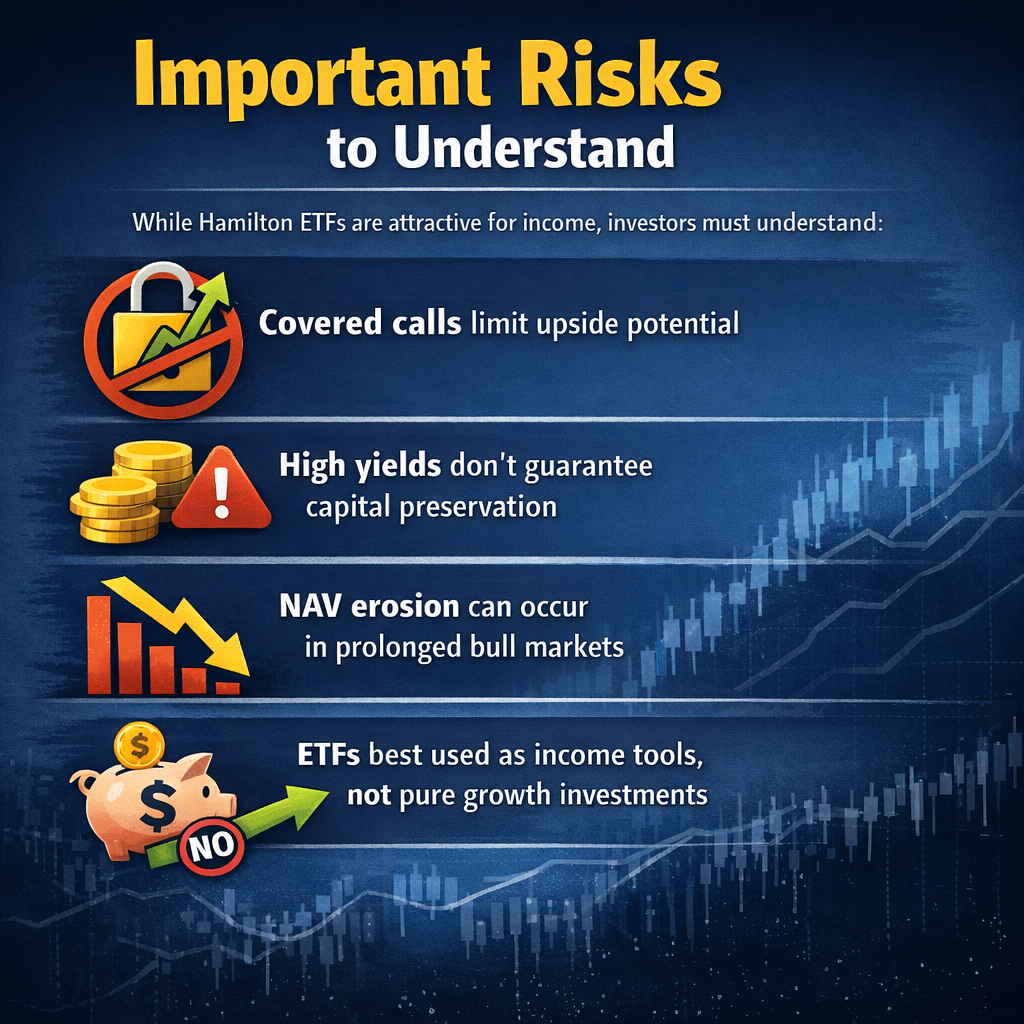
While Hamilton ETFs are attractive tools for generating monthly income, it is essential for investors to clearly understand the trade-offs involved before allocating capital. These ETFs are designed primarily for cash flow, not for maximizing long-term capital appreciation.
First, covered calls limit upside potential. By selling call options on a portion of the portfolio, the ETF collects option premiums that fund distributions. However, when markets rise sharply, gains on the covered portion are capped. This means investors may underperform the broader market during strong bull runs.
Second, high yields do not guarantee capital preservation. A double-digit yield can be appealing, but it does not imply safety. Distributions are generated from option premiums and dividends—not guaranteed returns—and market declines can still reduce the ETF’s net asset value (NAV).
Third, NAV erosion can occur in prolonged bull markets. When equities trend upward for extended periods, repeatedly selling calls can cause the ETF to lag the underlying stocks. Over time, this may result in slower NAV growth or even erosion compared to non-covered strategies.

Finally, these ETFs are best used as income tools, not pure growth investments. They are most effective when used intentionally—such as funding retirement income, enhancing portfolio cash flow, or replacing part of a bond allocation—rather than as long-term growth engines.
In short, Hamilton ETFs can play a valuable role in an income-focused portfolio, but success depends on understanding their mechanics and using them for the purpose they were designed for: reliable income, with controlled risk—not maximum growth.
Final Thoughts
Hamilton ETFs offer some of the most compelling monthly income solutions available to Canadian investors today. By combining sector-focused equity exposure with actively managed covered call strategies, these ETFs can play a meaningful role in:
- retirement income planning,
- cash-flow-focused portfolios,
- and yield enhancement strategies.
However, they are not one-size-fits-all investments. The higher income comes with clear trade-offs, including capped upside and potential NAV erosion over time. Understanding how each ETF generates income, which sector it targets, and the risks involved is essential before allocating capital.
Used thoughtfully—often as part of a broader, diversified portfolio—Hamilton ETFs can help investors prioritize income without losing sight of long-term portfolio stability. The key is aligning the ETF selection with your objectives, time horizon, and tolerance for volatility, rather than focusing solely on headline yields.