
If you invest in Canada, there’s a good chance you own an S&P 500 index ETF. Whether it’s VFV, ZSP, XUS, HXS, VSP, or another similar fund, you’ve probably heard this advice countless times:
“Buy an S&P 500 ETF, hold it for 20 years, and let time do the rest.”
For decades, this strategy has been difficult to challenge.
- Extremely low management fees
- Simple to implement
- Exposure to the largest U.S. companies
- Impressive historical returns
For many investors, the S&P 500 has become synonymous with diversification. But in 2026, an important reality has gone unnoticed by many Canadians. It’s not that S&P 500 ETFs have become bad investments. Far from it.
The real issue lies elsewhere. Millions of investors still believe that by buying an S&P 500 ETF, they are spreading their money evenly across 500 U.S. companies. In reality, that is no longer truly the case. Today, a handful of technology giants represent a historically large portion of the index. The performance of many portfolios depends more on a few companies tied to the artificial intelligence theme than on the overall U.S. economy. In other words, many investors believe they are broadly diversified when they are actually far more concentrated than they realize. And this illusion of diversification could become very costly during the next market downturn.
The Trap Nobody Clearly Explains
To understand this risk, we need to go back to the basics.
The S&P 500 does not work the way many investors believe it does.
It is not a basket where every company occupies exactly the same weight. Instead, the index uses a method called market-cap weighting.
In simple terms: the larger a company becomes, the more space it takes up in your portfolio.


A company that represents 7% of the S&P 500 automatically accounts for 7% of every dollar you invest in VFV.
A smaller company within the same index?
Less than 0.05%.
Not all stocks play in the same league. Some completely dominate the game.
The Magnificent 7: When 7 Companies Control Your Portfolio
A few years ago, the S&P 500 was relatively well balanced across sectors. Banks, healthcare, energy, technology—each had its place.
Today, the situation is dramatically different.
A group of seven companies—powered by the artificial intelligence and cloud computing revolution—has effectively taken control of the index:
- Nvidia
- Microsoft
- Apple
- Amazon
- Alphabet (Google)
- Meta Platforms
- Tesla
These seven companies now represent more than 30% of the entire S&P 500. Read that sentence again. There are 500 companies in the index. Yet only 7 of them influence nearly one-third of your total returns.
This is a level of concentration that U.S. markets have not seen in decades.
| Year | Magnificent 7 | Rest of S&P 500 |
|---|---|---|
| 2019 | $5.1T | $21.6T |
| 2020 | $8.5T | $23.2T |
| 2021 | $11.8T | $28.6T |
| 2022 | $6.9T | $25.2T |
| 2023 | $12.0T | $28.0T |
| 2024 | $17.6T | $32.2T |
| 2025 | $21.2T | $40.5T |
| 2026 | $22.7T | $44.4T |
*The Growing Share of the Magnificent 7 in the S&P 500

What Rises Quickly Can Fall Even Faster
As long as the technology giants continue to advance, everything seems perfect. Returns are impressive, account statements keep reaching new highs, and few investors question their exposure.
But it is important to understand a fundamental reality of financial markets: the more a rally is driven by high expectations, the greater the risk of disappointment.
Artificial Intelligence: The Engine Behind the Rally
A large portion of the recent appreciation in U.S. mega-cap stocks—particularly Nvidia, Microsoft, Meta, Amazon, Alphabet, and even Apple—has been driven by a single theme: artificial intelligence.
Since 2023, investors have been anticipating a major economic transformation fueled by AI. Companies are investing hundreds of billions of dollars in data centers, computer chips, cloud infrastructure, and artificial intelligence software.
This wave of optimism has pushed valuations to levels rarely seen before.
The problem is not that AI is a bad technology.
The problem is that markets have already priced a large portion of these expectations into current stock prices.
In other words, investors are no longer buying only today’s results. They are also buying years of future growth that has not yet materialized.
When Expectations Become Too High
Stock markets tend to overreact both in periods of optimism and pessimism.
Consider a scenario that is far from extreme:

- Spending on artificial intelligence begins to slow.
- Companies struggle to demonstrate a clear return on investment.
- The earnings of a few technology giants disappoint analysts.
- The U.S. economy experiences a moderate slowdown.
In such a scenario, investors could suddenly begin to question the elevated valuations of the technology sector.
And when expectations decline, stock prices can adjust far more quickly than they rose.
A 25% to 35% Correction Is Not Impossible
Many investors tend to believe that the Magnificent 7 have become too important to experience significant corrections.
History, however, shows the opposite.
Even the most dominant companies in the world have experienced declines of 20%, 30%, or even 50% when growth slowed or expectations became unrealistic.
A correction of 25% to 35% in the leading artificial intelligence-related stocks would therefore be far from unusual from a historical perspective.
The Real Danger: Concentration Risk
This is where the risk becomes particularly significant for S&P 500 ETF investors.
When a small number of companies represent a disproportionate share of an index, their struggles have an outsized impact on the entire portfolio.
Even if hundreds of other companies within the S&P 500 continue to deliver solid results, their weighting is often insufficient to offset declines in the largest holdings.
In other words, the fate of your portfolio depends more on a handful of technology giants than on the overall health of the U.S. economy.
A Portfolio That Is More Tech-Focused Than Diversified
Investors who believe they own a broadly diversified portfolio may be surprised to discover a different reality.
Their returns are heavily dependent on a small group of companies whose growth is closely tied to the same economic narrative: artificial intelligence.
This does not mean that S&P 500 ETFs are bad investments.
It simply means that they are far more concentrated today than they were ten or twenty years ago.
And if the AI narrative were to disappoint investors, this concentration could turn a routine technology-sector correction into a much larger decline than many investors expect.
The Overlap Trap
This brings us to one of the most common issues we see among Canadian investors.
A typical portfolio often looks something like this:
At first glance, it appears diversified. Multiple funds, multiple purchases, multiple boxes checked.

But look a little closer.
Nvidia is held inside VFV. It is also held inside XEQT. And inside VEQT. And then again as an individual stock.
The same is true for Apple, Microsoft, Amazon, and Meta.
As a result, many investors believe they own a diversified portfolio when, in reality, they are repeatedly buying exposure to the same companies through different investment vehicles.
This is known as portfolio overlap, and it can quietly increase your concentration risk without being immediately visible on your account statement.
The more overlap you have, the more your portfolio’s performance becomes dependent on the same handful of stocks. What appears to be diversification on paper may actually be a concentrated bet on a small group of technology giants.
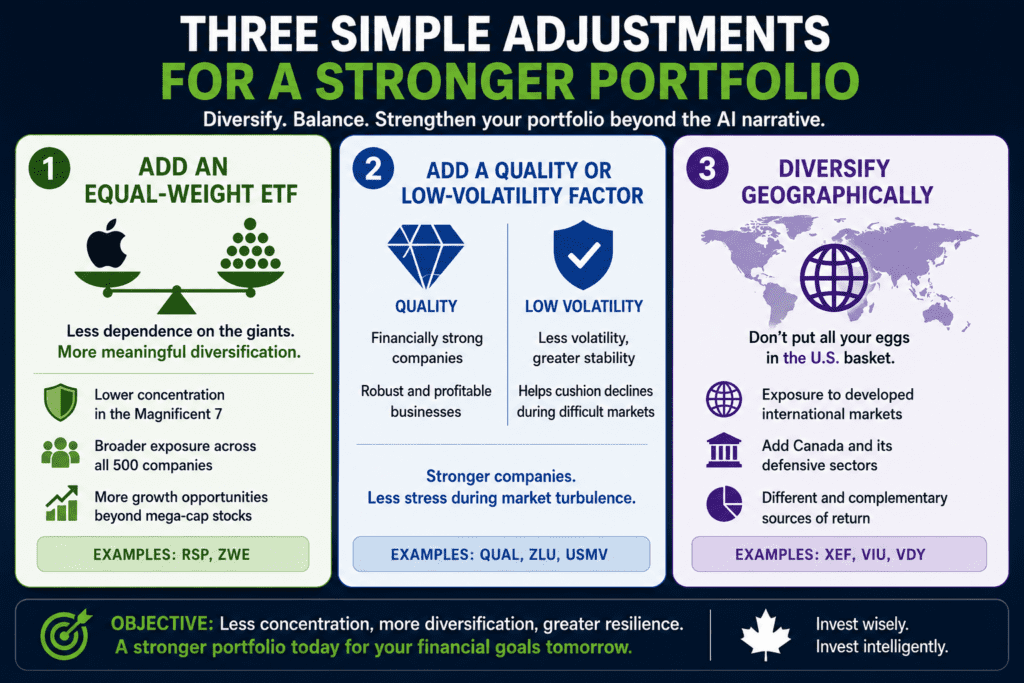
Three Simple Adjustments for a More Resilient Portfolio
Adjustment #1: Add an Equal-Weight ETF
The goal is not to panic or sell all of your VFV holdings. Instead, think of this as a portfolio enhancement. One of the simplest ways to reduce concentration risk is to add an equal-weight ETF as a counterbalance.
In an equal-weight index, every company is given the same allocation during the fund’s periodic rebalancing, regardless of its size or market capitalization.
💡 A Practical Example
In VFV, companies like Apple and Microsoft can each account for roughly 6% to 7% of the fund.
In an equal-weight ETF such as the Invesco S&P 500 Equal Weight ETF (RSP) or its Canadian-listed counterpart, the BMO S&P 500 Equal Weight Index ETF (ZWE), every company represents approximately 0.2% of the portfolio.
Nvidia represents 0.2%. A mid-sized pharmaceutical company represents 0.2%. An industrial company that few investors have heard of also represents 0.2%.
📈 The Key Benefits
Less Dependence on Technology Giants
Your exposure to the technology sector is significantly reduced compared to a traditional market-cap-weighted S&P 500 ETF, helping protect your portfolio from excessive reliance on a single sector.
More Meaningful Diversification
Your portfolio’s performance becomes more closely tied to the economic health of 500 individual companies rather than the market’s sentiment toward the Magnificent 7.
Broader Exposure to Mid-Sized Companies
You gain greater exposure to U.S. mid-cap businesses that are often overlooked as investment dollars continue to flow into the largest stocks.
Reduced Concentration Risk
No single company can dominate your portfolio. If a major technology company experiences disappointing results, regulatory issues, or a significant correction, the impact on your overall portfolio is much smaller.
Adjustment #2: Add a Quality or Low-Volatility Factor ETF
If you’re looking to further stabilize your portfolio, another effective strategy is to complement VFV with so-called Smart Beta ETFs, which focus on specific investment factors such as quality or lower market volatility.
💡 The Quality Factor Approach
Quality-focused ETFs select companies based on strict financial criteria, including strong balance sheets, low debt levels, robust cash flows, and consistent, predictable earnings.
ETFs to consider: The iShares MSCI USA Quality Factor ETF (QUAL) or the Canadian-listed iShares MSCI USA Quality Factor Index ETF (XQLT).
Why it works: Instead of buying companies simply because they are large—as a traditional S&P 500 ETF does—QUAL focuses on financially strong businesses such as Visa, Mastercard, and Home Depot. During economic slowdowns, these companies often prove more resilient thanks to their strong cash positions and durable business models.
💡 The Low-Volatility Approach
Low-volatility ETFs aim to reduce severe portfolio fluctuations while maintaining exposure to the stock market. They do this by selecting stocks that have historically experienced smaller price swings during both market advances and declines.
ETFs to consider: The BMO Low Volatility US Equity ETF (ZLU) or the iShares MSCI USA Min Vol Factor ETF (USMV).
Why it works: These funds tend to overweight defensive sectors such as utilities, consumer staples, and healthcare. Companies like PepsiCo and Procter & Gamble often play a larger role within these portfolios.
The goal is not to eliminate market declines. The goal is to reduce the likelihood of experiencing the kind of 30% to 40% drawdowns that often cause investors to panic and sell at the worst possible time.
📈 Key Benefits
Greater Peace of Mind
For investors approaching retirement—or simply those who struggle to stay invested during market turbulence—this adjustment can make a significant difference.
Improved Downside Protection
While these strategies may capture roughly 75% to 80% of strong market rallies, they have historically helped cushion portfolio losses during major market corrections.
Adjustment #3: Diversify Geographically
U.S. stocks now dominate many Canadian portfolios to a degree rarely seen before.
Yet compelling opportunities exist outside the United States.
ETFs such as XEF and VIU provide exposure to developed international markets including Europe, Japan, and Australia—regions that often perform differently from the U.S. market and can help improve diversification.
On the Canadian side, dividend-focused ETFs such as VDY provide exposure to sectors like banking, energy, and telecommunications. These industries may not attract the same attention as technology stocks, but they generate consistent cash flows, pay attractive dividends, and have often demonstrated greater resilience during market corrections.
The Hidden Risk: Currency Exposure Can Undermine Your Returns
Sector concentration is not the only blind spot.
There is a second one—and it is even less understood.
VFV is not currency-hedged against fluctuations in the U.S. dollar. In investing terminology, it is considered an unhedged ETF.
What does that mean in practice?
When you buy VFV, you are making two bets at the same time:
- The performance of U.S. stocks.
- The movement of the CAD/USD exchange rate.
A Real-World Example
Let’s assume the S&P 500 gains 10% this year. Great news.
But if the Canadian dollar appreciates by 8% against the U.S. dollar during the same period, your actual return in Canadian dollars could shrink dramatically.
You thought you earned 10%.
You may end up with only 2% or 3%.
Most investors were never told this when they purchased VFV.
Should You Sell Your VFV?
No.
VFV remains one of the best growth ETFs available to Canadian investors. The United States is still home to many of the world’s most innovative and profitable companies.
The problem is not the ETF itself.
The problem is how it is often used—alone, in excessive amounts, and without any meaningful counterbalance.
Fortunately, a few simple adjustments can make a significant difference.
What a Smart Investor Would Do in 2026
As the U.S. market becomes increasingly concentrated around technology giants, experienced investors begin to shift their perspective. Rather than trying to predict the next stock that will soar, they focus on strengthening their portfolio through diversification.
Their primary decision?
Keep VFV—but surround it with complementary investments.
To build a more resilient, all-weather portfolio in 2026, a thoughtful investor may rely on three complementary pillars:
🌐 International Exposure Through XEF or VIU
International diversification helps reduce dependence on the U.S. economy alone.
Funds such as XEF and VIU provide exposure to established industrial, financial, and consumer leaders across Europe, Japan, Australia, and other developed markets.
🛡️ A Quality or Low-Volatility Allocation
Adding ETFs such as XQLT or ZLU can act as a shock absorber within a portfolio.
These funds emphasize companies with strong balance sheets, stable cash flows, and resilient business models, helping protect capital when volatility in the technology sector increases.
🍁 Canadian Dividend Exposure
Dividend ETFs such as VDY or XEI provide access to recurring income streams while increasing exposure to Canadian banks, energy companies, and telecommunications firms. These sectors may not generate the same excitement as technology stocks, but they have historically offered stability and reliable dividend income during periods of market stress. This approach is not about eliminating VFV. VFV remains an excellent growth engine.
The objective is simply to surround it with additional layers of protection. The goal is not to outperform the market at any cost.
The goal is to avoid being overly dependent on a single investment theme at the wrong time. By diversifying across regions, sectors, and investment factors, investors can transform a concentrated technology-heavy portfolio into a more balanced and resilient wealth-building strategy that is better prepared for any economic cycle.
Conclusion
VFV remains an outstanding ETF. Its low cost, simplicity, and exposure to the U.S. market make it a core holding for many Canadian investors.
But the VFV of 2026 is not the VFV of 2015.
Concentration has increased dramatically. Technology exposure has reached historically high levels. And currency risk remains a factor that many investors continue to overlook.
Used wisely, VFV can remain a powerful portfolio cornerstone.
Used alone, without meaningful diversification, it has become a much more concentrated investment than most investors realize.
Smart diversification is not about complexity.
It’s about balance.
WyzeInvestors