The stock market environment in 2026 is shaped by several major forces that directly influence growth stocks:
• the spectacular rise of artificial intelligence
• massive investments in data centers and cloud infrastructure
• the transformation of the healthcare and biotechnology sectors
• the acceleration of automation and robotics

After several years dominated by large technology companies, investors are now looking to identify businesses capable of sustaining exceptional growth over the coming years. For Canadian investors, these companies often represent an excellent diversification opportunity, since the Canadian market is heavily concentrated in the following sectors:
• financial
• energy
• natural resources
Investing in technology or innovative companies therefore adds a powerful long-term growth engine to a portfolio. In this article, we analyze 7 companies that have some of the strongest growth profiles in 2026.
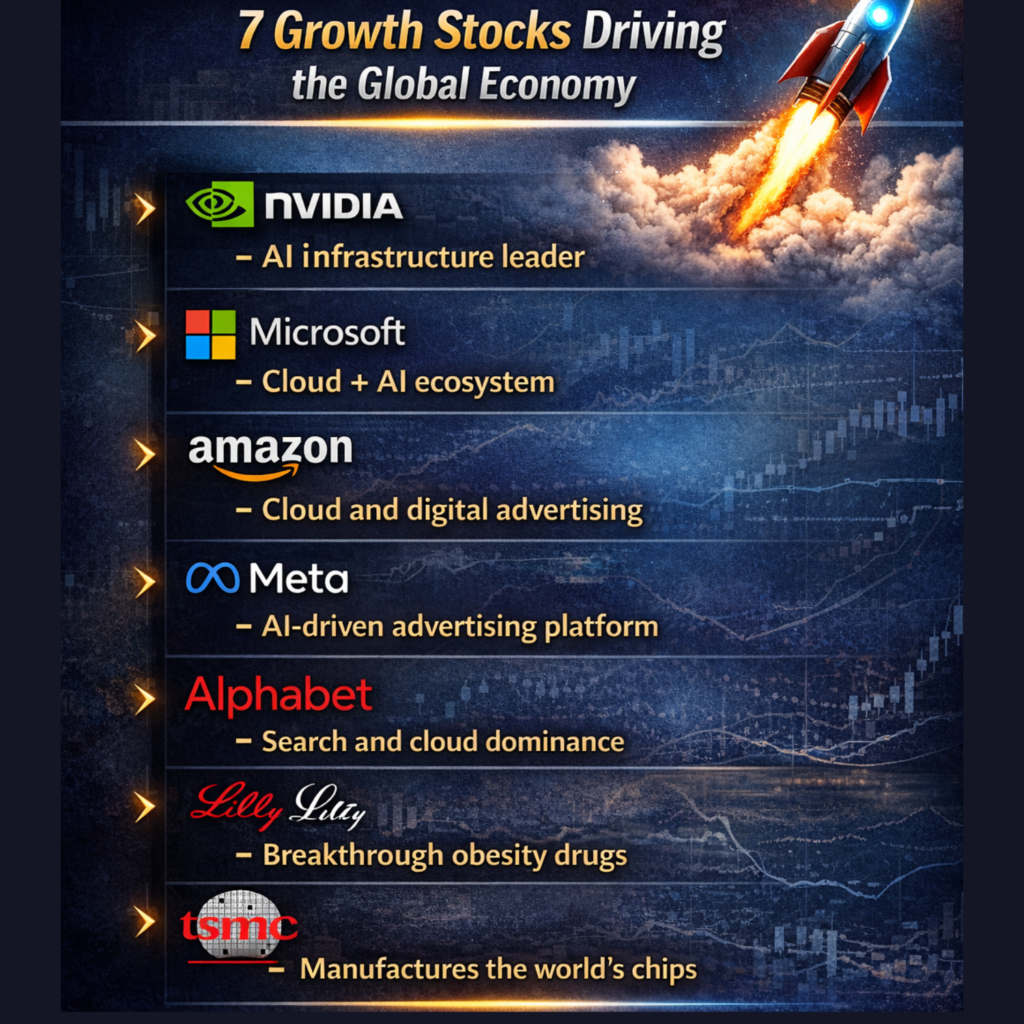
Executive Summary
The Criteria Used to Select These Companies
Before presenting the companies, it is important to understand the criteria used to identify a true growth stock.
Here are the key elements we looked for:
Strong revenue growth
The best growth companies typically show annual revenue increases above 15% or 20%.
Leadership in a rapidly expanding sector
Companies that dominate sectors such as:
• artificial intelligence
• cloud computing
• semiconductors
• innovative healthcare
often benefit from a durable competitive advantage.
High margins
The most successful technology companies often have high margins, allowing them to reinvest heavily in research and innovation.
Sustainable competitive advantage
This may include:
• a unique technology
• a massive user network
• a dominant platform.
Long-term growth potential
The selected companies must be able to continue growing for many years, rather than simply benefiting from a temporary trend.
1. Nvidia (NVDA) — The Heart of the Artificial Intelligence Revolution
Nvidia is no longer just a component manufacturer; it has become an indispensable architect of the global digital economy, with a market capitalization exceeding $4.5 trillion.
The company exerts near-hegemonic control over critical technologies:
• Market dominance: Nvidia holds roughly 92% of the discrete graphics processing unit (GPU) market as of early 2026.
• AI infrastructure: Its chips power more than 80% of AI servers used to train language models such as GPT.
• Strategic clients: The “Hyperscalers” (Microsoft, Amazon, Google, and Meta) alone represent about 40% of the company’s revenue, reinvesting heavily in the new Blackwell chips.
Why Nvidia remains an exceptional growth company despite its size:
• Explosive revenue growth: For fiscal year 2026, revenue is expected to grow by approximately 57%, driven by insatiable demand for data centers.
• Record profitability: The company reports a gross margin close to 75% and an exceptional net profit margin of 53%, figures rarely seen for a hardware company.
For many analysts, Nvidia is one of the companies best positioned to benefit from the artificial intelligence revolution over the next decade.
2. Microsoft (MSFT) — The Most Powerful Technology Ecosystem
Microsoft no longer just sells software; it manages the digital infrastructure of the planet. It is the quiet giant that combines double-digit growth with absolute financial stability.
Key figures for 2026:
• Azure growth: The Cloud segment (Azure) maintains strong growth of +33%, driven by the massive integration of AI.
• AI monetization: Copilot (AI integrated into Office 365) is estimated to add about $10 billion in additional annual revenue through premium subscriptions.
• Operating margins: The company maintains an extraordinary operating margin of around 43%, while heavily reinvesting in data centers.
Why include it in a portfolio?
• Office dominance: More than 400 million paying users (Office 365) are now deeply integrated into its AI ecosystem (Excel, Word, Teams).
• Dividend strength: Microsoft has increased its dividend every year for the past 20 years, with an average annual growth rate of about 10%.
• Cash reserves: With more than $100 billion in cash, it has the financial firepower to acquire virtually any future technological innovation.
The verdict: Microsoft is the ultimate core portfolio holding. It offers exposure to AI with significantly less volatility than semiconductor manufacturers.
Result: a company that combines growth, profitability, and market dominance.
3. Amazon (AMZN) — An Undervalued Technology Giant
Much more than just an e-commerce website, Amazon has become a powerful cash-flow machine thanks to its high-margin services.
Key figures for 2026:
• Cloud dominance (AWS): Amazon maintains its position as the global leader with about 31% market share, generating more than $100 billion in annual revenue with operating margins close to 30%.
• Advertising explosion: This is the hidden engine. Its advertising revenue is growing by +20% per year, exceeding $50 billion. It has become a pure profit engine that now rivals Google and Meta.
• Logistics optimization: Thanks to AI-driven automation, Amazon has reduced its delivery costs by more than 15% while increasing shipping speed.
Why buy it now?
• Attractive valuation: Despite its size, Amazon trades at a price-to-cash-flow ratio historically low compared with its 5-year average, making it appear “undervalued.”
• Net income growth: Analysts expect earnings per share (EPS) to increase by +35% for fiscal year 2026.
• AI synergy: Amazon plans to invest $150 billion over 15 years in data centers to support global demand for generative AI through AWS.
The verdict: Amazon is the ideal stock for investors seeking exposure to both retail consumption and the cloud revolution, with a more diversified risk profile than pure technology companies.
4. Meta Platforms (META) — AI at the Service of Advertising
Meta is no longer just a social network; it is the largest AI-optimized advertising targeting platform in the world. After a historic restructuring, the company shows extremely strong financial health heading into 2026.
The power of the ecosystem in numbers:
• Massive reach: More than 3.3 billion people use at least one Meta application (Facebook, Instagram, WhatsApp) every day.
• AI efficiency (Advantage+): AI-driven advertising tools have increased advertisers’ return on ad spend (ROAS) by 32%.
• Profit margins: Meta has recovered operating margins of around 40%, thanks to cost reductions and increased automation.
Why Meta remains a growth stock in 2026:
• Earnings growth (EPS): Analysts expect annual earnings growth of +14% over the next two years.
• Share buybacks: Meta has authorized a massive $50 billion share repurchase program, directly supporting shareholder value.
• WhatsApp monetization: The “Business Messaging” segment on WhatsApp is beginning to generate substantial revenue, with growth of +60% year over year.
The verdict: Meta is the ideal stock for investors betting on user data and digital advertising. It is the company that best converts artificial intelligence into immediate advertising dollars.
5. Alphabet (GOOGL) — The Engine of the Digital Economy
Alphabet dominates search and has successfully transitioned toward generative AI (Gemini), while transforming Google Cloud into a powerful profit engine.
Dominance in numbers for 2026:
• Search monopoly: Google holds more than 90% of the global search market share, generating over $60 billion in free cash flow annually.
• Cloud growth: Google Cloud has reached sustainable profitability with annual growth of +28%.
• YouTube power: With more than 2.7 billion active users, YouTube generates over $35 billion in annual advertising revenue.
Why Alphabet is an opportunity in 2026:
• AI integration: The “Gemini” AI is integrated into Android (3 billion devices) and Google Workspace.
• War chest: With more than $110 billion in net cash, Alphabet has the financial strength to repurchase its own shares.
Alphabet is a stock that combines stability, growing dividends, and innovation.
6. Eli Lilly (LLY) — The Revolution in Obesity Medications
Eli Lilly does not just sell medications; it holds the solution to one of the world’s biggest public health challenges: obesity. In 2026, the company stands as the most valuable healthcare company in the world.
The explosion of numbers in 2026:
• Revenue growth: Driven by the phenomenal success of Zepbound and Mounjaro, annual revenue growth exceeds 30%, an unprecedented pace for a pharmaceutical giant.
• Massive market: Analysts estimate that the global weight-loss drug market (GLP-1) will reach $150 billion by 2030. Eli Lilly currently captures nearly half of that market.
• Production capacity: The company has invested more than $18 billion since 2020 to build new manufacturing facilities to meet demand that still exceeds supply.
Why Eli Lilly is a powerful growth engine:
• Expanded indications: Its treatments are in late-stage trials for sleep apnea and kidney disease, significantly expanding its reimbursed patient base.
• Alzheimer’s pipeline: Beyond obesity, its new Alzheimer’s treatment (Donanemab) is beginning to contribute meaningfully to results in 2026.
• Stock performance: The stock has delivered more than 500% returns over the past five years, significantly outperforming the S&P 500.
The verdict: Eli Lilly is the ultimate healthcare growth stock. For Canadian investors, it offers valuable diversification in a sector where innovation creates extremely profitable monopolies.
7. Taiwan Semiconductor (TSM) — The Company That Manufactures the World’s Chips
If Nvidia is the brain of artificial intelligence, TSMC is its exclusive factory. Without this company, Apple, Nvidia, and AMD would practically cease to exist. In 2026, TSMC confirms its status as an indispensable technological monopoly.
Dominance in numbers for 2026:
• Overwhelming market share: TSMC manufactures more than 90% of the world’s most advanced semiconductors (3nm and below).
• Revenue growth: Thanks to the explosion of AI, the company expects a compound annual growth rate of 15% to 20% over the coming years.
• Iron margins: Despite massive investments, it maintains an impressive gross margin of 53%, effectively dictating prices to its clients.
Why TSMC is a pillar of growth:
• The transition to 2nm: In 2026, TSMC begins mass production of 2-nanometer chips, widening a technological gap that competitors (Intel, Samsung) struggle to close.
• Rising dividends: Unlike many growth stocks, TSMC pays a stable dividend that has increased by nearly 10% per year on average.
• Reasonable valuation: It often trades at a more attractive price-to-earnings (P/E) ratio than major U.S. software giants, offering a “value entry point” within a growth sector.
The verdict: This is the most strategic stock in your portfolio. By owning TSM, you are indirectly investing in the success of Apple, Nvidia, and the entire robotics and automotive revolution.
How to Invest in These Companies (For Canadian Investors)
Although many investors prefer to buy individual stocks such as Nvidia or Microsoft, there is also a simple way to gain exposure to these companies: ETFs (Exchange-Traded Funds).
ETFs allow investors to invest in multiple companies at once, which reduces the risk associated with holding a single stock.
Here are a few ETFs popular among Canadian investors that include several of the companies mentioned in this article.
VFV – Vanguard S&P 500 ETF
The VFV ETF tracks the S&P 500 index and includes several of the largest growth companies in the world.
Notably, it includes:
• Nvidia
• Microsoft
• Amazon
• Meta
• Alphabet
This ETF therefore provides broad exposure to leading U.S. technology companies.
Advantages:
• immediate diversification
• very low management fees
• exposure to the world’s largest companies.
QQC – Invesco Nasdaq-100 ETF
The QQC ETF tracks the Nasdaq-100 index, which is heavily concentrated in technology and growth companies.
This fund includes several companies mentioned in this article:
• Nvidia
• Microsoft
• Amazon
• Meta
• Alphabet
For investors who want to maximize their exposure to technology companies, this ETF is often considered one of the best options.
Buying the Stocks Directly
Some investors also prefer to buy individual stocks in order to concentrate their portfolio on their favorite companies.
In this case, the stocks can easily be purchased through a Canadian broker in accounts such as:
• TFSA
• RRSP
• non-registered account.
Tax Optimization for Canadian Investors
One element often overlooked by investors is the tax impact of the investment account they choose.
U.S. Stocks in an RRSP
When U.S. stocks such as Nvidia, Microsoft, or Amazon are held in an RRSP, Canadian investors benefit from an important tax advantage.
Thanks to the tax treaty between Canada and the United States:
• U.S. dividends are not subject to the 15% withholding tax.
This makes the RRSP particularly attractive for holding U.S. dividend-paying stocks.
U.S. Stocks in a TFSA
In a TFSA, the 15% U.S. withholding tax on dividends still applies.
However, the TFSA offers a major advantage:
• all capital gains are completely tax-free in Canada.
For growth companies such as Nvidia or Amazon — which pay little or no dividends — the TFSA remains an excellent investment vehicle.
Investing in Growth Stocks in a Volatile Market
The current market environment is characterized by increased volatility, particularly due to geopolitical tensions such as the conflict in the Middle East, as well as uncertainties surrounding interest rates and global economic growth. These factors can trigger rapid market corrections, even for very high-quality companies.
It is therefore not uncommon to see certain technology stocks decline by 10% to 20% over short periods, before resuming their long-term trajectory. For patient investors, these periods can represent attractive investment opportunities.
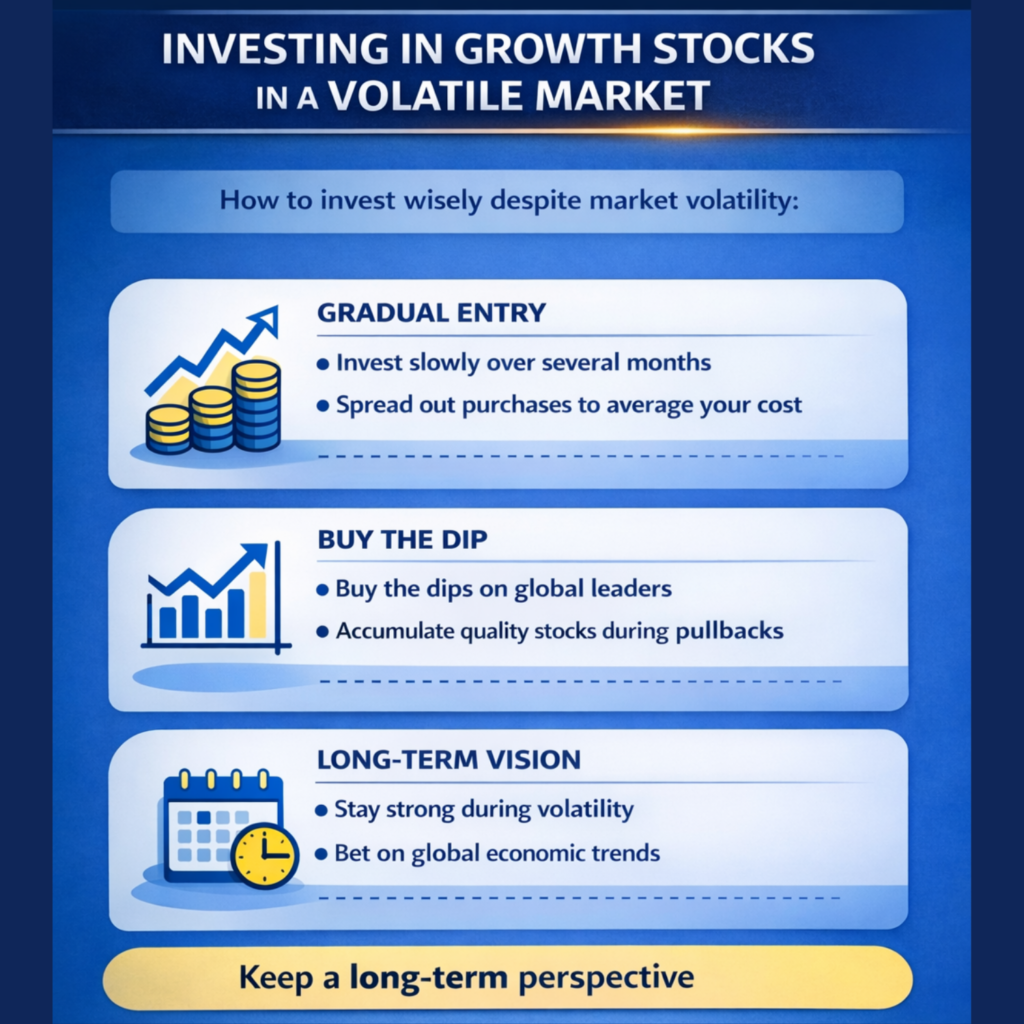
A first approach is to adopt a gradual entry strategy into the market. Rather than investing all capital in a single transaction, many investors prefer to spread their purchases over several weeks or months. This strategy helps reduce the risk of poor timing and allows investors to benefit from potential market pullbacks.
Another popular strategy is to take advantage of market dips, often referred to as buy the dip. During periods of uncertainty, markets can react excessively to economic or geopolitical news. This can temporarily lower the prices of high-quality companies, giving investors the opportunity to accumulate shares at more attractive valuations.
Finally, it is important to maintain a long-term perspective. Despite economic cycles and international tensions, several structural trends continue to support global growth, including artificial intelligence, cloud computing, semiconductors, and innovation in the healthcare sector.
The companies presented in this article are positioned at the center of these transformations. For this reason, many investors choose to use periods of volatility to gradually strengthen their positions while maintaining an investment horizon of several years.
Conclusion
Growth stocks remain one of the best ways to build long-term wealth.
In 2026, several companies clearly stand out thanks to their dominant position in rapidly expanding sectors.
Among the most promising:
• Nvidia
• Microsoft
• Amazon
• Meta
• Alphabet
• Eli Lilly
• Taiwan Semiconductor.
For Canadian investors, these companies provide direct exposure to major global technological and economic trends, which are often underrepresented in the Canadian market.
Of course, growth stocks can be volatile. A prudent strategy is therefore to diversify your portfolio and invest with a long-term perspective.