If you’re looking at GPTY because you saw a distribution yield north of 35%, you’re not alone — that number is what draws most income investors to this fund. This article breaks down what GPTY (YieldMax AI & Tech Portfolio Option Income ETF) actually is, whether that yield is real money you can count on, what the risks are, and how (or whether) it should fit into an income portfolio.
Video
The basics: what is GPTY?
GPTY is an ETF that owns real shares in 15 to 30 well-known AI and technology companies — think NVIDIA, Microsoft, Apple, Amazon. On top of owning those stocks, the fund manager sells options contracts against them every week to collect extra cash, which gets paid out to shareholders as a weekly distribution.
| What you need to know | Detail |
|---|---|
| Ticker | GPTY |
| Who runs it | YieldMax |
| Where it trades | NYSE Arca (U.S. exchange, priced in USD) |
| Launched | January 22, 2025 |
| How often it pays | Weekly |
| Current distribution yield | 35.58% (annualized, as of 8/18/2026) |
| Annual fee (total operating cost) | 1.06% (gross expense ratio) |
| Fund size | $129.7 million (8/19/2026) |
| Share price / NAV | ~$41.84 (8/19/2026) |
Source: YieldMax GPTY fund page.
How the fund actually generates income
GPTY doesn’t just sell plain “covered calls” the way some simpler income funds do. A basic covered call sells one call option against a stock and caps 100% of the upside above that price. GPTY instead sells call spreads — it sells a call option at one price and simultaneously buys a call option at a higher price on the same stock. This costs a small piece of the premium collected, but in exchange it lets GPTY still capture some of the stock’s gains between those two price points, instead of having all upside cut off at a single level. In plain terms: it’s a middle ground between owning the stock outright and a fully capped covered-call strategy — you still give up some of the biggest gains, but not all of them.
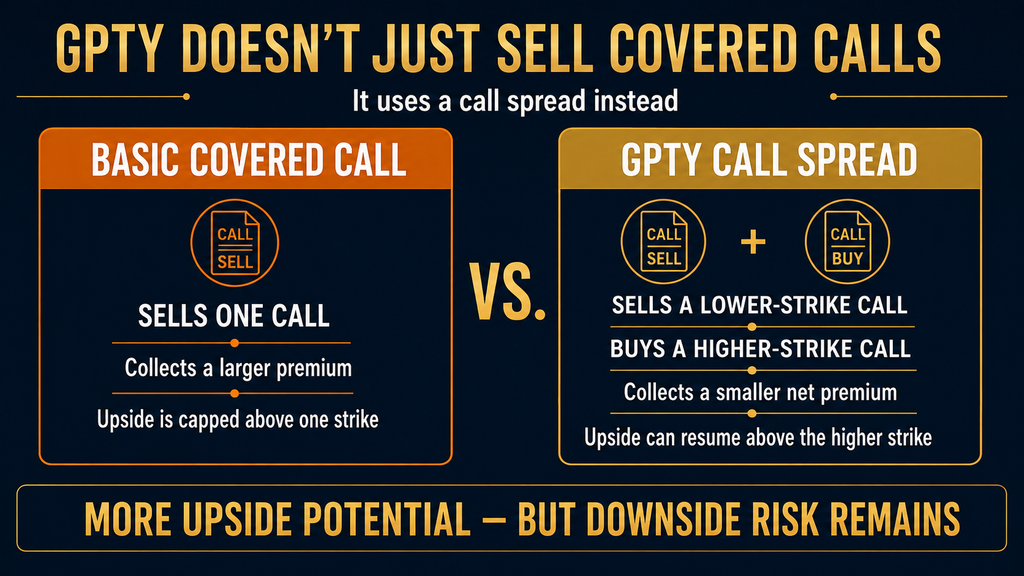
option income explained: YieldMax AI & Tech Portfolio Option Income ETF
How does it pay 35%? Is that real?
Yes, the cash is real — but it doesn’t come for free, and it isn’t “extra” money on top of normal stock returns. It comes from three places:
- Dividends the underlying companies pay (small — most tech companies pay little or no dividend)
- Option premiums — cash collected from selling options contracts on the stocks it holds
- Return of your own capital — when the first two sources aren’t enough to cover the payment, the fund simply hands back a piece of your original investment
That third source is the important one to understand. Looking at GPTY’s last 12 weekly payments, several weeks were funded almost entirely by option premiums (good), while others were funded 95–100% by return of capital (essentially your own money being handed back to you, not a “gain”).
Last 12 weekly payments:
| Date | Amount/share | % that was your own capital, not a gain |
|---|---|---|
| 08/19/2026 | $0.2946 | 97% |
| 08/12/2026 | $0.2933 | 41% |
| 08/05/2026 | $0.2858 | 0% |
| 07/29/2026 | $0.2758 | 0% |
| 07/22/2026 | $0.2805 | 96% |
| 07/15/2026 | $0.3416 | 48% |
| 07/08/2026 | $0.3077 | 45% |
| 07/01/2026 | $0.3045 | 0% |
| 06/24/2026 | $0.3678 | 0% |
| 06/17/2026 | $0.3709 | 0% |
| 06/10/2026 | $0.3237 | 99% |
| 06/03/2026 | $0.3834 | 100% |
Total paid over these 12 weeks: $3.83/share. That’s not a fixed, predictable paycheck — the amount and the source of the money both bounce around from week to week.
Return of Capital?
The one thing to remember: getting a return of your own capital back isn’t automatically bad. It only becomes a real problem if it happens over and over, for years, faster than the fund is actually growing — because that slowly shrinks the value of what you own, even while the checks keep arriving.
One more nuance worth knowing: “return of capital” is partly a tax label, not just a verdict on fund health.
In option-income funds like GPTY, some option-premium income legally gets classified as ROC for tax purposes rather than as ordinary income — which mainly affects how it’s taxed (it lowers your cost basis instead of being taxed immediately) rather than proving the fund lost money that week. The distinction that actually matters for your wallet is whether the fund’s share price is trending down over months and years alongside these payments — that’s the sign of the “destructive” version of ROC you want to watch for, not the tax classification itself.
Is the 35% yield sustainable?
Nobody can promise that, including YieldMax itself — they say plainly that distributions can change and aren’t guaranteed. Here’s the honest picture:
The 35% figure is a snapshot: it takes one recent payment and multiplies it out for a full year. It’s not a lifetime promise.
It depends on AI and tech stocks staying volatile enough to generate rich option premiums. If volatility drops, the income drops too.
The fund is only about 19 months old. It has never been tested through a real AI-sector crash, only through a strong rally. We don’t yet know what the payments — or the share price — look like in a bad year.
Has it actually made money for investors so far?
Yes, so far. Since it launched in January 2025 through July 2026, an investor who reinvested every distribution would have turned $10,000 into roughly $13,964 — a total gain of about 40%, which actually beat the S&P 500 over the same stretch (about 25%).
But here’s the catch: that comparison only covers a strong bull market for AI stocks. GPTY hasn’t been tested in a downturn, and a big chunk of its “return” so far has come from cash payments rather than the share price actually going up.
In fact, GPTY has paid out roughly $24 per share in cash distributions since launch — more than half of its current $41.84 share price. That’s a useful gut-check on how much of this fund’s story is “income” versus “growth.”

The real risks, in plain terms
You can lose money — including your original investment. GPTY owns real stocks. If AI/tech stocks fall hard, the fund’s share price falls too. The option income cushions the blow a little, but it does not protect you from a real downturn.
Your “yield” can shrink your principal over time. If the fund keeps paying out more than it earns, the share price will drift lower over the years — meaning you could be getting paid consistently while your account balance quietly shrinks. Watch the share price/NAV over time, not just the size of the deposit.
concentration risk
It’s a one-theme bet. Over half of the fund is packed into just 10 stocks (NVIDIA, Snowflake, Alphabet, Palantir, Microsoft, IBM, Apple, Amazon, Marvell, AMD), and all 15–30 holdings are in AI and technology. If that sector has a bad year, there’s no other sector in this fund to soften the fall.
You give up some of the upside. The option strategy that generates the income also caps some of the gains if the stocks rally hard. In the last year, a plain AI-focused fund with no option strategy (AIQ) returned about 42%, compared to GPTY’s roughly 26% — the income has a real cost.
It’s expensive. The annual fee is 1.06% — five to seven times more than a basic tech-index fund like QQQ (0.20%) and about three times more than a lower-cost competitor like JEPQ (0.35%).
Tax
Weekly payments mean weekly tax complexity. Some of what you receive may be taxed as regular income, some as capital gains, some not taxed right away at all (return of capital). This makes tax season more complicated than a simple dividend stock. Talk to a tax professional, especially if you’re not a U.S. resident — GPTY is a U.S. fund, priced in U.S. dollars, and non-U.S. investors need to think about currency risk and withholding tax too.
How much of your portfolio should this be?
For an income-focused investor, GPTY is best thought of as a satellite position, not a core holding — a small slice of your portfolio dedicated to higher, more volatile income, not the foundation you build everything else on. Reasonable ways to think about sizing it:
- Conservative income investor: Skip it, or keep it under 5% of your portfolio if you’re curious. Your core income should come from more stable sources — bonds, dividend-growth stocks, or broad-market income funds.
- Growth-and-income investor comfortable with risk: A 5–10% “satellite” allocation, paired with a diversified core (broad index funds, bonds, real dividend payers), lets you enjoy the cash flow without betting your retirement on one volatile sector.
- Aggressive income investor who understands the risks: Could go higher, but even then, most advisors would caution against making a single-theme, single-fund option-income product more than 15–20% of a portfolio.
The bigger point: don’t let a big weekly deposit convince you this is a “safe” core holding. It’s a high-risk, high-reward income tool, not a bond replacement.
GPTY vs. similar funds — is there a better option for you?
| Fund | What it owns | Yield (approx.) | Annual fee | How risky |
|---|---|---|---|---|
| GPTY | 15–30 AI/tech stocks | ~35.6% | 1.06% | High — one sector, young fund |
| YMAG | Just 7 “Magnificent Seven” mega-caps | ~48.7% | 1.12% | Very high — even more concentrated |
| CHPY | 15–30 semiconductor stocks only | ~39% | 0.99% | Very high — single sub-sector, extremely volatile |
| QQQI | Full Nasdaq-100 (~100 companies) | ~14% | 0.68% | Moderate — broader, less concentrated |
| JEPQ | Full Nasdaq-100 (~100 companies) | ~11% | 0.35% | Lower — broadest of this group, cheapest fee, longest track record |
What this tells you: the higher the advertised yield, the narrower and riskier the fund tends to be. GPTY sits in the middle of the YieldMax family — more diversified than a single-stock fund, but far more concentrated than JEPQ or QQQI.
A genuinely “better strategy” for most income investors is often not to chase the highest number on this list at all. A few alternatives worth considering instead of — or alongside — GPTY:
–JEPQ or QQQI if you want the same basic idea (income from tech stocks via options) but with far more diversification and a lower fee. You’ll collect a smaller check, but with meaningfully less concentration risk.
–A simple Nasdaq-100 or broad-market index fund (QQQ, QQQM, or a total-market fund) if your real goal is long-term growth. You’ll get no special “income,” but historically you keep 100% of the upside with no cap — and you can always sell shares periodically to create your own “distribution.”
–A blend approach: hold your core portfolio in broad, low-cost index funds and bonds, and use a small GPTY (or similar) position purely as a bolt-on for extra cash flow — treating the high yield as a bonus, not your retirement plan.
Quick summary: Who should buy vs. avoid GPTY
✅ GPTY may make sense if you:
- Want extra weekly cash flow and are comfortable that the amount will vary
- Already hold a diversified core portfolio and are adding this as a small, deliberate “satellite” slice
- Understand that a chunk of each payment can be your own capital, not new gains
- Can tolerate real ups and downs in the share price, including sharp short-term drops
- Are investing money you don’t need to touch on a fixed schedule (so a bad month doesn’t force you to sell at a loss)
🚫 GPTY probably isn’t for you if you:
- Need predictable, stable income you can budget around (e.g., to cover essential monthly expenses)
- Are looking for a “safe” bond-like or core retirement holding
- Want maximum long-term growth and would rather keep 100% of the upside in AI/tech stocks
- Aren’t comfortable with a fund that’s concentrated in one sector and has less than two years of history
- Would panic-sell during a sharp drawdown rather than sit through it
Bottom line
GPTY does what it says: it pays large, real, weekly cash distributions built from AI/tech stock ownership plus options income. So far, since its 2025 launch, it has even outperformed the S&P 500 on a total-return basis. But the 35%+ yield is not “free” income — a meaningful part of it can be your own capital coming back to you, the fund is concentrated in one volatile sector, it has no track record through a downturn, and it costs more than most alternatives.
Use it, if at all, as a small, deliberate slice of an income portfolio — not as a replacement for a diversified core. Keep an eye on the share price over time (not just the size of your weekly deposit), and go in understanding that a large chunk of any given payment might simply be your own money coming back to you rather than new investment income.
This article is for educational purposes only and is not financial or tax advice. GPTY involves a real risk of losing money, including your original investment. Distributions are not guaranteed and can include return of capital, which can reduce the fund’s value over time. Past performance does not predict future results. Talk to a licensed financial advisor and a tax professional before investing, especially if you live outside the United States.
Quick FAQ
Is the 35% yield guaranteed?
No. It’s based on one recent payment and can go up or down. YieldMax states clearly that distributions are not guaranteed.
Can I lose money in GPTY?
Yes. It owns real stocks, and the option income does not fully protect you from a market decline.
Is this a good “safe” retirement income fund?
No — it’s a high-risk, concentrated, single-sector fund best used as a small satellite position, not a core retirement holding.
What’s a lower-risk alternative with similar income?
JEPQ or QQQI offer a similar options-income idea across the broader Nasdaq-100, with lower fees and less concentration, though smaller yields.
How much of my portfolio should be in something like GPTY?
Most guidance suggests keeping single-theme, high-yield option-income funds like GPTY to a small slice — commonly under 10–15% of a portfolio — alongside a diversified core.