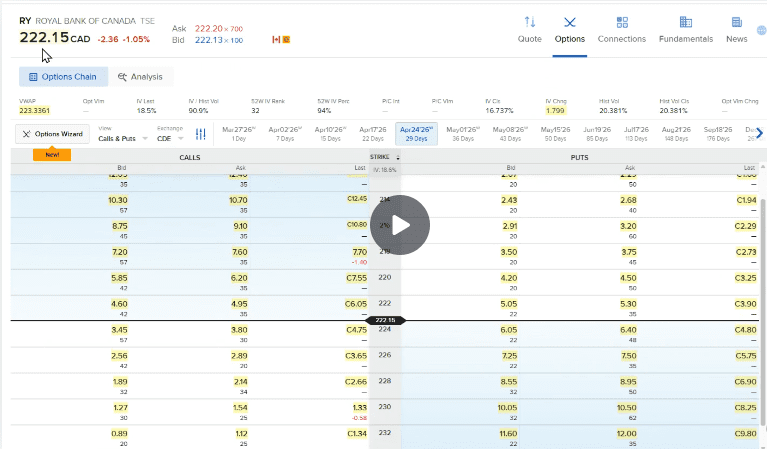
You’ve held shares of Royal Bank, Enbridge, or Bell Canada for years. You collect your dividends every quarter. But did you know there’s a simple strategy to generate additional monthly income from those same shares — without selling them, without major added risk? This strategy is called the covered call. It’s one of the most popular income-generating options strategies among dividend investors, and for good reason: it’s straightforward, transparent, and works especially well on quality stocks you intend to hold for the long term.
💡 The idea in one sentence You sell another investor the right to buy your shares at a pre-set price, in exchange for a cash premium received immediately — regardless of what happens next.
2. Why This Strategy Works Especially Well on Quality Stocks
Selling covered calls is ideal for stocks you want to hold long-term. Here’s why it’s such a powerful combination:
You have no intention of selling your RY, ENB, or BNS shares anyway. So you might as well get paid to say “I won’t sell below $X.”
Quality blue-chip stocks have moderate volatility — which generates reasonable premiums without excessive uncertainty.
These stocks already pay dividends. Selling calls creates a second income stream that adds on top.
If the stock drops sharply, you remain a shareholder in all cases — the premium received partially offsets the decline.
🛡 The Least Risky Strategy Among All Options Strategies Selling covered calls is considered the most conservative options strategy available. Unlike buying options (where you can lose 100% of your investment), the covered call seller always remains a shareholder. In the worst case, you sell at a good price. In all other cases, you keep your shares AND the premium.
Best Canadian and U.S. Stocks for This Strategy
Royal Bank (RY) — high liquidity, options available on TSX and NYSE
TD Bank (TD), Bank of Nova Scotia (BNS), BMO — same profile
Enbridge (ENB) — strong dividend, low volatility
BCE, Telus — stability, options available
Manulife (MFC), Sun Life — financial sector, solid premiums
U.S. side: JPMorgan, Apple, Microsoft, Johnson & Johnson
3. Real-World Example: Royal Bank at $222
Starting position: You bought 100 shares of RY at $222. Current price: $222. Total position value: $22,200.
You decide to sell 1 covered call contract on these 100 shares with the following parameters:
Parameter
Value
Stock
Royal Bank (RY)
Purchase price
$222
Current price
$222
Strike chosen (conservative OTM)
$230
Expiration
In 30 days (1 month)
Premium received
$200 ($2.00 × 100 shares)
Contracts sold
1 contract
✅ Immediate result As soon as you sell the option, $200 is credited to your account. That money is yours, no matter what happens next.
4. The Three Scenarios at Expiration
Scenario A — RY stays below $230 (e.g., $218 or $225)
📌 Result: The option expires worthless. You keep everything. The option buyer won’t exercise because they can buy RY cheaper on the open market. The option expires. You keep your 100 shares of RY AND the $200 premium. The next day, you can do it again and sell a new call for the following month.
You keep: 100 shares of RY
You keep: $200 premium received
Monthly return on premium: $200 / $22,200 = 0.90% in one month
Action: Repeat the strategy next month
Scenario B — RY rises but stays below $230 (e.g., $228)
📌 Result: The option expires, you benefit from the gain AND keep the premium. Even if RY rises to $228, the buyer doesn’t exercise the option (strike = $230). You benefit from the $6/share unrealized gain AND keep the $200 premium.
Unrealized gain on shares: +$600 (100 × $6)
Premium received: +$200
Total: +$800 on the position this month
Scenario C — RY rises above $230 (e.g., $235) — Assignment
⚠️ Result: You are assigned. You must sell your 100 shares at $230. The buyer exercises their option. You must sell your 100 shares at the strike price of $230. You don’t benefit from the move above $230. But you still made a total gain of $800 on the sale (230 – 222 = $8 × 100) + $200 premium = $1,000 total gain.
Sale price: $230 (you miss the upside above this level)
Gain on shares: +$800 (100 × $8)
Premium received: +$200
Total gain: $1,000 in one month — excellent return
Downside: You no longer own the shares. To get back in, you’d need to buy at market price (e.g., $235).
Solution: Choose a sufficiently high strike to reduce this risk
5. The ‘Aggressive Income’ Investor: Strike at $222 (At the Money)
Some investors want to maximize the premium received. To do so, they sell an at-the-money (ATM) call — with a strike equal to or very close to the current stock price.
Conservative Profile (Strike $230)
Aggressive Profile (Strike $222)
Strike
$230 (OTM — 3.6% above current)
$222 (ATM — at current price)
Premium received
~$200/month
~$500/month
Assignment risk
Low (~15-25%)
High (~45-55%)
Est. annual income
~$2,400/year
~$6,000/year
Risk of losing shares
Low
Near-certain over time
Recommended for
Investor who wants to hold shares LONG-TERM
Flexible investor, willing to repurchase shares
⚠️ Warning — Assignment at 4:00 PM on Expiration Day Assignment happens automatically at 4:00 PM (market close) on expiration day if the stock is above the strike. With an ATM strike at $222, if RY is at $222.01 at the bell, you lose your shares. This is mechanical and automatic — no intervention is possible.
6. Monthly or Weekly — How Often Should You Repeat?
Monthly Strategy (Recommended for Beginners)
Sell 1 call per month — expiration on the 3rd Friday
Less monitoring required — ideal for passive investors
Higher premiums per contract (more time value)
Example with RY: $200/month × 12 = $2,400/year in additional income
Weekly Strategy (For Active Investors)
Sell 1 call per week — expiration every Friday
Smaller premiums (~$50-80/week on RY) but more frequent
Higher annual potential but requires more active management
Assignment risk is more frequent — requires closer attention
Requires your broker to offer weekly options (weeklys) on the stock
💡 WyzeInvestors Recommendation To start, use the monthly strategy on a single stock you know well (e.g., RY or ENB). Master the mechanics, observe a few full cycles, then move to weeklies if you want to be more active.
7. Supplementing Your Existing Dividend Income
One of the most powerful aspects of this strategy is how it stacks on top of the dividends you already receive:
Income Source
Est. Annual Amount
Est. Yield
RY Dividends (100 shares)
~$540/year
~2.4%
Covered Call Premiums (OTM)
~$2,400/year
~10.8%
Total Combined
~$2,940/year
~13.2%
* Estimates based on RY at $222, 100 shares. Premiums vary with implied volatility. Dividends are subject to change.
8. Which Platforms Support This Strategy?
Wealthsimple Options
Available on Wealthsimple — BUT only for U.S.-listed securities
RY, BNS, ENB listed on NYSE/NYSE MKT: accessible
RY listed on TSX (in CAD): options not available on Wealthsimple
Simple interface — great for beginners
Fees: $0 per options trade (free)
Interactive Brokers (IBKR)
Most complete platform — all eligible stocks, both U.S. AND Canadian
Access to options on TSX-listed stocks (in CAD)
Very low fees (~$0.65 to $1 USD per contract)
More technical interface — recommended for intermediate investors
CIBC Investor’s Edge (and Other Major Banks)
RBC Direct Investing, TD WebBroker, BMO InvestorLine, National Bank Direct Brokerage
All offer options on Canadian and U.S. stocks
Higher fees (typically $6-10/contract)
Familiar interface for existing banking clients
⚠️ Important Warning — Sell, Don’t Buy For this strategy, you must SELL the call option (Sell to Open / Write a Call) — not buy it. On your platform, make sure to select ‘Sell’ or ‘Sell to Open’. Buying a call is a completely different strategy with a total loss of premium possible. Familiarize yourself with your broker’s interface before placing your first order. A mistake in the direction of the transaction can have significant consequences.
9. Practical Tips to Get Started Safely
Start with 1 contract on 1 stock you know well (e.g., RY or ENB)
Choose an OTM strike (3 to 5% above current price) to minimize assignment risk
Prefer options with 20-30 days to expiration (the risk/reward sweet spot)
Never sell more contracts than you have lots of 100 shares
Document every trade: date sold, strike, premium, expiration, outcome
If the stock rises sharply before expiration, you can ‘buy back’ the option to close it (Buy to Close) — often at a cost above the premium received
Keep a trade journal: it will help you optimize your strike selection and timing
Conclusion
Selling covered calls is a simple, time-tested strategy perfectly suited for Canadian investors who hold quality stocks for the long term. It transforms a passive position into an active monthly income stream, without changing your investment philosophy.
The more you like the stocks you hold, the more comfortable this strategy becomes — because even during market turbulence, you’re not tempted to sell at a loss. You wait, collect your premiums, and keep going.
🌿 Summary in 4 Points 1. You hold 100+ shares of a quality stock (RY, ENB, etc.) 2. You sell 1 monthly covered call with a comfortable OTM strike 3. You receive an immediate premium (~$200-500 depending on your profile) 4. You repeat every month — dividends + premiums, combined
Legal Disclaimer
This article is provided for educational purposes only and does not constitute financial, tax, or legal advice. The strategies described involve risk. Past performance does not guarantee future results. Consult a licensed financial advisor before implementing any options strategy. The figures used are estimates for illustrative purposes only.