Canadian investors are increasingly interested in dividend stocks. And it makes sense: they offer a powerful double advantage:
- Regular income in the form of dividends
- Long-term capital growth potential
But not all dividends are created equal. Some companies have a high dividend… only because their stock price has fallen sharply. This is called a “dividend trap” : attractive yield, but dividend at risk of cut-off. That’s why, for 2026, the strategy we’re putting forward is simple:
👉 Prioritizing “quality” over “high yield”
This article focuses on:
- financially strong companies
- Sustainable and growing dividends
- Robust balance sheets
- High cash flow generation
In short: companies that are not only able to pay today… but also to continue to increase their dividends tomorrow.

Why focus on “quality” in 2026?
The current economic environment is characterized by:
- Interest rates still high
- moderate economic growth
- Geopolitical risks
- Markets that are sometimes very volatile
In this context, high-quality companies offer three major advantages.
1. Protection contre les “yield traps”
Some companies advertise returns of 8%, 9%, 10% or more. This sounds very attractive to an investor looking for income, but such a level of return often hides a less positive reality. In many cases, this high yield is mainly due to a sharp drop in the share price. Since the return is calculated according to the price, when the stock falls, the percentage rises mechanically. It is therefore not necessarily a “good deal”, but sometimes a warning signal.
These companies often combine fragile profits with high debt. When profits fall or interest rates rise, it becomes difficult to maintain a high dividend. The consequence is known:
❌ Fall in the share price❌, reduction or cut of the dividend, lasting❌ loss for the investor
Conversely, quality companies generally display:
✔ Controlled debt
✔, stable
✔ profits , a prudent payout policy
In their case, the dividend is sustainable and becomes a real tool for long-term wealth creation, rather than a hidden risk. The conclusion is clear: a reasonable and reliable dividend is better than an exceptionally high yield built on shaky foundations.
2. Stability of payments
Investors are increasingly looking for:
- Predictability
- Regular income
- Low dividend volatility
Quality companies tend to:
✔ Weathering recessions
✔ Adjusting capital intelligently
✔ Maintaining dividends even in difficult times
3. Capital Growth Potential
Dividends represent only a portion of the total return on a stock market investment. The other essential component is the appreciation of the stock price over time. A quality investment is therefore not limited to receiving regular payments: it must also allow the value of the security to increase sustainably.
Strong companies often share several characteristics: they innovate, develop new products, improve efficiency, and defend strong competitive positions. They generate significant and recurring cash flows, which allows them to finance their growth, reduce their debt and remunerate shareholders. They intelligently reinvest their profits: modernization, expansion, targeted acquisitions, or share buybacks.
These companies thus offer a double efficiency engine :
• gradual growth in dividend paid• potential long-term share price growth
For the patient investor, this combination is powerful. The dividend provides regular income, while the increase in the share price helps build wealth. This is why focusing only on the dividend rate can be misleading: it is better to favor companies that can grow their earnings, dividends and stock market value over time.
How we selected the titles: the “high quality” factor
Our criteria are based on the “Quality” factor studied by Fidelity and other institutional managers. It is based on four concrete financial pillars.
✔ 1. Strong balance sheets
We give priority to companies:
- Well capitalized
- with cash
- Shock-absorbing
A strong balance sheet means:
👉 Ability to maintain the dividend even during a crisis
We favour companies with strong balance sheets, well capitalised and sufficient liquidity to weather difficult times. Such a financial profile offers significant room for manoeuvre in the event of a recession, a rise in interest rates or a sector shock. These companies can continue to invest, repay their debts and maintain their dividends without having to resort to emergency financing. In concrete terms, a strong balance sheet means the ability to absorb crises without massive shareholder dilution or abrupt cuts in payouts. For a dividend investor, this is a central criterion: it increases income security and sustainability.
✔ 2. Predictable cash flows
The selected companies show:
- Recurring cash flows
- from core or dominant activities
Examples:
- Infrastructure energy
- Big banks
- Mining royalties
The successful companies generate stable and recurring cash flows, often from core or dominant activities in the economy. This type of cash flow makes it possible to simultaneously finance dividends, investments and debt reduction. It is frequently found in sectors such as energy infrastructure, large banks, telecommunications or mining royalties. The predictability of receipts greatly reduces the risk of dividend cuts. It also allows managers to gradually increase payments over time. For the long-term investor, this visibility is a major asset, as it promotes steady, growing and sustainable returns.
✔ 3. High profitability
We looked for companies that could:
- Generate high margins
- Turning revenue → profit
- Financing Growth + Dividends
We look for companies that can effectively convert their revenues into net profits. High profitability translates into strong margins, disciplined cost management and the ability to maintain their prices even in challenging economic environments. These companies can finance their organic growth, make strategic acquisitions and continue to remunerate their shareholders through higher dividends. Sustainable profitability is also a sign of competitive advantage: a strong brand, a dominant network, unique assets or differentiated technology. For the investor, this means a greater likelihood of long-term value creation, beyond just the current return.
✔ 4. Debt under control
Low debt allows:
- Greater strategic flexibility
- resistance to rising rates
Controlled debt allows companies to remain flexible when economic conditions deteriorate or interest rates rise. Interest costs that are too high can eat into profits and threaten the dividend. Conversely, reasonable debt allows you to invest, acquire and weather economic cycles without undue pressure. Firms with low debt are less vulnerable to banks, markets, and costly refinancing. They can continue to pay their dividends even when the environment becomes more difficult. For an income-oriented portfolio, financial discipline is therefore a key factor in stability and resilience.
The 7 Best Canadian Dividend Stocks for 2026
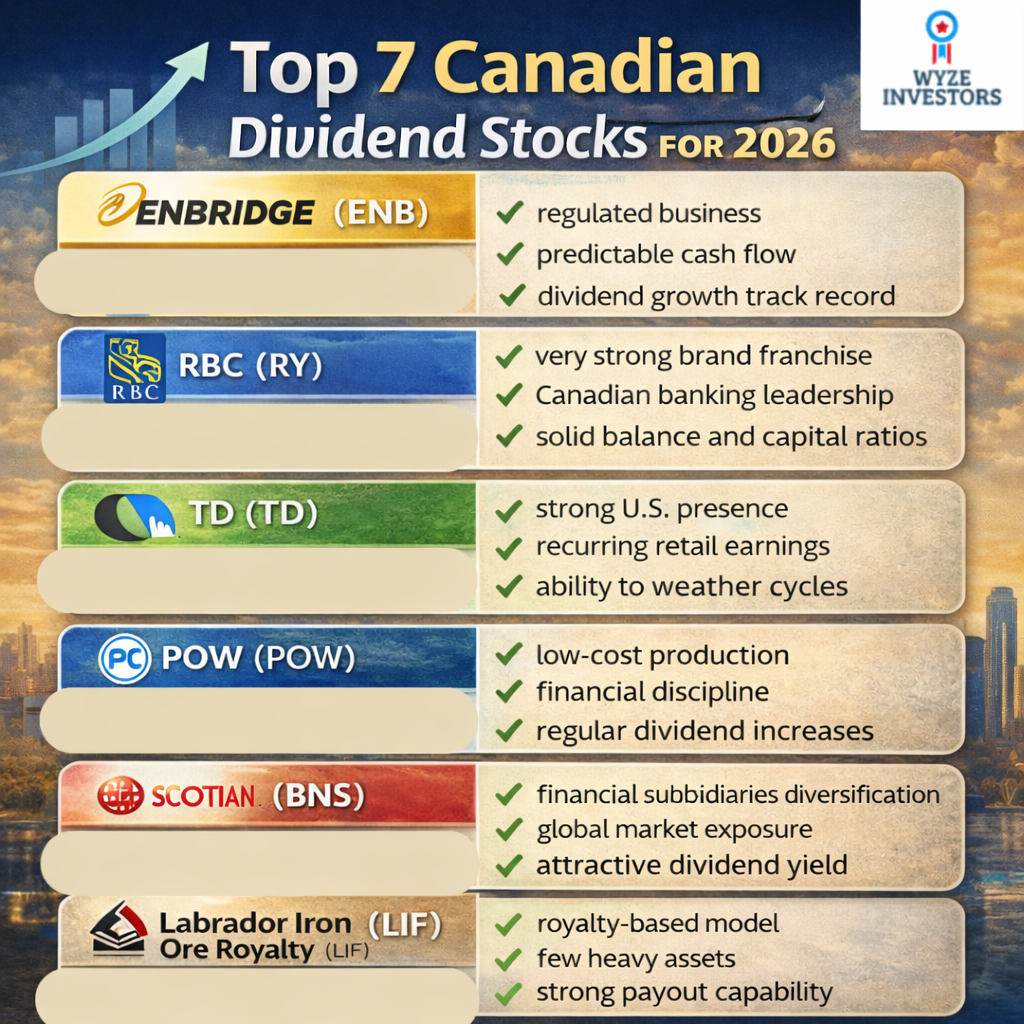
1. Enbridge (ENB) — The Energy Infrastructure Pillar
Enbridge is one of Canada’s most popular companies among dividend investors. It operates an extensive network of:
- pipelines
- Gas infrastructure
- Energy utilities
Why does it stand out?
✔ Dividend announced to increase towards 2026
✔ More than 30 consecutive years of relatively
✔ predictable increase in cash flow distributed
The dividend is based on distributable cash flow (DCF), estimated between:
👉 $5.70 and $6.10 per share for 2026 (guidance)
Investment thesis
- regulated activity
- Structural energy demand
- Long-term infrastructure projects
Enbridge operates in a largely regulated business, making its revenue streams more predictable than those of many energy companies. It benefits from a structural energy demand, linked to the transport of oil and gas necessary for the functioning of the North American economy. Its long-term infrastructure projects provide high visibility into future cash flows through often multi-year contracts. For these reasons, Enbridge is particularly appealing to investors who are looking for stability, resilience and a gradual increase in dividend over time, rather than rapid but uncertain growth.
2. Royal Bank of Canada (RY) — The Canadian Banking Reference
RBC is the country’s largest bank by market capitalization.
It benefits from:
- of a dominant national network
- an international presence
- an image of solidity
Why is RY a “quality” stock?
✔ Uninterrupted dividends for more than 150 years
✔ High profitability
✔ Income diversification (retail banking, insurance, capital markets)
Its yield is not the highest in the industry, but:
👉 It is among the most reliable
Investment thesis
• Strong brand franchise
• Essential positioning
• Balance sheet strength
Royal Bank of Canada has an extremely strong brand franchise, built on more than a century of history and a dominant presence in the country. Its key positioning in personal, commercial and wealth management banking provides it with diversified and resilient revenue streams. The bank also stands out for the strength of its balance sheet, with high capital ratios and prudent risk management. RY is particularly suitable for long-term investors who are looking for security, consistency and regularity of the dividend, rather than speculative bets on more volatile securities.
3. Toronto-Dominion Bank (TD) — North American Growth
TD combine :
- Strong Canadian platform
- huge presence in the United States
It is one of the banks most exposed to the US market.
Key Points
✔ Yield around 4%
✔ Valuation has become attractive again after recent
✔ challenges Business model focused on retail banking
Investment thesis
- future growth related to the United States
- Recurring retail profits
- Ability to Navigate Economic Cycles
The Toronto-Dominion Bank has significant growth leverage with its strong presence in the U.S., where it continues to expand its retail business. Its recurring profits from retail banking provide a stable revenue base that is less dependent on short-term capital markets. TD has repeatedly demonstrated its ability to navigate economic cycles, maintaining prudent risk management and disciplined capital policy. This stock is particularly suitable for investors looking for both a regular dividend and the potential for a medium-term recovery when economic conditions improve.
I’ve created ready-to-use ETF portfolios and a passive income calculator designed specifically for Canadian investors.
Start building your income strategy today.
4. Canadian Natural Resources (CNQ) — La machine à cash-flow
CNQ is one of the most profitable energy companies in the country.
Why does CNQ attract?
✔ Yield around 5%
✔ 23 consecutive years of dividend
✔ increase Low operating costs
CNQ is recognized for its financial discipline:
- Deleveraging
- Share buybacks
- distributions progressives
Investment thesis
- High correlation to the price of oil
- Low-cost production
- Shareholder-oriented management
Canadian Natural Resources (CNQ) remains highly correlated with the price of oil, which can lead to sharp swings in the stock in the short term. However, the company stands out for its very low-cost production, which allows it to remain profitable even when energy prices fall. Its management adopts a clear management approach to shareholders, combining debt reduction, share buybacks and regular dividend increases. This makes CNQ a flagship stock for investors who accept volatility in exchange for growing dividends and long-term value creation potential.
5. Power Corporation of Canada (POW) — The Heritage Conglomerate
Power Corp owns:
- Great-West Lifeco
- IGM Financial
- Wealthsimple (partial)
Why is POW interesting?
✔ Returns often higher than banks
✔ Global exposure to asset
✔ management Diversified holding structure
Investment thesis
- Profits linked to the global financial markets
- Growth through acquisitions and subsidiaries
- Profits redistributed via dividends
Power Corporation (POW) derives a large portion of its profits from global capital markets through its significant holdings in wealth management and insurance. Its model is based on growth through acquisitions and the development of its subsidiaries, which allows it to diversify its revenue sources and smooth out economic cycles. A significant portion of profits is returned to shareholders in the form of dividends, supported by strong cash flows. POW is therefore particularly attractive to investors who are looking for high returns, geographic and sector diversification, and a long-term stability approach.
6. Bank of Nova Scotia (BNS) — Highest Yield of the Big Banks
Historically, BNS has offered the most generous bank dividend among Canada’s major banks.
Why does SNB attract despite the challenges?
✔ high
✔ performance international presence (especially Latin America)
✔ strategic recovery plan underway
Points of vigilance
- Exposure to emerging markets
- Restructuring still in place
The Bank of Nova Scotia (NBS) is unique in its strong exposure to emerging markets, particularly in Latin America, which provides it with superior long-term growth opportunities, but with more volatility. The bank is also engaged in a strategic restructuring that is still being rolled out, aimed at improving its profitability, strengthening its risk management and refocusing its activities on its most profitable markets. On the other hand, this adjustment phase can create short-term stock market fluctuations. SNB is therefore mainly aimed at investors who accept a little more risk in exchange for a generally above-average dividend yield.
7. Labrador Iron Ore Royalty (LIF) — Les redevances minières
Unlike traditional mining producers, LIF generates revenue through a royalty model.
It benefits from iron ore sales without directly assuming the costs of operating a mine.
What makes LIF unique?
✔ High
✔ margins, commodity-price-sensitive dividend,
✔ low operating debt
Investment thesis
- correlated with iron ore price
- Few heavy assets to manage
- Good redistributive capacity
Labrador Iron Ore Royalty (LIF) is highly correlated with the price of iron ore, which means that its revenue and distributions can fluctuate with commodity cycles. Its business model is unique: the company holds royalties and therefore few heavy assets to manage, which limits operating costs and operational risks. Thanks to this lean structure, LIF often has a good redistribution capacity in the form of variable dividends. This stock may be attractive to investors looking to add sector diversification related to natural resources, while benefiting from attractive income potential.
Comparison
| Stock | Yield | Strength | Risk Level |
|---|---|---|---|
| ENB | ~7% | Stable cash flow | Medium |
| RY | ~4% | Strong balance sheet | Low |
| TD | ~4% | US growth | Medium |
| CNQ | ~5% | Cash machine | Cycle risk |
| POW | ~5% | Diversified | Medium |
| BNS | ~6% | High yield | Higher risk |
| LIF | Variable | Royalty model | High |
Conclusion — Dividends yes… but with quality
For 2026, the most reasonable strategy is to focus on strength rather than the search for maximum return at all costs. The aim is to select companies that can maintain and increase their dividends over time, even in times of economic volatility. This means focusing on companies with strong balance sheets, stable cash flows and controlled debt. Conversely, it is prudent to avoid “high-yield traps” – securities that offer very attractive rates but are based on fragile or over-leveraged models.
The seven companies selected—Enbridge, RBC, TD, Canadian Natural Resources, Power Corporation, The Bank of Nova Scotia and Labrador Iron Ore Royalty—embody this central idea: financial quality remains a long-term investor’s best ally. They combine a strong competitive position, the ability to generate cash flow and discipline in the distribution of dividends. This approach does not promise quick wealth, but it does prioritize income sustainability and incremental capital growth. In 2026 and beyond, building wealth is above all about patience, diversification and the rigorous selection of solid companies.
Educational clause
This article is intended to be informative and educational. It does not constitute a recommendation to buy or sell.
Each investor should evaluate:
- their risk tolerance
- its investment horizon
- their personal situation
and consult a professional if necessary.